
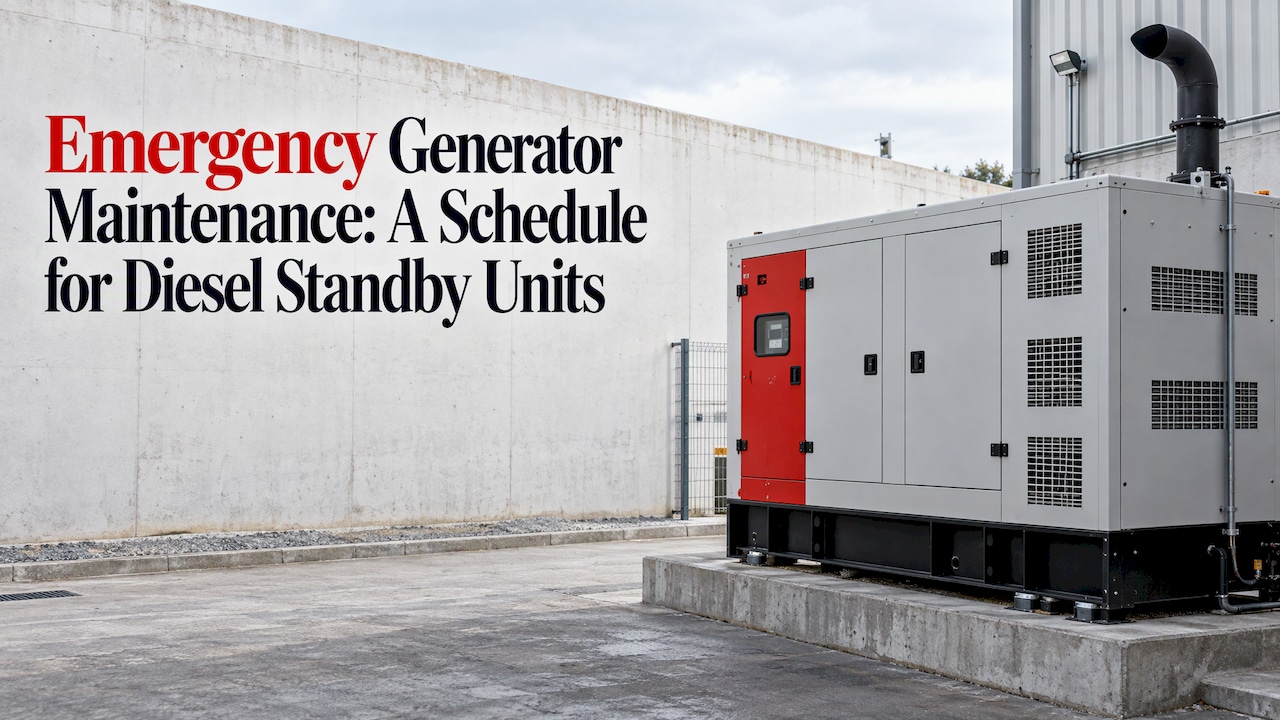
An emergency generator that starts and carries load on the day of an outage is the result of a routine: short inspections often, a loaded run every month, a deeper service on a fixed interval, and the right parts on the shelf when a check turns up a worn component. Codes such as NFPA 110 leave the schedule to you and your manufacturer’s manual, so the job is to build one you actually keep. This guide gives that schedule for diesel standby sets, with what each check looks for, where it goes wrong, and which parts to have ready. For Yanmar and Sensei engines, Iberspares supplies the parts that these routines call for.
TL;DR
- Inspect the set weekly, run it under load monthly for at least 30 minutes, and service it on the manufacturer’s hours or calendar interval, whichever comes first.
- Weekly and monthly checks cover fuel, oil, coolant, exhaust, battery, electrical connections and the transfer switch.
- Log every run, reading and part change. Trends in the log show a failing component before it fails to start.
- Keep filters, belts, hoses and battery spares on site so a finding becomes a same-day repair, not a downtime event.
- Fix what the manual lists as a service item; call a qualified technician for electrical, control and transfer switch faults.
Table of Contents
- Why standby generators fail when they are needed
- What the codes say, and what they leave to you
- A working schedule at a glance
- Weekly inspection: ten minutes that catch most problems
- The monthly loaded run
- Transfer switch: the part that decides whether power reaches you
- Fuel, oil, coolant and air: the service items
- What operators can do and what needs a technician
- Records that prove the set is ready
- Warning signs that need action now
- Keep the right parts on the shelf
- Our view: maintenance and parts belong together
- Parts for Yanmar and Sensei engines
- FAQ
- Sources
Why standby generators fail when they are needed
A standby set spends most of its life idle. Idle engines fail differently from working ones: batteries discharge, fuel ages, seals dry, coolant degrades, rodents find the enclosure and connections corrode. None of this shows until the controller sends a start signal.
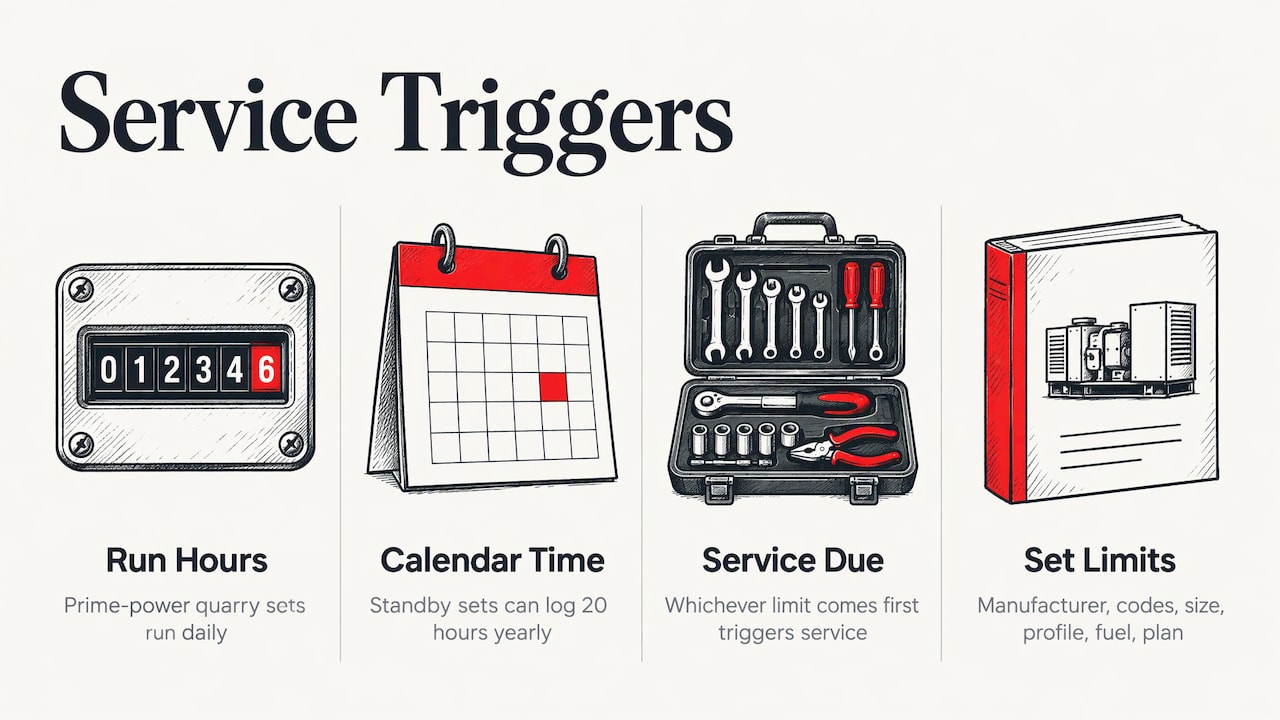
That is why maintenance for an emergency unit is built around readiness, not hours. A prime-power generator at a quarry runs daily and shows wear in its hours meter. A standby unit at a marina, a farm grain dryer or a workshop might log 20 hours a year and still be due for service, because time degrades it as well as use.
The practical consequence: the schedule needs two clocks. One counts run hours, the other counts calendar months. Whichever clock hits its limit first triggers the service. The Pacific Northwest National Laboratory’s standby generator guidance says schedules should follow the manufacturer’s recommendations and applicable codes, and that needs vary with generator size, operating profile, fuel and the maintenance plan in place.
What the codes say, and what they leave to you
NFPA 110 is the US standard for emergency and standby power systems. According to Minnesota Department of Health guidance, it does not set specific testing times; management determines the schedule, typically to minimize disruption of facility operations. So the standard gives you the test content and leaves the timetable to you.
The same guidance sets out what health care facilities must do, and it is a useful benchmark for any operator:
- Emergency generators are inspected weekly, covering fuel, lubrication, cooling, exhaust, battery, electrical and prime mover systems.
- Diesel generator sets are exercised monthly for at least 30 minutes, using the manufacturer’s recommended exhaust temperature or, alternatively, at least 30% of nameplate load.
- Transfer switches are inspected routinely, with monthly inspections recommended to check connections, overheating, unusual sounds, dust and dirt.
If your site is not a health care facility, these are not necessarily your legal requirements. Your insurer, local authority, lease or customer contract may set its own. Check those documents, then use the schedule below as the baseline.
A working schedule at a glance
| Interval | What to do | What you are looking for |
|---|---|---|
| Weekly | Walk-around inspection, fluid levels, control panel status, battery charger | Leaks, low oil or coolant, fault lights, charger not on float, debris or nests |
| Monthly | Loaded run of at least 30 minutes, transfer switch inspection, belts and hoses | Exhaust temperature or load reached, smoke, vibration, hot connections, dust |
| Every 6 months or at the manufacturer’s hour interval | Oil and filter change, fuel filter and water separator, air filter, coolant check, battery service | Contaminated oil, clogged filters, weak batteries, cracked hoses |
| Annually | Full inspection and service, battery load test, cooling system and fuel quality check, transfer switch test | Anything the monthly runs cannot show |
Treat the intervals as a starting point. Your engine manual overrides this table, and a dusty farm shed or a salt-air marina shortens them.
Weekly inspection: ten minutes that catch most problems
The weekly walk-around is the cheapest maintenance you will ever do. It needs no tools beyond a flashlight, and the person doing it just needs to know what normal looks like.
- Check the controller. The panel should be in auto with no active alarms. A set left in “off” after a service is one of the most common reasons a generator does not start in an outage.
- Look under and around the set. Oil, coolant or fuel on the skid or ground points to a seal, hose or fitting that is weeping. Small leaks become big ones under vibration.
- Read the fluid levels. Check oil with the engine off and cold, coolant at the recovery bottle, and the fuel gauge or day tank.
- Check the battery charger. It should show float voltage. A dead charger lets the starting battery drain slowly, and you only find out at the crank.
- Clear the enclosure and intakes. Leaves, rodent nests, stored boxes and snow drifts block cooling air and exhaust.
- Look at belts, hoses and clamps. Cracks, glazing and soft spots mean replacement, not another month of hope.
Where it goes wrong: the check gets skipped when nothing seems wrong. Put it on a calendar with a named person and a sign-off sheet, and the habit holds.
The monthly loaded run
Starting the set and letting it idle for five minutes proves very little. A loaded run does the real work: it brings the engine to operating temperature, checks that the alternator and transfer arrangements accept load, and exposes fuel, cooling and exhaust problems that idling hides.
The benchmark from the guidance above is at least 30 minutes, at the manufacturer’s recommended exhaust temperature or at least 30% of nameplate load. To reach that:
- Run it on the building load through the transfer switch where your operation can tolerate the brief transfer, or
- Use a resistive load bank, which is a controllable electrical load used to put the set under a known load without disturbing the site.
During the run, watch and record oil pressure, coolant temperature, voltage, frequency and amps, and listen for knocking, surging or a change in note. Afterward, look for leaks again, because pressure and heat reveal what a cold inspection does not.
Where it goes wrong: lightly loaded diesel sets that never reach their working temperature are a common finding on sites that run the monthly test with nothing connected. If the building load is too small to reach 30%, plan a load bank session instead of repeating a test that does not prove anything.
Transfer switch: the part that decides whether power reaches you
The generator can be perfect and the outage can still continue if the automatic transfer switch fails to move. The same Minnesota guidance recommends monthly inspections for connections, signs of overheating, unusual sounds, dust and dirt.
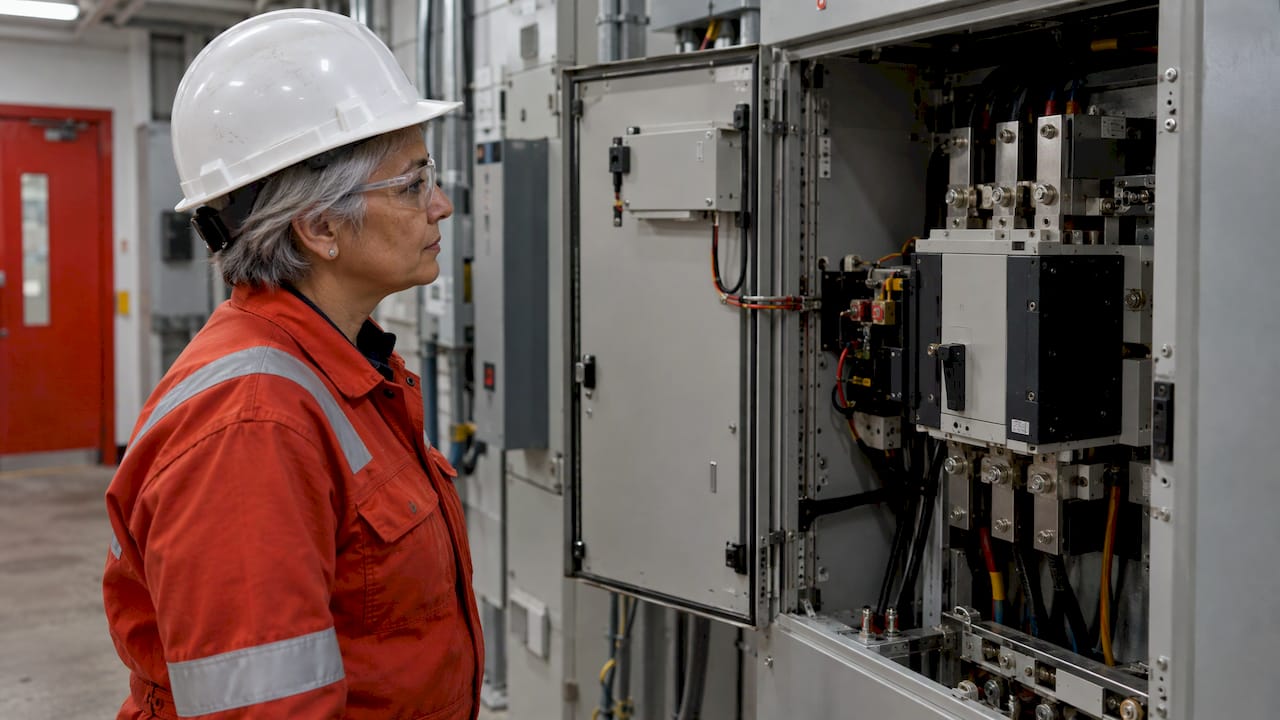
In practice that means looking at the cabinet for discolored or hot-smelling connections, listening for chatter during transfer, and keeping the enclosure clean and dry. Work inside a live switch is for a qualified electrician or generator technician. You can inspect and record; leave the testing of de-energized and live internals to a person trained for it.
Fuel, oil, coolant and air: the service items
The six-month or hour-based service is where the engine itself gets attention. For a diesel standby set it normally includes:
- Engine oil and oil filter. Fresh oil even if hours are low, because oil degrades with time and condensation. The PNNL checklist also lists oil sampling, which shows wear metals and contamination in the lab before they become a failure.
- Fuel filters and water separator. Diesel stored for months picks up water and sediment. A clogged filter starves the engine under load, which is exactly when a standby set is needed.
- Air filter. Dust-laden sites, such as construction yards, farms and workshops, clog these quickly.
- Coolant. Check level, concentration and condition, and replace on the manufacturer’s interval. Inspect the radiator fins, hoses and clamps.
- Belts and tensioners. Replace on condition, not only on age.
- Batteries. Clean terminals, check tightness, and load-test annually. Loose or corroded battery connections are among the standard seasonal findings on emergency sets.
- Exhaust system. Check for leaks, loose supports and blocked rain caps.
The PNNL practice list groups the routine tasks as general inspections, lubrication, cooling and fuel system services, battery testing and engine exercise. If you cover those categories on the manufacturer’s timetable, you have covered the ground.
A note for sites with gas-fired standby units: the fuel supply side has its own checks, and a gas safety check explains what such an inspection covers for gas installations in general.
What operators can do and what needs a technician
The split is about training and risk, not pride.
Operators and site maintenance staff can usually handle:
- Weekly walk-arounds and fluid level checks
- Monthly exercise runs and recording of readings
- Visual inspection of belts, hoses and the transfer switch enclosure from outside
- Replacing filters, belts, hoses and batteries where the manual describes the job and the set is locked out and cannot start
- Keeping the enclosure and intakes clear
Leave to a qualified generator technician or electrician:
- Work inside the transfer switch or on live electrical terminals
- Controller programming, setpoint changes and alarm diagnosis that goes beyond reading the fault code
- Alternator and output breaker faults
- Load bank connection to the site electrical system
- Anything the warranty or insurer says must be done by an authorized person
Before any hands-on work, put the controller in off, disconnect the starting battery and make sure nobody can start the set remotely or automatically. A standby generator can start without warning.
For repair workshops and maintenance companies that service customers’ sets, the same logic applies in reverse: the faster you identify the exact part for the exact engine, the shorter the downtime for the customer.
Records that prove the set is ready
PNNL says maintenance activities and run hours should be logged, and operating parameters recorded and trended; it calls preventive and predictive maintenance, logged to track trends, critical for performance and asset longevity. A simple log does three jobs:
- It triggers service. Hours and dates tell you when the next interval is due.
- It shows drift. Oil pressure sliding down over six months, or coolant temperature creeping up at the same load, is a warning visible only against earlier readings.
- It answers questions after an incident. Insurers, inspectors and customers ask for the log.
Record at least: date, run duration, hours meter reading, load or exhaust temperature reached, oil pressure, coolant temperature, voltage and frequency, any alarms, any parts replaced with part numbers, and the initials of the person who did the work. Recording part numbers pays back later, because the next order is exact.
Warning signs that need action now
Some signs call for a stop and a repair before the next test, not at the next scheduled service:
- Hard starting or slow cranking. Check the battery, connections and charger first, then the fuel supply.
- White, blue or black smoke. Each points somewhere different: coolant or unburned fuel, oil burning, or over-fueling and restricted air.
- Oil pressure low or coolant temperature climbing at a given load. Stop the run and investigate.
- Visible leaks, fresh drips, or fuel odor.
- Surging, hunting or unstable frequency. Often a fuel supply or governor issue.
- Alarms that appear and clear. Intermittent alarms are early warnings.
- A hot or discolored connection at the battery, breaker or transfer switch.
If the generator fails to start
Work from the simplest cause outward:
- Confirm the controller is in auto and no emergency stop is engaged.
- Check there is fuel in the tank and that any fuel valve is open.
- Look at the starting battery: terminals clean and tight, charger on float. A flat battery or corroded connection is a frequent cause.
- Check for a fuel filter restriction or air in the fuel system, which on a diesel often follows a filter change.
- Read the controller’s fault history before you reset anything.
If it still does not start, stop cranking. Repeated attempts drain the battery and can flood the engine. Bring in a qualified technician for electrical or control faults and have the part numbers from your log ready so any needed parts can be ordered without delay.
Keep the right parts on the shelf
A maintenance program creates a predictable shopping list: oil filters, fuel filters and separator elements, air filters, belts, hoses, thermostat and coolant, and batteries. For emergency sets, the point is to turn a finding into a same-day repair. A cracked belt discovered on Monday, with the belt on your shelf, is a ten-minute job. The same belt ordered by guesswork can take days, and the set stays unavailable.
To keep a spares kit useful:
- Build it from the engine’s serial number and the manufacturer’s parts list, not from memory.
- Stock two of each consumable filter for each set, so one service does not exhaust the kit.
- Replace what you use immediately and note it in the log.
- Review the kit after every annual service.
For multi-brand workshops and distributors, the same discipline across a customer base means a short list of repeat parts per engine family, with Yanmar being a common one on compact generators, marine auxiliaries and light industrial sets.
Our view: maintenance and parts belong together
Most maintenance plans are written as a list of tasks. We think they should be written as a list of tasks and the parts each task consumes.
Every service item is a filter, a belt, a hose, a seal, a battery or a fluid. When the part is identified in advance, matched to the engine and kept in stock, the service happens on schedule. When it is not, the service slips, and the generator sits at a lower readiness than anyone thinks.
That is where our work starts. We focus on Yanmar and Sensei engines and equipment, and on the application: the same engine can be in a generator, a compact excavator, a marine installation or a tractor, and the right component is not always the same. Identifying it correctly the first time avoids the errors and delays that turn a small finding into downtime.
We also keep a broad stock for quick dispatch, because routine and emergency needs both arrive on someone else’s timetable. A good log, the engine’s serial number and a short spares list are all you need to order accurately.
Duarte
Parts for Yanmar and Sensei engines
If your standby sets, compact equipment, marine auxiliaries or farm machinery run Yanmar or Sensei engines, Iberspares supplies genuine Yanmar and Sensei parts across construction and industry, agriculture, marine, power and generators, material handling and compact equipment. Bring the engine model and serial number from your maintenance log, and you can order the filters, belts and service parts your next interval needs.

Browse the full range on the Iberspares parts catalog and put the service kit on the shelf before the next test run.
FAQ
How often should an emergency generator be serviced?
Follow the manufacturer’s interval, by run hours or calendar time, whichever comes first. Many sets are serviced about every six months, with a fuller annual service. NFPA 110 does not fix the testing times itself, so the schedule is set by the facility and by your insurer or authority.
How long should I run a standby generator each month?
At least 30 minutes under load. The health care benchmark is the manufacturer’s recommended exhaust temperature or at least 30% of nameplate load for diesel sets. A no-load idle run does not prove the set can carry your building.
What should be on a standby generator maintenance checklist?
Fuel level and filters, engine oil and filter, coolant, air filter, belts and hoses, battery and charger, exhaust, electrical connections, the controller and the transfer switch. Add a loaded exercise run and a log entry for each visit.
Can I do generator maintenance myself?
Yes for inspections, exercise runs, fluid checks and filter or belt changes described in the manual, with the set locked out first. Work on live electrical parts, the transfer switch internals and controller programming belongs to a qualified technician or electrician.
What records should I keep?
Run hours, dates, load and temperature readings, operating parameters, alarms, parts replaced and who did the work. PNNL recommends logging maintenance and run hours and trending operating parameters to spot problems early.
Sources
- Inspection and Testing of Emergency Generators, Minnesota Department of Health (2024)
- Best Practices for Standby Generator Operations and Maintenance, PNNL (2021)
Content strategy and optimisation for Google and AI-powered search platforms by Velveteen SaaS — specialists in online visibility and customer acquisition.