
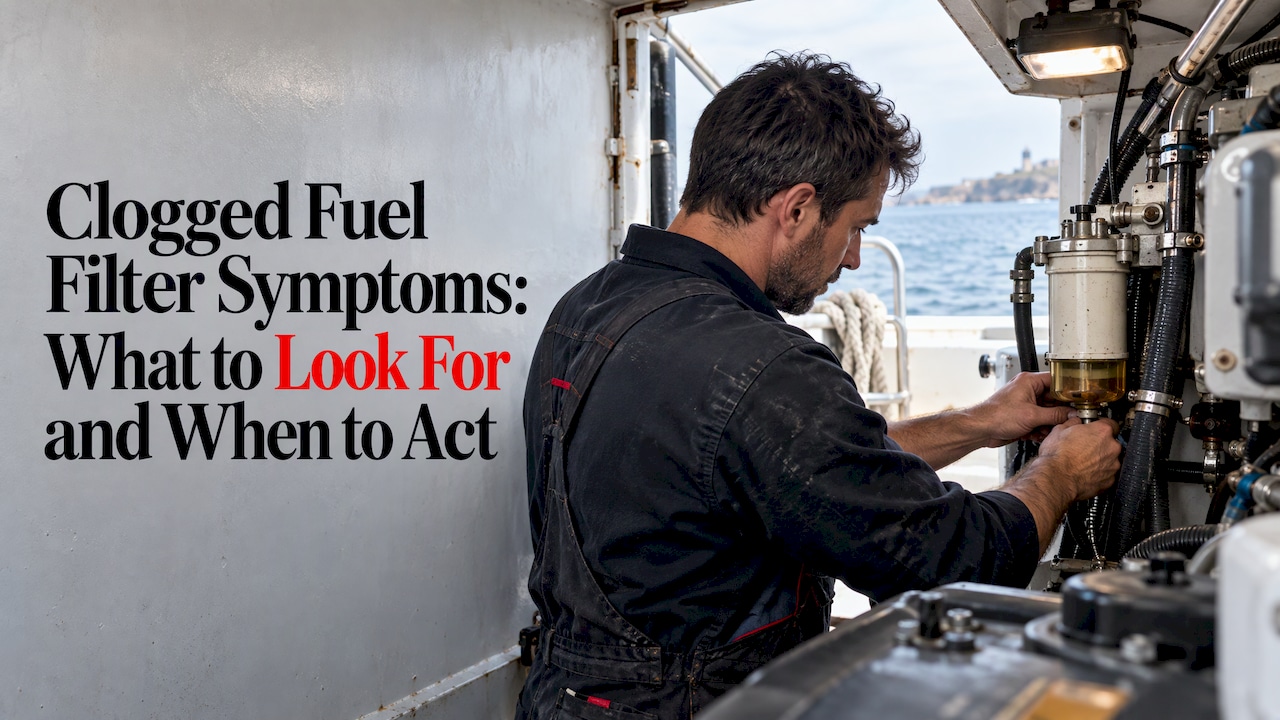
A clogged fuel filter starves the engine of fuel, and the first signs are hard starting, weak acceleration, loss of power under load, stalling and rough running. On equipment, the clearest tell is an engine that idles fine but fades when you ask it to work. Confirm the filter is the cause with a flow or restriction check, then replace the element and bleed the system. Keep the right filter in stock for each engine and you turn a breakdown into a short job. For Yanmar and Sensei engines, we at Iberspares help you identify the correct part quickly.
TL;DR
- The four classic symptoms are poor fuel economy and acceleration, trouble starting, stalling, and misfiring or rough idle, according to AAA.
- On working equipment, loss of power under load is the symptom to trust most: pressure can look fine at idle while flow is too low at full demand.
- Do not stop at a pressure reading. Check flow volume or pressure drop under load, and inspect the water separator.
- Relieve pressure safely, never crack a high-pressure line with the engine running, and bleed air after the change.
- Keep filters for each engine in stock, matched to the exact engine and application, so a clog costs hours instead of days.
Table of Contents
- What a fuel filter does and why it clogs
- The main clogged fuel filter symptoms
- Symptom quick reference
- How to tell a clogged filter from another fuel problem
- Where the fuel filter is on your equipment
- What to do when the engine stops or will not start
- Replacing the filter without creating a new problem
- How often to change fuel filters on engines and equipment
- Why a stocked filter beats a stopped machine
- Our view at Iberspares
- Find the right filter for your engine
- FAQ
- Sources
What a fuel filter does and why it clogs
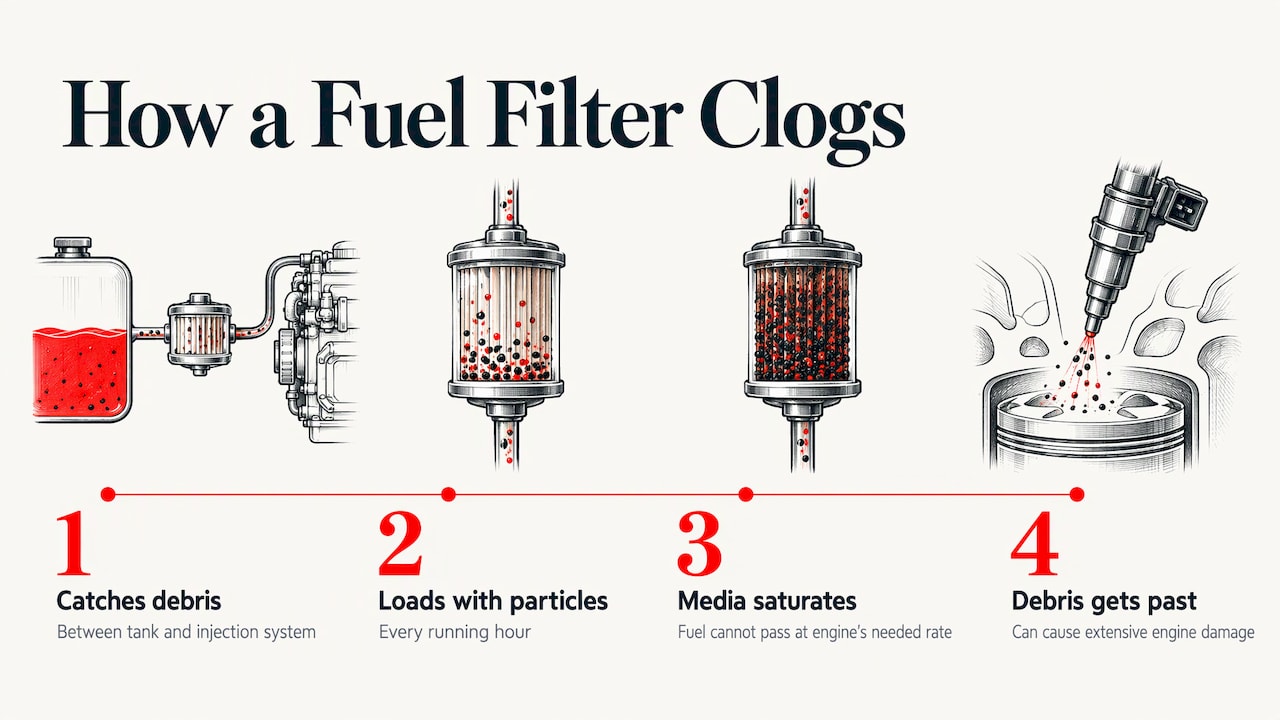
The fuel filter sits between the tank and the injection system. Its job is to catch dirt, rust, scale and (in a water separator) water before they reach pumps and injectors. Those parts are machined to very tight tolerances, so a small amount of debris does real damage.
A filter clogs because it works. Every hour of running loads it with particles. Contaminated fuel, a dirty tank, long storage and condensation all speed that up. Once the media is saturated, fuel cannot pass at the rate the engine needs. AAA warns that debris that gets past a failing filter can cause extensive engine damage, which a timely filter replacement prevents.
That is why the symptoms below deserve attention early. A restricted filter is a cheap, quick fix. The injectors and pump it was protecting are not.
The main clogged fuel filter symptoms
1. Hard starting or extended cranking
The engine turns over but takes longer to fire, or fires and dies. With too little fuel arriving, the system cannot build the pressure needed to start cleanly. In a severe case the engine will not start at all. For diesels, the UK motoring organization RAC Drive notes that blockages in a diesel filter can stop enough fuel reaching the engine, resulting in very poor performance or a no-start.
2. Loss of power under load
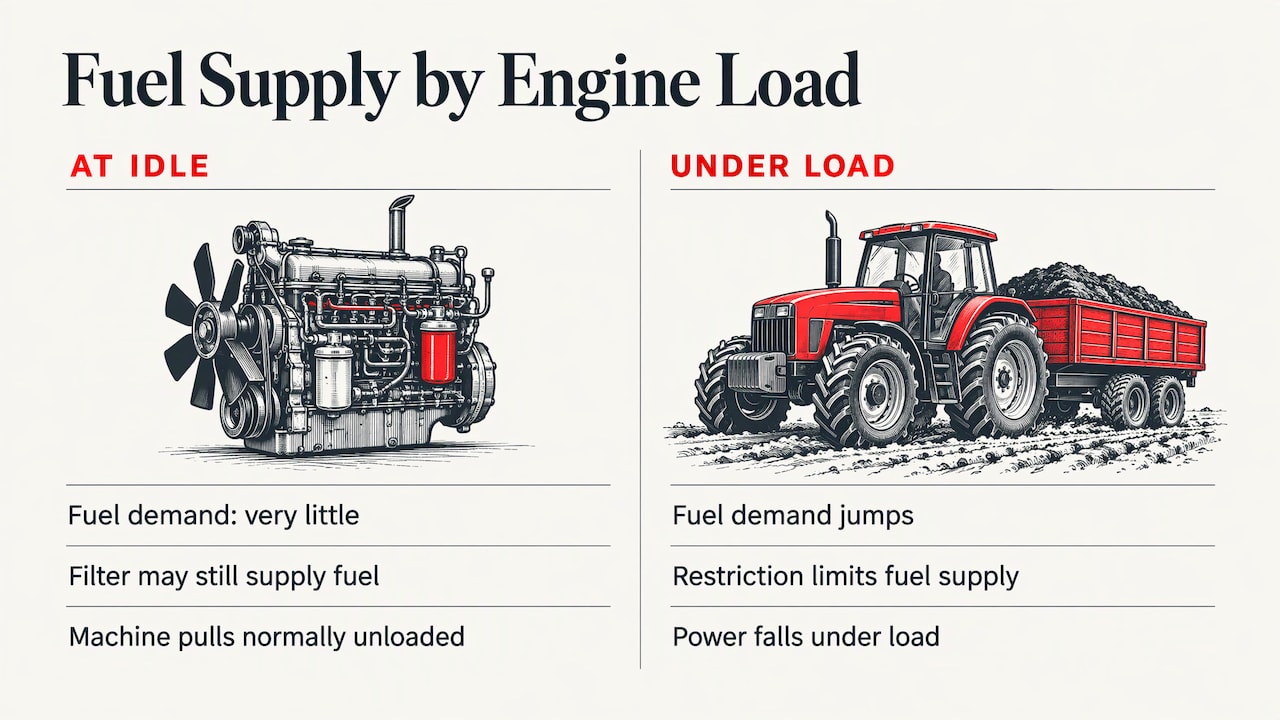
This is the symptom construction, farm and marine operators describe most. The machine pulls normally unloaded, then falls on its face when the bucket is full, the implement is deep in the ground, the boat is pushed onto plane or the generator picks up a heavy load. Innova states that on fuel-injected engines a clogged filter shows up as loss of power during acceleration or under load.
The reason is simple. At idle the engine needs very little fuel and a restricted filter can still supply it. Under load demand jumps, and the restriction becomes the limit.
3. Stalling
The engine dies at idle, when you let off the throttle or when load changes suddenly. On carbureted engines, Innova lists stalling at idle, stumbling on acceleration and failure to start among the signs, as covered in the same guide. Stalling that comes and goes, and is worse when the fuel level is low or the machine is on a slope, is a typical pattern for a partly blocked filter.
4. Misfiring, surging and rough idle
Low fuel pressure gives uneven combustion. You hear it as roughness, hunting revs or hesitation. AAA lists misfiring or rough idling from low fuel pressure among its four symptoms of a bad filter.
5. Poor fuel economy and sluggish acceleration
If the engine works harder for the same output, or the machine feels lazy in every gear, a restriction may be involved. This sign is easy to miss because it builds slowly. Track fuel use per hour on fleet machines and the trend will show before the breakdown does.
6. Warning lights, derate and codes
Electronic engines watch fuel pressure and may derate to protect themselves. Be careful with codes, though. Innova points out there are no trouble codes specific to a clogged fuel filter, and codes such as P0300, P0171 and P0174 may appear even though other faults usually cause them. A low-fuel-pressure message or a water-in-fuel light is a prompt to inspect the filter and separator, not proof of the cause.
Symptom quick reference
| Symptom | What you notice | What it points to |
|---|---|---|
| Hard start | Long cranking, fires then dies | Not enough fuel reaching the pump or rail |
| Power loss under load | Fine at idle, fades when working | Flow limit at high demand |
| Stalling | Dies at idle or on load change | Intermittent starvation |
| Rough idle or misfire | Hunting revs, shaking | Low or uneven fuel pressure |
| Higher fuel use | More fuel per hour for the same work | Engine compensating for restriction |
| Water-in-fuel light | Separator filling quickly | Contaminated fuel, saturated element |
How to tell a clogged filter from another fuel problem
The same symptoms come from a weak lift pump, air in the lines, a failing injector, a blocked tank pickup or a bad sensor. Guessing wastes hours. Work through it in order.
Check flow, not just pressure
A restricted filter behaves like a failing pump. Apex Technation explains that pressure can be adequate at idle while volume is insufficient under high demand, so a pressure test alone can mislead. Test flow volume, or run a pressure-drop test while the engine is under load. If pressure collapses when demand rises, the filter or the supply side is the suspect.
Inspect the filter and separator
Drain the water separator bowl and look at what comes out. Water, sludge or a dark, gritty residue means the fuel is contaminated and the element is likely loaded. A frequent water warning means the bowl is filling faster than you drain it.
Look at the other usual suspects
- Air in the system: check for loose fittings and a cracked bowl or seal, especially after any recent service.
- Supply side: a collapsed hose, a clogged tank pickup or a tired lift pump gives the same starvation.
- Fuel quality: if the new filter clogs again quickly, the problem is upstream, in the tank or the fuel supply.
Innova adds that when a filter has clogged, the fuel tank should be cleaned before a new filter goes on. Otherwise the new element inherits the same dirt.
Where the fuel filter is on your equipment
Location varies with the engine and machine. Older vehicles, roughly pre-2000, usually have an external serviceable filter on the frame rail or in the engine bay, while most modern cars have an in-tank filter built into the pump module, as Apex Technation describes. Diesel equipment is different. Expect one or more of these:
- A spin-on primary filter with a water separator bowl, mounted on the engine block, bulkhead or frame.
- A secondary filter on the engine, close to the injection pump or rail.
- In larger setups, a frame-mounted primary and an engine-mounted secondary. A Ford owner guide, for example, describes a frame-mounted primary filter and water separator plus an engine-mounted secondary, both changed at the service interval.
Some engines carry two filters side by side, and both must be replaced together. One published service procedure for a 2.8L Duramax says exactly that for its two side-by-side filters. The lesson for any engine: confirm from the engine’s own manual how many filters it has before you order.
What to do when the engine stops or will not start
Work methodically and safely.
- Stop and make the machine safe. Shut it down, apply the brakes or chocks, and let the engine cool.
- Check the basics. Fuel level, tank valve open, no obvious leaks, no collapsed hoses.
- Drain the water separator into a container and inspect what you drain.
- Relieve pressure correctly. Cummins service documentation says to never crack a high-pressure fuel line with the engine running and to relieve pressure only at the pump inlet fitting, as stated in its quick reference guide. Follow your engine maker’s procedure.
- Replace the element with the correct part for that engine, and renew seals.
- Prime and bleed before the first start (see below).
- Run and recheck. Watch for leaks and confirm power under load.
If the engine still will not run after a new filter and a proper bleed, the fault is elsewhere: supply, pump, injectors or electronics. That is the point to move to full diagnostics on that engine.
Replacing the filter without creating a new problem
Most post-service no-starts come from air, not from the filter. Three habits prevent them.
Use the right part and fresh seals
A filter that looks right but has the wrong thread, micron rating or sealing geometry can leak air or restrict flow. Match the part to the engine model and application, not just to a similar-looking element. Lubricate the new seal lightly with clean fuel and fit it cleanly.
Fill and prime the way the maker says
Cummins instructs installing the filter dry and cycling the key three to four times so the priming pump fills it, and, if you pre-fill, using the dirty-side holes so fuel passes through the media. Both points are in the same guide. Never pour fuel into the clean side, which sends unfiltered fuel straight to the injection system. Other engines use a hand primer or bleed screws instead, so follow the procedure for yours.
Torque the housing
Over-tightening cracks housings and under-tightening leaks air. One procedure for a Duramax filter housing gives a cap torque of 15 ft-lb (20 Nm). Your engine will have its own figure, so use the one in its manual.
How often to change fuel filters on engines and equipment
There is no single number. Intervals depend on the engine, the duty cycle and the fuel quality you actually get.
Two published examples show the spread. Cummins’ X12 guide sets the fuel-filter interval from 1,500 hours or 12 months for severe duty up to 60,000 miles for light duty. Late-model cars are another world: Innova reports in-tank filters and many in-line filters can exceed 100,000 miles of service life, and many manufacturers advise replacement only when clogged.
For off-road, marine and generator work, take the interval from the engine manual and shorten it when conditions are harsh:
- Dusty fields and building sites, where refueling from drums or bowsers adds dirt.
- Marine use, where water and condensation are constant.
- Standby generators that sit for months, since stored fuel degrades and collects water.
- Machines fueled from bulk tanks that are rarely cleaned.
Diesel breakdowns from filters are common enough to be measurable. RAC Drive reports around 800 diesel filter-related breakdowns a month, rising to around 1,500 in harsher winter months. Cold weather thickens fuel and makes any restriction worse, so change filters ahead of winter instead of after the first no-start.
Why a stocked filter beats a stopped machine
The filter itself costs little. The downtime does not. A rental unit off hire, a combine idle in harvest, a vessel that cannot leave the dock or a standby generator that fails its test all cost far more than the element.
So the practical answer to clogged fuel filter symptoms is partly logistics:
- Keep one or two sets of filters per engine type in the workshop or on the vessel.
- Record the engine model and serial number against each machine, so the part is identified correctly the first time.
- Buy seals and spare O-rings with the filter.
- Plan the change around the service schedule, not around the breakdown.
Our view at Iberspares
Most filter problems we hear about start with a part that nearly fits. Someone orders by appearance, the thread is slightly different or the filter is rated for another engine variant, and the machine is back in the workshop a week later.
Yanmar and Sensei engines turn up in very different jobs: compact excavators, tractors, marine propulsion and auxiliaries, generator sets, forklifts. The same engine family can be fitted with different filter arrangements depending on the application. That is why we focus on application-specific knowledge, so the part you order is the one your machine needs.
Our approach is built around identifying the correct component efficiently, keeping extensive stock for rapid dispatch and helping professional buyers keep their equipment running. When a filter clogs at the worst moment, you want the right element in your hands, not a research project.
Treat filters as planned consumables. Change them on schedule, keep spares on the shelf and note what the old one looked like. A filter that comes out heavily loaded tells you something about your fuel supply.
Duarte
Find the right filter for your engine
Iberspares supplies spare parts for Yanmar and Sensei engines and equipment across construction and industry, agriculture, marine, power and generators, material handling and compact equipment. Our team knows the applications, so you can identify the correct filter for your engine and get it dispatched from our in-stock inventory.
Browse the Yanmar and Sensei parts range to find filters and related service parts for your machine, or start from the main Iberspares shop and pick your equipment category.
FAQ
Can a clogged fuel filter cause loss of power?
Yes. A restricted filter can pass enough fuel at idle but not enough when the engine is working hard, so power fades under load. Innova describes loss of power during acceleration or under load as a typical sign on fuel-injected engines. Confirm with a flow or pressure-drop test under load.
How do I know if a diesel fuel filter is blocked?
Look for hard starting, power loss under load, stalling and rough running, then drain the water separator and inspect it. Check flow rather than idle pressure alone, because a restricted filter can look healthy at idle. If a new filter and a proper bleed fix the symptoms, the diagnosis is confirmed.
How often should you change a fuel filter?
Follow the engine manual and shorten the interval in dirty, wet or cold conditions. Published schedules vary widely, from 1,500 hours or 12 months in severe duty on one large diesel to very long lifetimes on late-model car in-tank filters. Changing filters ahead of winter reduces cold-weather no-starts.
Can a clogged fuel filter set a check engine light?
It can, but not with a dedicated code. There are no trouble codes specific to a clogged filter, though codes such as P0300, P0171 and P0174 may be triggered by one. Treat a low-fuel-pressure or water-in-fuel warning as a reason to inspect the filter and separator.
Why won’t the engine start after I changed the filter?
Air in the system is the usual cause. Prime and bleed the engine as its maker specifies, check the seal and housing for air leaks, and never fill the clean side of the filter. Cummins, for example, advises installing the filter dry and letting the priming pump fill it.
Sources
- 4 Symptoms of a Bad Fuel Filter, AAA Club Alliance
- Maintain Engine Health: The Crucial Role of Fuel Filters, Innova
- Diesel fuel filters: what to do if blocked, RAC Drive
- Fuel System Overview, From Tank to Combustion Chamber, Apex Technation
- Truck Maintenance and Operation quick reference guide, X12, Cummins
- Ford owner guide, fuel filter and water separator
- Service procedure TP1007, 2.8L Duramax fuel filter
Content strategy and optimisation for Google and AI-powered search platforms by Velveteen SaaS — specialists in online visibility and customer acquisition.