Marine diesel maintenance comes down to three things: checks you do every day, services you do by engine hours or calendar, and the right parts in your hands when a service falls due. The first two are set by the engine maker. The third is where fleets and workshops lose time, because a service planned for Tuesday stalls when the correct filter, impeller or anode is not on the shelf. For Yanmar and Sensei engines, Iberspares supplies application-specific parts, so the service schedule below can be matched to a parts list before the boat is hauled or the engine opened.
TL;DR
- Check oil, coolant, fuel and leaks daily. The periodic schedule only works if the daily checks are actually done.
- Typical intervals: oil and filters every 100 to 150 hours or at season’s end, fuel filters around 300 to 600 hours depending on the maker. Your engine’s manual overrides any general figure.
- Severe duty (dust, frequent starts, poor fuel, long lay-ups) shortens every interval.
- Keep a log of hours, top-ups, parts used and changes in exhaust color or temperature.
- Plan parts by service interval, so filters, impellers, belts and anodes are on hand before the work starts.
Table of Contents
- Daily and weekly checks that protect the engine
- Service intervals by engine hours
- When conditions shorten the schedule
- Fluids and specifications that matter
- Anodes, hoses, impellers and the raw-water side
- Winter lay-up and the end-of-season service
- Keep a log
- What you can do yourself and what needs a technician
- Planning parts around the schedule
- Where we come in
- Our point of view
- FAQ
- Sources
Daily and weekly checks that protect the engine
Every maker’s schedule starts with the same short routine. The Pacific Community’s diesel learner’s guide lists daily checks of lube oil, fresh water, fuel, the water trap, V-belts, leaks, gauges and the battery. The RYA’s guidance for boat owners adds a weekly layer: belt tension, gearbox oil, water or sediment in the tank, the raw-water strainer and battery electrolyte.
In practice, a good start-up sequence looks like this:
- Confirm the gearbox is in neutral and the seawater strainer is clean and open.
- Check engine oil and coolant levels, with the engine stopped and cool.
- Look for oil, fuel or water leaks around the engine, hoses and bilge.
- Drain any water or sediment from the fuel pre-filter or water trap.
- After starting, check oil pressure at once, listen for hard metallic knocks and confirm seawater is discharging overboard.
The guide describes these same points as the pre-start routine, including checking oil pressure immediately after starting and confirming seawater discharge.
Safety at the filler cap. Yanmar’s L-series operation manual warns that the coolant pressure cap must only be opened when the engine is cold, because hot pressurized coolant can be expelled violently and cause burns. The same manual calls for oil level checks with the engine cool and not running. Wear gloves and long sleeves, and never open a hot header tank.
Service intervals by engine hours
Intervals are set per engine family, and the manual for your model is the authority. Hours and calendar limits both apply, and whichever comes first triggers the service. Three reference points show the range.
| Task | RYA general guidance | Yanmar L-series (2022 manual) |
|---|---|---|
| Engine oil and filter | Every 100 to 150 hours or at season’s end | 150 hours |
| Gearbox oil | Every 150 hours or annually | Per manual schedule |
| Fuel filters | Every 300 hours | Fuel pre-filter and fuel filter at 600 hours |
| Coolant | Per maker | 300 hours |
| Valve clearance | Per maker | 1200 hours |
Sources: RYA guidance and the Yanmar L-series manual, which also lists services at 300, 600, 900, 1200, 2400 and 3000 hours or at calendar limits, whichever comes first.
The first 50 hours
New and rebuilt engines get an early service. Yanmar’s 4LHA manual explains that oil is quickly contaminated by initial wear of internal parts, so the first oil and filter change is done at 50 hours. For a workshop commissioning a repowered boat, that means ordering a second oil and filter set at the same time as the first.
A worked example for a working boat
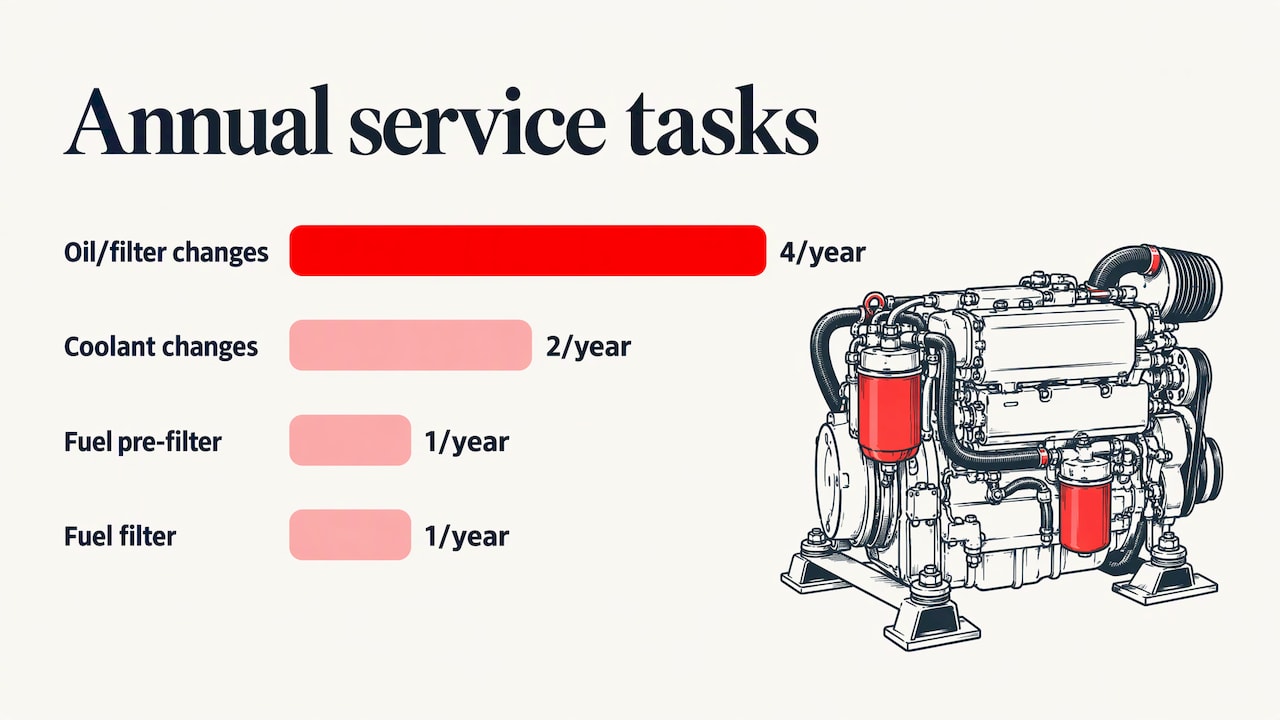
Take a workboat on a Yanmar L-series engine that runs 600 hours a year. On the 150-hour oil and filter interval, that is four oil and filter changes a year. Coolant at 300 hours falls twice. The fuel pre-filter and fuel filter at 600 hours fall once, at roughly the same point as the fourth oil change. A single parts order at the start of the season, built from that schedule, covers the year. A pleasure boat that runs 50 hours a year is different: the calendar limit decides, and the RYA notes that the average sailing yacht runs only about 50 hours a year under power, so oil is usually changed once a year before lay-up.
When conditions shorten the schedule
Published intervals assume normal operation. Maker manuals say so directly, and the Pacific Community guide notes that check frequency varies with engine use, conditions of use, oil quality and operating methods. Shorten the interval when the engine sees:
- frequent starts and stops, or long periods at no load
- dusty air in the engine room, which loads the air filter
- long idle periods or a prolonged winter season
- fuel or oil of uncertain quality
For commercial fishing boats, rental fleets and harbor craft, these are the normal conditions, not the exception. Treat the manual’s figure as a ceiling and set your own interval below it, based on what the log shows.
Fluids and specifications that matter
Using the right fluid matters as much as changing it on time. Yanmar’s L-series manual specifies:
- fuel compliant with EN 590 (sulfur under 10 ppm) or ASTM D975 (sulfur under 15 ppm)
- engine oil meeting at least ACEA E7 or API CI-4
- organic coolant to ASTM D6210 Type 1-FF, mixed 50% with water
These are specific to that engine family. Always read your own model’s manual and record the spec on the service sheet so the right oil goes in every time.
Anodes, hoses, impellers and the raw-water side
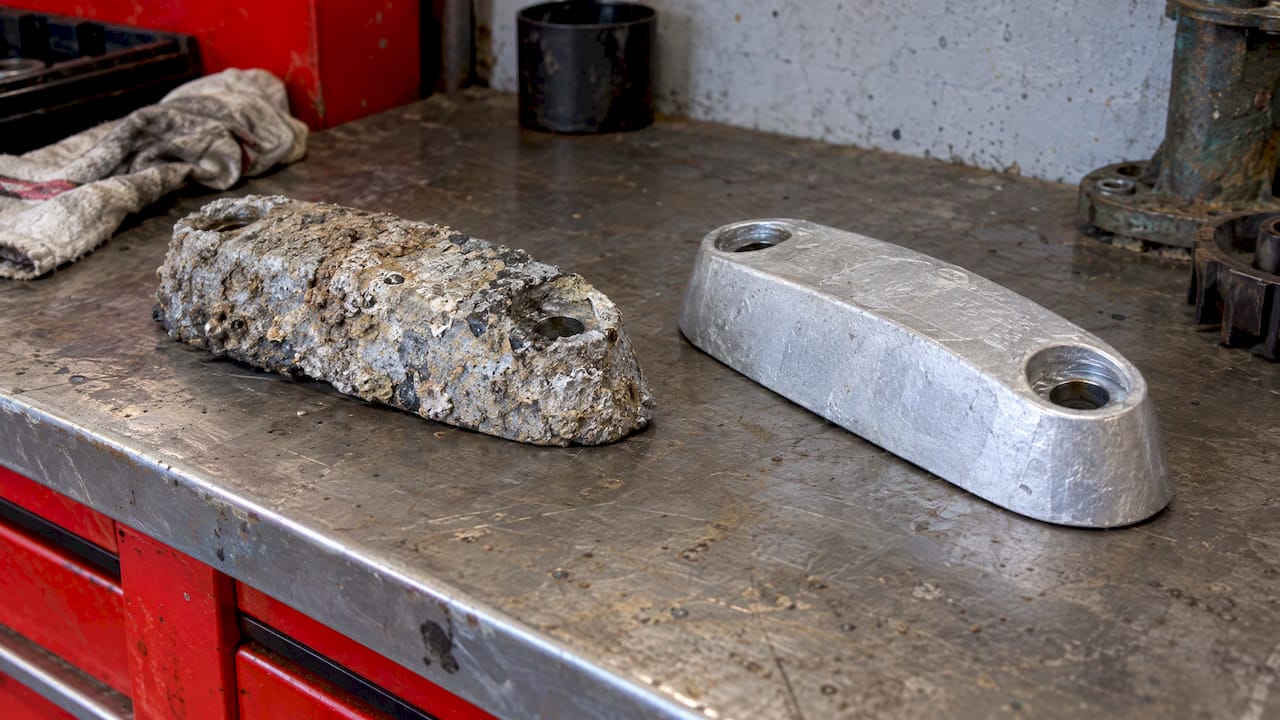
The seawater circuit wears out on its own timetable. The RYA’s annual list includes anodes, hoses and clips, the air filter, exhaust elbow, mounts and shaft coupling. Yanmar’s manual sets a clear anode rule: replace a zinc when corrosion has affected more than 50% of its volume, and in warm, very salty waters such as the Mediterranean, check anodes every 6 months.
For the raw-water pump, impeller checks appear in the periodic schedule rather than only at breakdown. Replacing it on schedule is cheaper than a overheated engine and a tow. If the boat spends long periods afloat in salt water, hull and deck corrosion is a related problem, and this guide to saltwater protection for boats covers the exterior side.
Winter lay-up and the end-of-season service
For seasonal boats, the end-of-season service is the main service of the year. The RYA explains that oil changes are often done in autumn so that combustion acids do not attack metal surfaces over winter. Pair it with the fuel filter, gearbox oil, anodes and impeller check, and order the parts before haul-out so the work is not waiting on freight. A winter lay-up checklist helps cover the rest of the vessel.
Keep a log
Yanmar’s manuals stress that keeping a log of engine hours, daily checks, repairs and parts used is essential, and that skipping periodic maintenance will shorten the life of the engine. A useful log has:
- engine hours at each service
- oil, coolant and fuel top-up quantities
- dates and part numbers of every filter, belt, impeller and anode fitted
- oil pressure and coolant temperature readings
- any change in exhaust color, noise or vibration
For a workshop or fleet, the part-number column is the one that saves time at the next service. It also makes reordering a matter of looking up a line rather than identifying a part from scratch.
What you can do yourself and what needs a technician
Oil and filter changes, strainer cleaning, belt checks, anode swaps and fuel water draining are routine operator or in-house tasks. Maker manuals reserve some work for trained technicians: the Yanmar 4LHA schedule marks valve lapping and injector pressure and timing work as items to consult a dealer about. Do not clean an engine with compressed air or work near moving parts, and treat electrical diagnosis with dry hands and proper footing.
Planning parts around the schedule
A service schedule is also a parts forecast. For each engine, list what the next two services need: oil filter, fuel pre-filter, fuel filter, air filter, impeller, belts, anodes, gaskets and coolant. Then match each to the engine model and serial number. Most delays come from a mismatch: a filter for a similar engine, a belt for the wrong pulley layout, an impeller for a different pump.
Where we come in
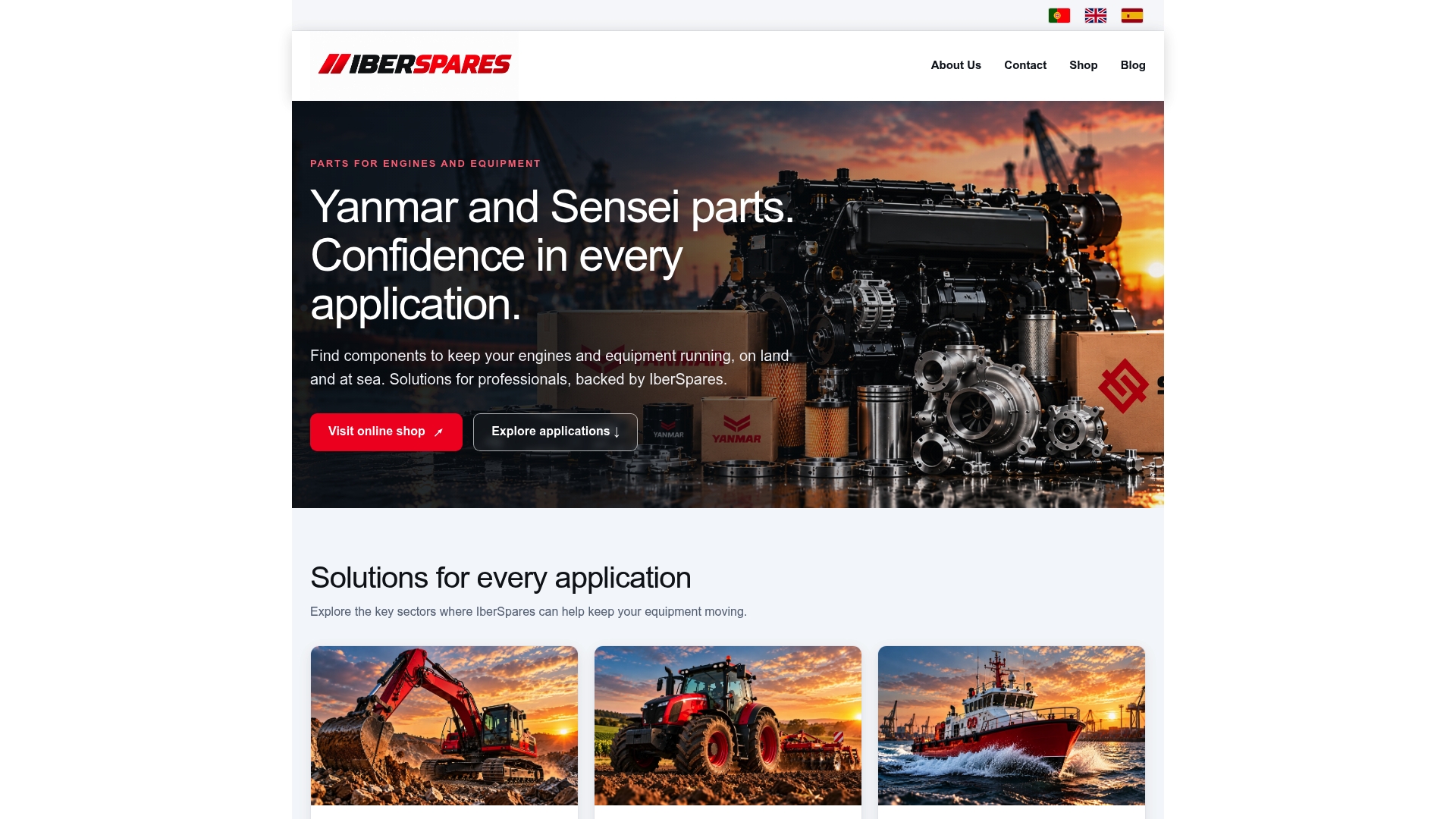
Iberspares distributes spare parts for Yanmar and Sensei engines and equipment, with a marine category alongside construction, agriculture, power generation, material handling and compact equipment. We focus on identifying the right application-specific part, and we keep an extensive in-stock inventory for rapid dispatch, so routine service parts and emergency parts reach workshops, marinas, shipyards and fleet operators quickly. Browse the Yanmar and Sensei parts range and build your service kits ahead of the season.
Our point of view
Most marine engine failures we hear about start as small, scheduled jobs that slipped: a filter left past its interval, an anode left too long, an impeller put off because the part was not at hand.
That is why we think about maintenance as a parts problem as much as a labor problem. The schedule tells you what is due. The only question left is whether the correct part for that exact engine is on the shelf when the boat is on the lift.
Our knowledge is in Yanmar and Sensei applications, and in matching parts to the machine, whether it is a marine engine, a generator set or a compact tractor. We hold stock so that routine and emergency orders can go out fast and downtime stays short. For a workshop or a fleet, that means planning service kits in advance and ordering from one source that understands the application.
Duarte
FAQ
How often should a marine diesel be serviced?
Follow your engine’s manual, using hours or calendar time, whichever comes first. General guidance puts oil and filters at 100 to 150 operating hours or at season’s end, and Yanmar’s L-series manual sets the oil and filter change at 150 hours. Shorten intervals in severe duty.
What are the daily checks?
Check oil, coolant and fuel levels, drain water from the fuel pre-filter, look for leaks, and check belts, gauges and the battery. After starting, confirm oil pressure and that seawater discharges overboard.
How often should zinc anodes be replaced?
Yanmar’s manual says to replace a zinc once corrosion has affected more than half of its volume. In warm, very salty waters, check them every 6 months.
What is the first service on a new engine?
The first oil and filter change comes early, at 50 hours on the Yanmar 4LHA, because initial wear contaminates the oil quickly. Check your own manual for the exact break-in service.
Sources
- Dealing with diesel engines, RYA
- Diesel learner’s guide, Pacific Community
- Yanmar L-series marine operation manual, 2022
- Yanmar 4LHA use and maintenance manual
- Saltwater protection for boats
- Winter lay-up checklist
Content strategy and optimisation for Google and AI-powered search platforms by Velveteen SaaS — specialists in online visibility and customer acquisition.