
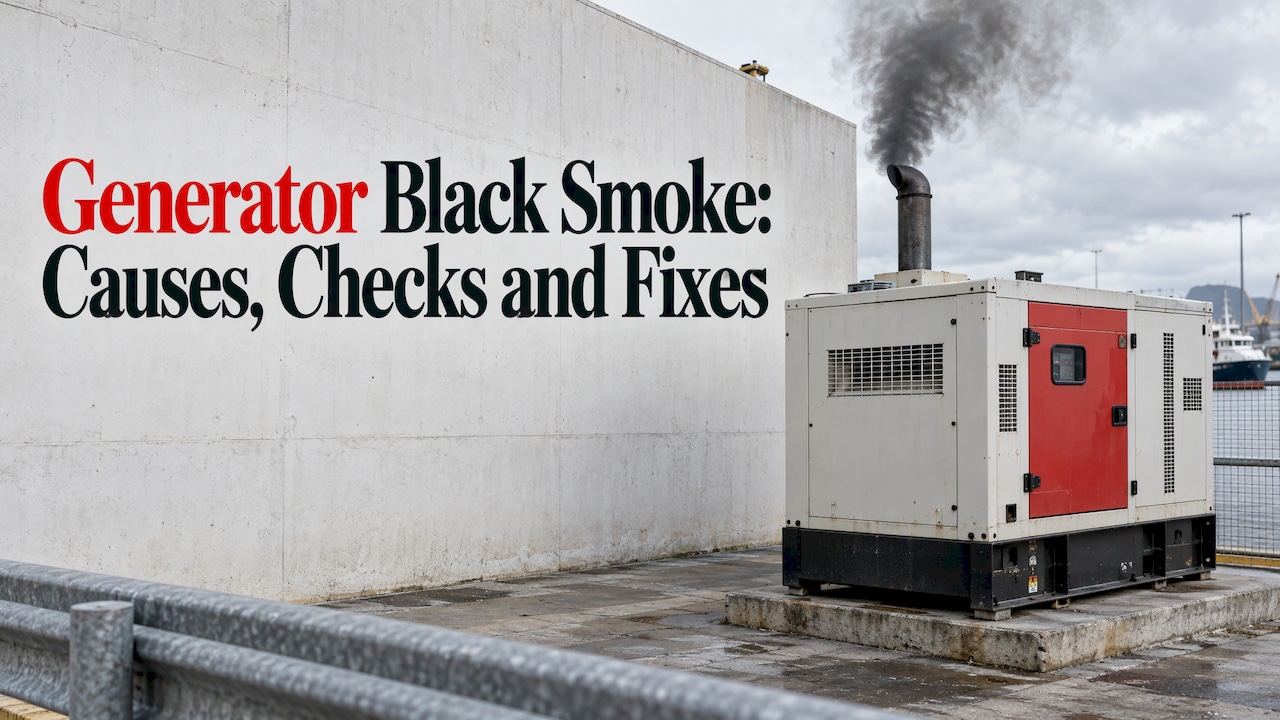
Black smoke from a generator exhaust is unburned carbon, or soot. It means the engine is getting too much fuel, too little air, or both. A few seconds at startup is usually normal. Smoke that lasts a minute or more, or that grows with load, points to a fault you can trace: an overloaded set, a restricted air path, a worn injector or a boost problem. Once you know which one, the repair is mostly a matter of getting the right part quickly. For Yanmar and Sensei engines, Iberspares supplies those parts.
TL;DR
- Black smoke is soot from incomplete combustion. Official guidance links it to a wrong air-fuel ratio, poor fuel, carbon build-up or cool running.
- Dark smoke for a few seconds at startup is likely. Smoke lasting a minute or more is a problem.
- Check load, the air filter and the intake path first. Then look at injectors, fuel timing and the turbocharger.
- Stop the set if smoke is heavy and comes with power loss, odd noise, overheating or leaks.
- Never run a generator in an enclosed space. Exhaust carries carbon monoxide.
Table of Contents
- What black smoke actually is
- Is it normal? Startup puffs versus a real fault
- Smoke after a service or overhaul
- Checks in the order that saves time
- Wet stacking: smoke from running too light
- Black, white or blue: what colour tells you
- When to stop the set
- Getting the right part fast
- Promo
- Perspective
- FAQ
- Sources
What black smoke actually is
Diesel burns cleanly only when each cylinder gets enough air for the fuel injected. When fuel arrives faster than air, or the spray is poor, part of the fuel does not burn fully. It leaves as fine carbon particles, which is the black cloud you see. The City of London Corporation’s combustion plant guide names an incorrect air-fuel ratio, poor-quality fuel, carbon build-up and cool operating temperatures as contributors.
So the question is never just “why is it smoking?” It is “is the engine short of air, or is it over-fuelled?” Every check below answers one of those two.
Is it normal? Startup puffs versus a real fault
The same guide says dark smoke for a few seconds during startup is likely, while dark smoke lasting one minute or more indicates a problem. A small set that gives a puff and then runs clear is behaving normally in most cases.
Load changes matter too. An older diesel can puff briefly when load is applied suddenly, because turbocharger airflow lags behind the injected fuel, according to JS Power’s smoke guide. The same source says modern diesels should not visibly smoke.
Use this rule of thumb:
| What you see | Likely meaning |
|---|---|
| Puff of a few seconds at start, then clear | Normal for many sets |
| Smoke only as a big motor starts, gone in seconds | Load step; usually normal |
| Smoke that worsens as load rises | Overload or air restriction |
| Smoke at all loads | Injector, fuel-pump timing or fuel setting |
| Smoke with power loss and turbo whistle or oil | Turbocharger or boost trouble |
The last three rows follow the diagnostic table in Reddy Generators’ guide.
Smoke after a service or overhaul
This is a common complaint: the set was serviced and still smokes. Re-check what the service touched. A wrongly seated air filter, a loose intake or charge-air hose, an air cleaner left restricted, or injectors that were disturbed can all leave the engine short of air or over-fuelled. Work through the checks in the next section in order before assuming the overhaul failed.
Checks in the order that saves time
Start with what costs nothing and rules out the most.
1. Measure the load
Overload is the first suspect. Measure actual electrical load against the engine’s rating at your site, since heat and altitude lower what the engine can deliver. EmersonEIMS recommends comparing real load with the site-derated rating. Check each phase and the power factor, because one heavily loaded phase can hide behind a reasonable total.
2. Check the air filter and intake path
A restricted filter starves the engine of air. Judge it with a restriction indicator or manometer, not by how it looks, as the same source advises. Then inspect intake and charge-air hoses for cracks and loose clamps, and check that the enclosure ventilation is not recirculating hot air.
3. Look at fuel quality and recent service
Poor diesel and clogged fuel filters both show up as dirty combustion. Note when the fuel and filters were last changed. If smoke began right after a fuel delivery, that is a strong clue.
4. Test the injectors
A partly blocked injector or low opening pressure is a listed cause of black smoke in the Cummins Onan service manual, which directs you to check the spray pattern and opening pressure against the engine workshop manual. Uneven spray leaves fuel unburned in one or more cylinders. Injectors and their nozzles are wear parts, and on a smoking engine they are among the most common replacements.
5. Check fuel-pump timing and high-pressure supply
Carrier’s genset troubleshooting manual lists poor high-pressure fuel supply or injection, intake restriction, exhaust problems and sensor faults among causes of emission deterioration. On electronically controlled engines it directs technicians to use ECU live data, comparing target and actual rail pressure, coolant temperature and atmospheric pressure. A gas analyser can support this work on more advanced diagnostics, for example a used exhaust gas analyser.
6. Inspect the turbocharger
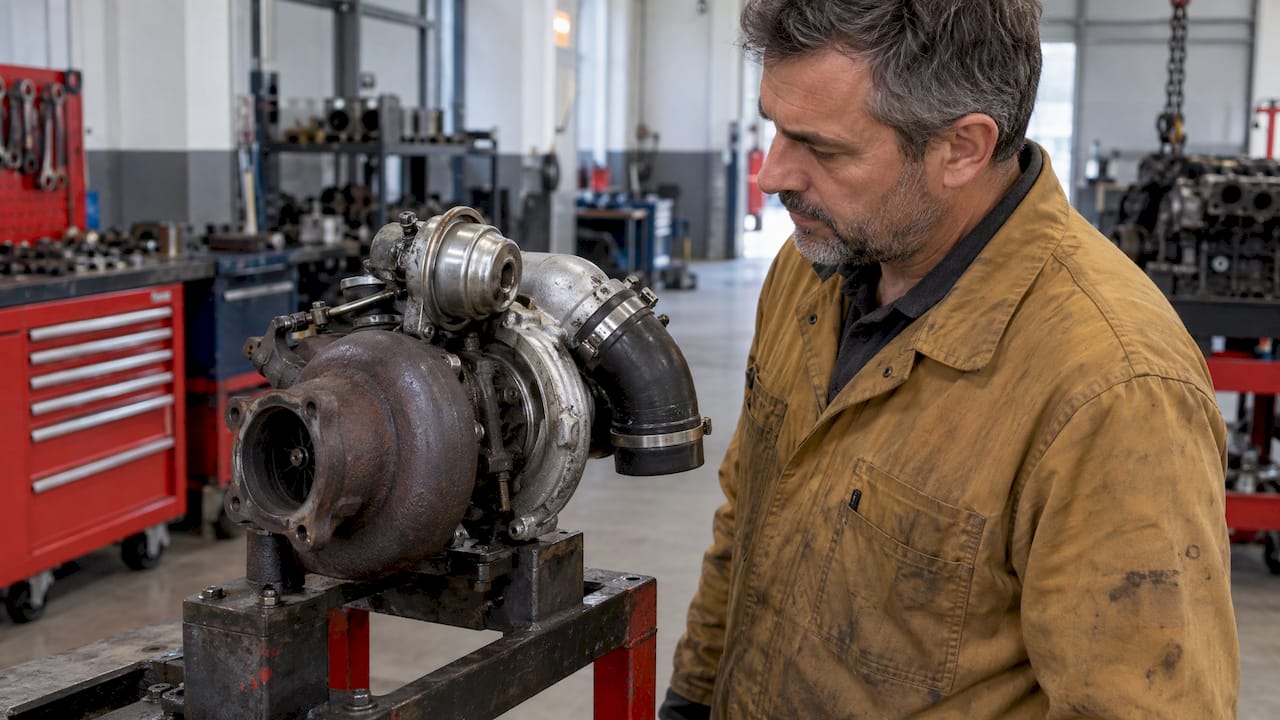
On a turbocharged set, smoke plus power loss can mean inadequate boost or a charge-air leak. Check boost pressure, the charge-air connections and cooler, and the turbo itself for shaft play and oil leakage. EmersonEIMS warns that running on after a turbo failure can let debris damage the engine.
Log it before you touch it
Write down when the smoke appears, how long it lasts, outdoor temperature, panel load and phase currents, filter restriction, fault codes and the last fuel and filter service. That record usually points straight at one of the causes above and saves a workshop hours.
Wet stacking: smoke from running too light
A set that is too big for its job can smoke too. The City of London guide says diesel sets are usually optimized for 50 to 80% load, and that extended running below 45% of nameplate rating can shorten engine life through wet stacking and related deposits. Generac’s owner’s manual says wet stacking can occur below 30% of full load, causing continuous black exhaust under constant load and fouling injectors or depositing material on valves.
The fix is operational: match the set to the load, or run it under a proper load so it reaches working temperature. Fouled injectors and valves that result are replaced like any other wear part.
Black, white or blue: what colour tells you
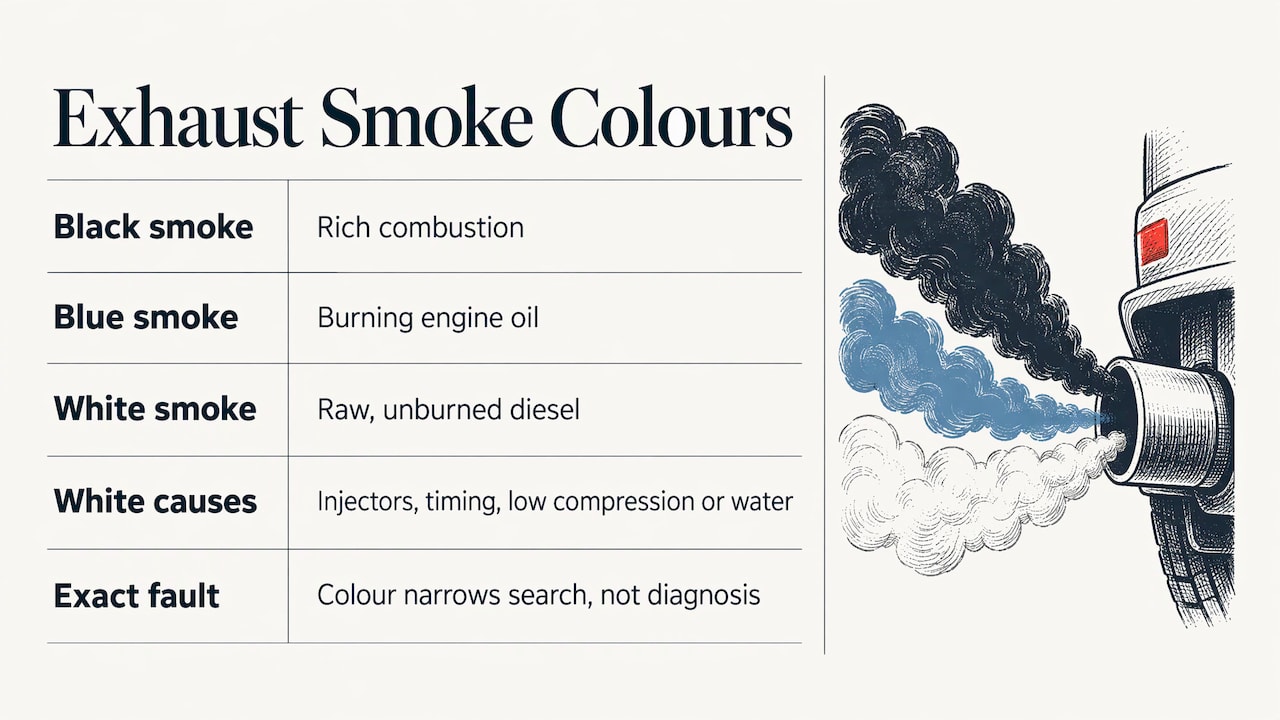
Colour narrows the search but does not name the fault. The City of London guide describes blue smoke as burning engine oil and white smoke as raw, unburned diesel, with faulty injectors, incorrect timing, low compression or water as possible white-smoke causes. JS Power cautions that colour helps identify a system but does not itself establish the exact fault. Black means rich combustion. For a plain-language look at the white-smoke side, see this explanation of white smoke from exhaust.
When to stop the set
Stop and do not keep running if heavy or persistent smoke comes with power loss, unusual noise, overheating or leakage, as FIRMAN’s FAQ advises. The PowerTech operator manual says persistent black smoke that may indicate overload or over-fuelling warrants calling a dealer or diesel technician. Smoke with rising exhaust temperature or suspected turbo failure also calls for a qualified professional.
Safety first: diesel exhaust is harmful, and carbon monoxide can be fatal. Never run a generator in an enclosed or poorly ventilated space, a warning repeated by EmersonEIMS.
Getting the right part fast
Once the diagnosis points at an injector, filter, hose or turbo component, the delay is usually identifying the correct part number for the exact engine. A wrong part means a second shutdown. If your set runs on a Yanmar or Sensei engine, the part list is the place to start.
Promo
Iberspares supplies parts for Yanmar and Sensei engines and equipment, including power and generators, construction, agriculture, marine, material handling and compact equipment. Our focus is application-specific components and fast identification of the correct part, with extensive stock for rapid dispatch. Browse the genuine Yanmar and Sensei parts for your set.

Workshops and maintenance teams can order routine and emergency parts online in one place.
Perspective
When a generator smokes, the engine is telling you one of two things: not enough air or too much fuel. Most of the time the fix is a small, inexpensive part, and the cost is in the hours the set sits idle while someone works out which part it is.
That is why we concentrate on Yanmar and Sensei applications. Knowing how an engine is used, whether on a standby generator, a compact excavator or a vessel, lets us identify the right component the first time and avoid the delays that come from a wrong order. We keep extensive stock so the part can ship quickly.
Diagnose methodically, log what you see, and replace what the evidence points to. Then get the set back to work.
Duarte
FAQ
Is black smoke from a generator dangerous?
When a generator smokes, the engine is telling you one of two things: not enough air or too much fuel. Most of the time the fix is a small, inexpensive part, and the cost is in the hours the set sits idle while someone works out which part it is.
That is why we concentrate on Yanmar and Sensei applications. Knowing how an engine is used, whether on a standby generator, a compact excavator or a vessel, lets us identify the right component the first time and avoid the delays that come from a wrong order. We keep extensive stock so the part can ship quickly.
Diagnose methodically, log what you see, and replace what the evidence points to. Then get the set back to work.
Duarte
Is black smoke from a generator dangerous?
It signals incomplete combustion, so the engine is wasting fuel and may be fouling injectors and valves. The exhaust itself is harmful, so run the set only outdoors or with proper exhaust ventilation. Never run it in an enclosed space because of carbon monoxide.
Why does my generator smoke black only at startup?
A few seconds of dark smoke at startup is likely, according to the City of London Corporation’s guidance. If it lasts a minute or more, check the air filter, injectors and fuel quality.
Why does black smoke get worse under load?
Smoke that worsens with load usually means overload or restricted air. Measure actual load against the site-derated rating and check filter restriction. If the set is turbocharged, also check boost and the charge-air connections.
Can running a generator on a light load cause black smoke?
Yes. Extended low-load running can cause wet stacking, with continuous black exhaust and deposits on injectors and valves. Matching the set to the load or running it nearer its working range avoids it.
Sources
- City of London Corporation, Combustion Plant: Recommendations for best practice
- JS Power, Investigating Diesel Generator Smoke
- Reddy Generators, Generator Black Smoke: Causes, Checks & Fixes
- EmersonEIMS, Generator Excessive Smoke
- Cummins Onan service manual A066T111
- Carrier T-382 genset troubleshooting
- Generac mobile generator owner’s manual
- PowerTech PTI-15SI and PTI-20SI operator manual
- FIRMAN generator FAQ
- Used gas analyser listing
- White smoke from exhaust explainer
Content strategy and optimisation for Google and AI-powered search platforms by Velveteen SaaS — specialists in online visibility and customer acquisition.