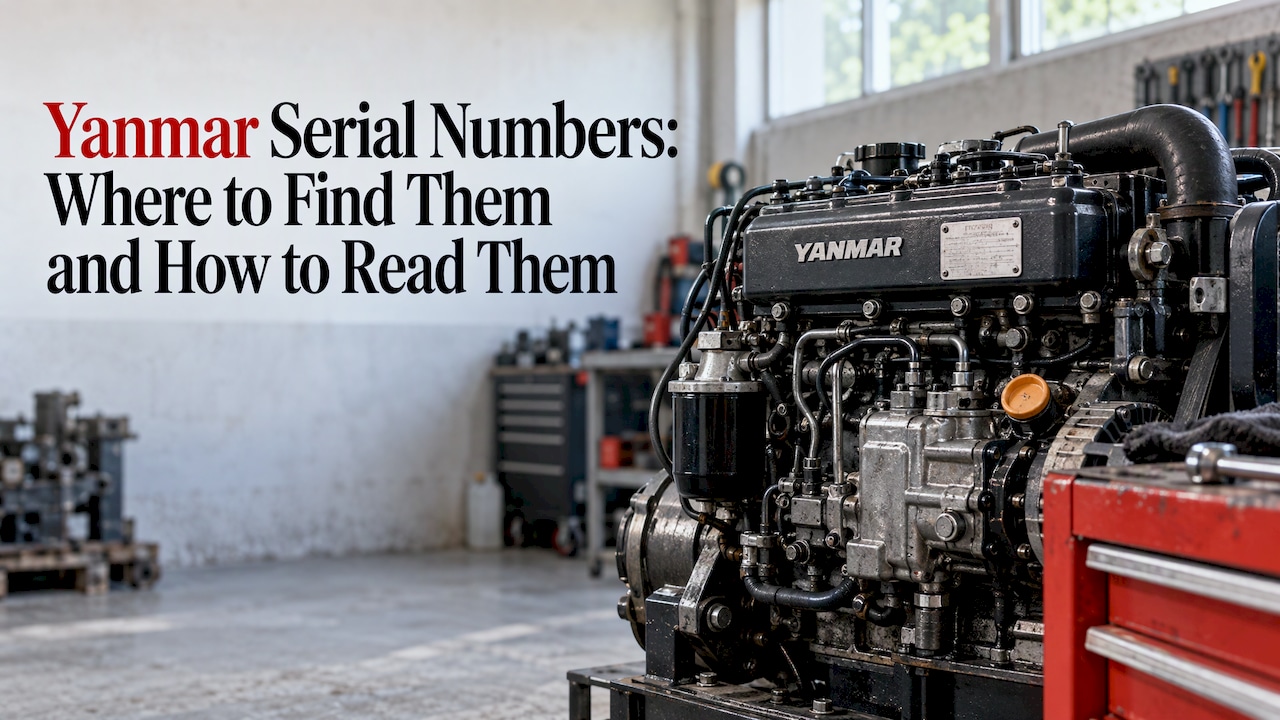
The Yanmar serial number is stamped on the engine’s identification plate, next to the line marked “ENGINE NO.”, and it only does its job together with the model name printed above it. Where the plate sits depends on the engine family: a riveted metal label on the valve cover for liquid-cooled TN-series engines, an adhesive label on the cooling-air conveyor for air-cooled L-series engines. Send us both the model and the serial number and we can match the part to the exact engine revision, not just the engine family.
TL;DR
- The nameplate has two separate entries: “MODEL” is the engine type, “ENGINE NO.” is the serial number. You need both to order parts.
- TN-series (liquid-cooled) engines carry a metal plate held by four rivets on the valve cover, fan side. L-series (air-cooled) engines carry an adhesive label on the cooling-air conveyor, toward the power take-off.
- A serial number alone does not identify an engine, because the Yanmar line is too large. Parts catalogs split engine revisions by serial ranges.
- Photograph the plate, and the machine plate too, before you start a parts search. Paint, grease and heat wear plates out.
- Iberspares supplies Yanmar and Sensei parts for construction, agriculture, marine, power generation, material handling and compact equipment.
Table of Contents
- What the Yanmar serial number tells you (and what it does not)
- Where to find the serial number on your engine
- Reading the plate without making costly mistakes
- Why parts catalogs care about serial ranges
- Matching parts by serial number: a practical workflow
- Serial numbers by sector
- If the plate is missing or unreadable
- What genuine parts and the right identification save you
- Our perspective
- Order the right Yanmar or Sensei part
- FAQ
- Sources
What the Yanmar serial number tells you (and what it does not)
Every Yanmar engine carries an identification plate. On it, Yanmar’s own parts guide separates two entries: “MODEL” is the engine model and “ENGINE NO.” is the serial or identification number. Its examples show the pattern: an air-cooled engine reads L100N5EA1C1C AID with serial S12345, and a liquid-cooled one reads 4TNV88-DSA with serial 012345.
That split matters because people mix the two up all the time. The model is a long alphanumeric string that describes the engine design: cylinder count, series, bore class and application variant. The serial number is a shorter sequence that tells you where in the production run your particular engine falls. Think of the model as the family and the serial number as the individual.
The serial number does not, by itself, tell you the model. Yanmar USA says its product line is too large to identify an engine from the serial number alone, so identification needs the complete model number and the serial number together. Yanmar’s global marine FAQ says the same thing from the other direction: the serial number is on the engine information plate and the model information must accompany it, with 4JH3, 6LY2 and 8LV given as example model names.
In practice, that means the useful unit for any parts inquiry is a pair:
| Plate entry | What it is | Example from Yanmar’s guide |
|---|---|---|
| MODEL | Engine type and variant | 4TNV88-DSA |
| ENGINE NO. | Serial number of your unit | 012345 |
| MODEL | Air-cooled engine type | L100N5EA1C1C AID |
| ENGINE NO. | Serial number of your unit | S12345 |
Note the letter prefix on the air-cooled example. A serial can start with a letter, and that letter is part of the number. Copy it exactly.
Where to find the serial number on your engine
The location depends on the engine family. The two layouts below come from Yanmar’s own identification guide.
Liquid-cooled TN-series engines
The nameplate is a metal label fixed with four rivets on the valve cover, on the fan side of the engine. These engines are common in compact excavators, loaders, generator sets and many other machines. The guide adds that a recurring label may also be fixed on the machine itself, so you may have a second reading to compare with the engine plate.
Air-cooled L-series engines
For the L-AE, L-EE, LN, LV and LW families, the nameplate is an adhesive label on the cooling-air conveyor, toward the power take-off. Because it is adhesive rather than riveted, it is the one most likely to be scuffed, painted over or missing on an older engine. If you find a blank patch where the label should be, check the machine for the recurring label before assuming the number is lost.
Marine engines
On marine units such as the 4JH3, 6LY2 and 8LV, the serial number is on the engine information plate. Yanmar’s FAQ for recreational marine engines points to that plate and reminds you to note the model alongside it. Engine bays are tight and damp, so use a phone camera and a flashlight, or a small inspection mirror, rather than trying to read the plate from above.
A quick routine at the engine
- Wipe the plate with a dry rag. Do not use solvent on an adhesive label.
- Photograph the whole plate square-on, then close-ups of the MODEL and ENGINE NO. lines.
- Write the two values in your own notes, character by character, including any letter prefix.
- If the plate is unreadable, photograph the machine’s own plate and the engine’s overall shape, including where the fuel filter, oil filter and starter sit.
- Note the machine make, model and approximate year. This is not a substitute for the serial number, but it narrows the search.
Reading the plate without making costly mistakes
A handful of errors cause most wrong-part orders.
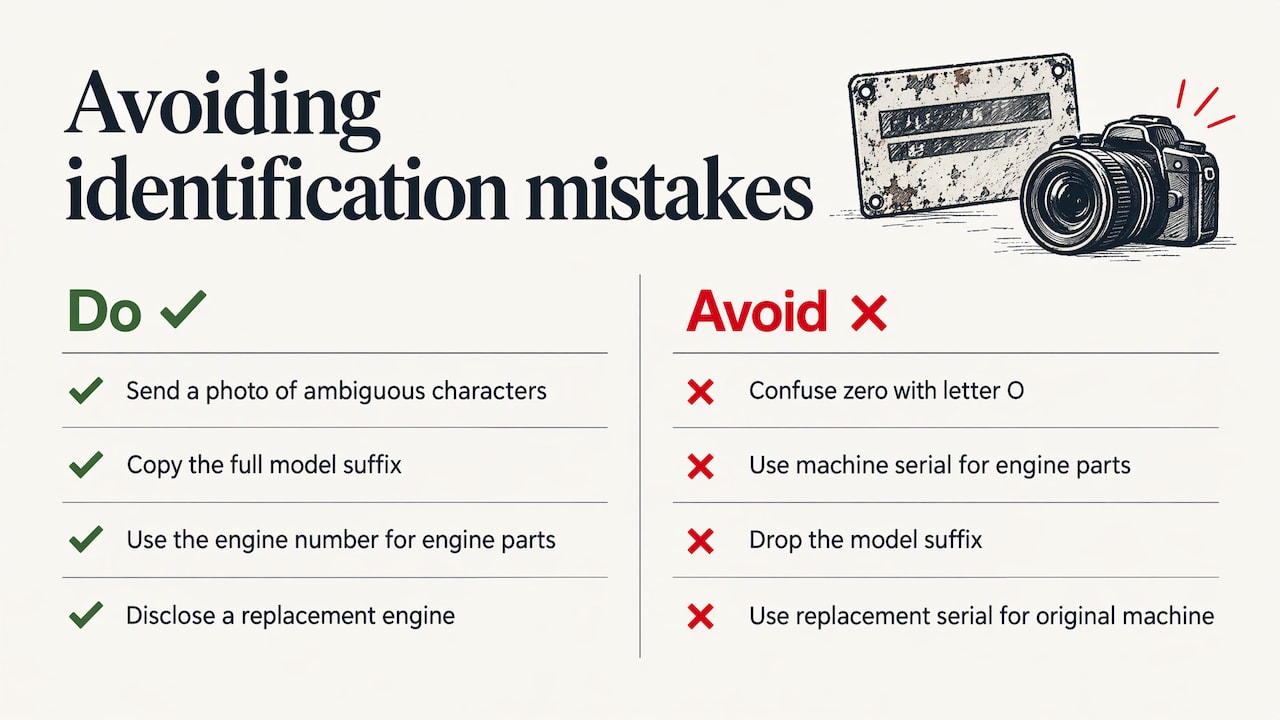
Confusing 0 and O, 1 and I. Serials from older engines can be worn. If a character is ambiguous, say so when you ask for a part and send the photo.
Reading the machine number as the engine number. A machine plate also carries a serial number. It belongs to the machine, not to the engine. Parts for the engine are identified by the engine’s number. The machine number matters for machine-specific parts such as hydraulics and bodywork.
Dropping the suffix on the model. The difference between 4TNV88-DSA and a similar-looking model can be a single suffix, and that suffix often reflects an application or emissions variant that changes which injector, turbocharger or sensor fits. Copy the full string.
Using a replacement engine’s number for the original machine. If an engine was swapped, the serial in front of you belongs to the engine now fitted. The parts catalog entry for the original machine may describe a different engine.
Assuming the badge brand decides who supports the engine. Yanmar USA notes that engines powering certain other brands’ products, including John Deere, Komatsu, Thermo King, Ingersoll-Rand, NACCO (Hyster/Yale), Volvo, Isuzu and ISM, are not supported by the Yanmar service network. If your engine is fitted to one of those, say so when you ask, so the identification starts from the right place.
Why parts catalogs care about serial ranges
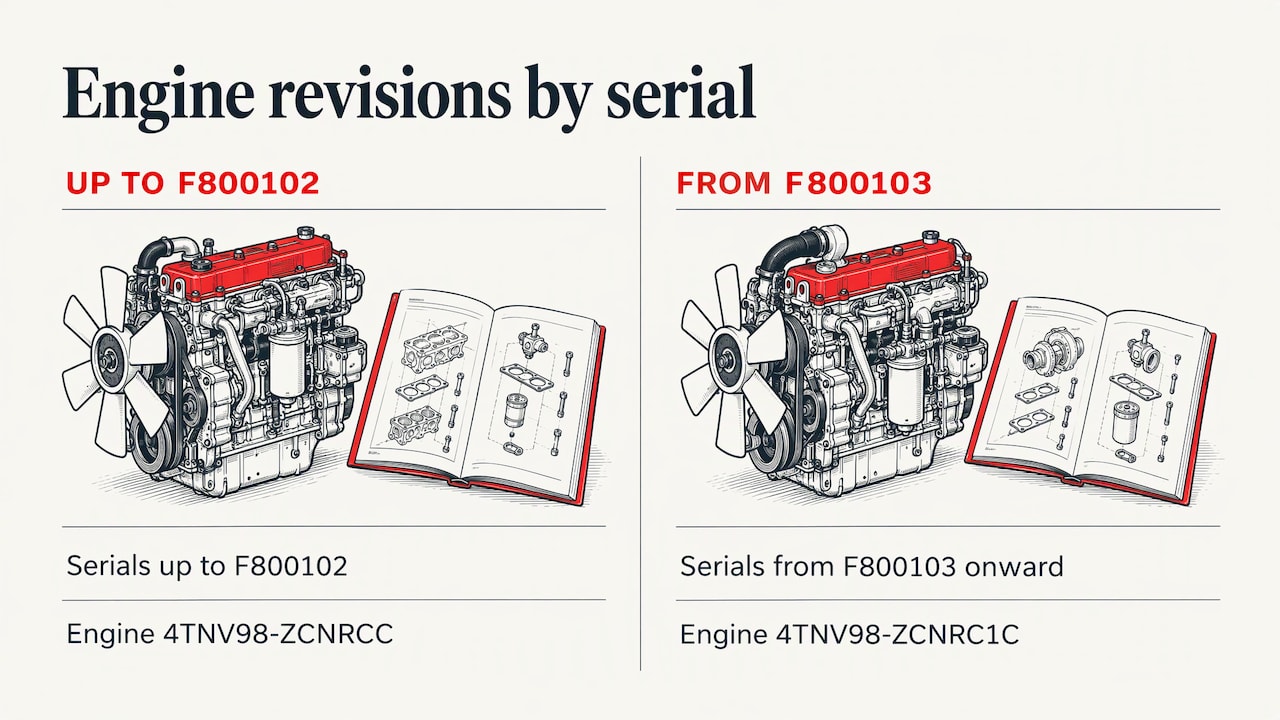
The serial number does real work when you reach the parts catalog. Engines are revised during production: a supplier changes, a component is redesigned, an emissions step arrives. The catalog records the break as a serial range.
A Yanmar parts catalog document (0CNP6-M06211EN, last updated March 2019) shows this clearly. For one machine, the AW70GV,RSX(F)-IN, serials up to F800102 use engine 4TNV98-ZCNRCC, and serials from F800103 onward use 4TNV98-ZCNRC1C. Two engines, one machine, one number apart. A part listed for one revision may not be listed for the other.
Here is a worked example of how that plays out for a workshop.
A customer brings in a compact machine with a 4TNV-series engine that needs a service kit. The model on the plate says 4TNV98 plus a suffix. You search by the model and find two entries, each with a different engine code. The serial number is what tells you which side of the break the engine sits on. Order from the wrong entry and the kit arrives, the job is half done, and the machine sits in the bay while you wait for the correct one. With the model and serial both in hand, the search lands on a single entry.
Matching parts by serial number: a practical workflow
This is the routine we suggest for any Yanmar parts request, whether you are a one-bay workshop or a fleet maintenance department.
- Record the pair. Full MODEL string and full ENGINE NO., from the plate, with the photo saved against the job.
- Add the application. Is the engine in a compact excavator, a tractor, a generator set, a marine propulsion installation, a forklift? Application-specific components such as mounting brackets, cooling arrangements and governors can differ with the installation.
- Name the part by function and position. “Fuel filter, primary” or “raw water pump impeller” is better than “filter” or “pump”. If you have the old part, photograph its numbers.
- Check for revision breaks. If the catalog or your supplier shows two entries split by serial range, the ENGINE NO. decides which one applies.
- Confirm before dispatch. Read the model, serial and part description back to whoever is quoting. A thirty-second read-back is cheaper than a return.
For a repeat customer base, keep a simple register: machine, engine model, engine serial, hours at last service, parts used. It turns every later order into a lookup rather than a search.
Serial numbers by sector
The reader at a workshop in construction sees different problems from the one running a marina, and the identification habits that help differ a little.
Construction and compact equipment. Machines pass through rental fleets and second owners, and plates take abuse. Photograph the plate at intake and record it in the machine file. Engines are often TN-series liquid-cooled units, with the riveted metal label on the valve cover.
Agriculture. Tractors and implements often carry both a machine serial and an engine serial. For compact tractor parts, take the engine plate reading, not the tractor’s chassis plate, when the part belongs to the engine. Dealers who stock mixed brands should record the model and serial on every engine job card.
Marine. Engine information plates live in damp, hot spaces. Photograph them when the engine is new to your yard, and keep the picture with the vessel record. Marinas and shipyards that service many hulls benefit most from a register.
Power generation. Generator sets can carry a set plate (the complete unit) and an engine plate. Parts for the engine follow the engine number. Emergency power providers should hold these numbers for every standby unit on the contract, so that an urgent request for a part never starts with a trip to the unit.
Material handling. Forklift engines may be installed in several machine models. Machine model alone does not identify the engine, so the engine plate is the reliable reference.
If the plate is missing or unreadable
Plates go missing. Engines are repainted, labels peel, rivets corrode. Then the work is to rebuild the identification from other evidence.
- Check the recurring label on the machine, which Yanmar’s guide says may be present on the machine as well as the engine.
- Check paperwork: the purchase invoice, the original parts order, a service record or the machine manual.
- Look at the machine’s own plate for the make, model and year, and photograph the engine from several angles.
- Note cylinder count, cooling type (air or liquid), and the position of the major components.
Send all of this together. The more evidence in the first message, the quicker the identification. Without the serial number, a match may rely on the model and application, and any resulting parts list should be checked against the engine before fitting.
What genuine parts and the right identification save you
A wrong part costs more than its price. Machine downtime, a second delivery, and labor on a job that has to be redone all add up, and for a commercial operator the downtime is usually the largest line. That is the reason to treat identification as part of the repair, not a clerical step before it.
The cheapest identification is a clear photo of the plate taken at the first service visit. The most expensive is the one you try to piece together while the machine is down and the customer is waiting.
Our perspective
Most of the parts problems we see described start before the order: the model was copied without its suffix, or the serial was read from the machine plate instead of the engine plate. The fix is simple and it is a habit, not a tool.
We built our approach around application-specific knowledge of Yanmar and Sensei engines and equipment. An engine in a compact excavator, a marine installation and a generator set can share a family name and still call for different components. Knowing the application is what lets us identify the correct part quickly, with fewer errors and fewer delays.
That is also why we keep extensive stock for rapid dispatch. When a machine is down, the identification and the shipping both have to be fast, and they have to be right the first time.
Give us the model, the engine number and a photo of the plate, and we will work from the engine itself.
Duarte
Order the right Yanmar or Sensei part
Once you have the model and serial in hand, the next step is the part itself. Iberspares supplies spare parts for Yanmar and Sensei engines and equipment across construction and industry, agriculture, marine, power and generators, material handling and compact equipment, with the focus on professional buyers who keep machines working.
Browse the Yanmar and Sensei parts range and have the model, the engine number and a plate photo ready when you order or ask about a part.
FAQ
Where is the serial number on a Yanmar diesel engine?
On TN-series liquid-cooled engines it is on a metal label held by four rivets on the valve cover, fan side. On air-cooled L-series engines it is an adhesive label on the cooling-air conveyor toward the power take-off, according to Yanmar’s identification guide. Marine engines carry it on the engine information plate.
Can I identify my engine from the serial number alone?
No. Yanmar USA states that its range is too large for serial-only identification, so you need the complete model and the serial number together. Always copy both lines from the plate, including any prefix letters and the model suffix.
What is the difference between the model and the engine number?
The model describes the engine design, for example 4TNV88-DSA. The engine number is the serial of your individual unit, for example 012345. Both appear on the nameplate, labeled “MODEL” and “ENGINE NO.” in Yanmar’s guide.
Why does the serial number change which part fits?
Because engines are revised during production and catalogs mark the change by serial range. One Yanmar parts catalog lists a machine whose engine code changes at serial F800103. Parts for one side of that break may not suit the other.
What should I send when I ask for a part?
Send the full model, the full engine number, a clear photo of the plate, the machine make and application, and a description of the part with its position on the engine. If you have the old part, add a photo of any numbers on it.
Sources
- Yanmar: identify your engine (nameplate, model and engine number, label locations)
- Yanmar global FAQ: finding the serial number on recreational marine engines
- Yanmar USA: genuine parts FAQs
- Yanmar parts catalog 0CNP6-M06211EN (March 2019)
Content strategy and optimisation for Google and AI-powered search platforms by Velveteen SaaS — specialists in online visibility and customer acquisition.