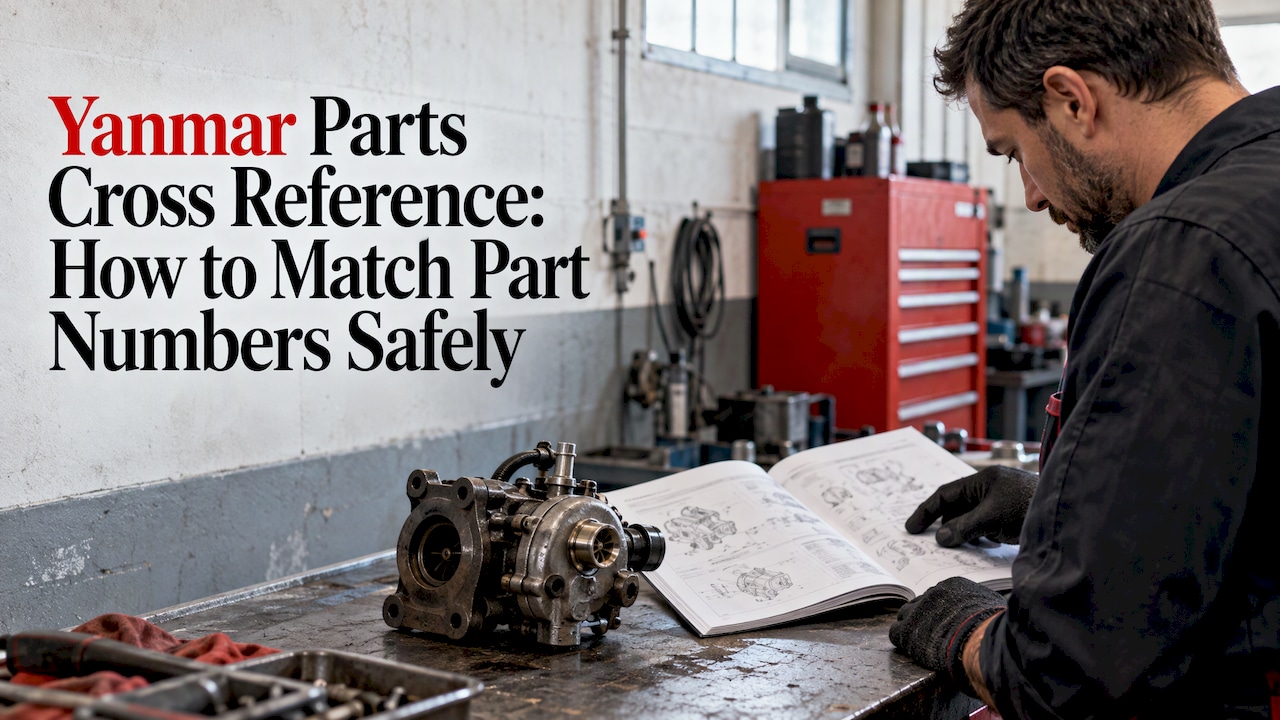
A Yanmar cross reference is only as good as the data you start with. The reliable method is to begin with the engine model and serial number, pull the part number from the parts catalog for that exact engine, and only then compare it against any other number. Do it in that order and you avoid most wrong-part orders. Skip a step and you pay for it in freight, labor and downtime. Iberspares supplies Yanmar and Sensei parts and identifies application-specific components for construction, agriculture, marine and power generation, so this routine is the one we work from.
TL;DR
- Start with the engine model and the serial number from the engine’s identification plate, never with a guess from the machine’s appearance or horsepower.
- Take the part name and number from the catalog for that engine, and treat a cross reference as a second check, not the first source.
- Supersessions run forward with confidence. Running them in reverse needs judgment, because an old part is not guaranteed to do everything the new one does.
- Before accepting an alternative number, compare dimensions, ratings and the application, not just the label on the box.
- Send the model, serial number and part number together when you order, so the match is confirmed before dispatch.
Table of Contents
- What a cross reference actually is
- Step 1: Identify the engine before the part
- Step 2: Get the part number from the catalog for that engine
- Step 3: Read supersessions in the right direction
- Step 4: Compare what the number cannot tell you
- Step 5: Verify fit against model, serial range and application
- Common mistakes that cause wrong-part orders
- Match by sector: what to watch for
- Promo: sourcing the matched part
- Perspective
- Keeping a cross-reference record
- FAQ
- Sources
What a cross reference actually is
A cross reference is a table that links one part number to another. In Yanmar work it usually means one of three things:
- Supersession: Yanmar replaced an older number with a newer one, often after a design change.
- Interchange: a number from another manufacturer’s range that is listed as fitting the same position.
- Application match: the same part used across several engine models or serial ranges, each listed under its own catalog entry.
These are different claims with different levels of certainty. Mixing them up is the most common source of errors. A supersession comes from the manufacturer’s own parts system. An interchange comes from whoever built the table, and its quality depends on how it was checked.
For a workshop, rental fleet or marina, the practical question is never “does a number appear in a table?” It is “will this part do the same job in this engine, in this application, for the life of the service interval?”
Step 1: Identify the engine before the part
Every cross reference rests on the engine. Yanmar’s own parts catalog for the 3TNV84T-GKM engine, catalog number 0CV10-M95900EN, updated July 2020, says that when you order parts you should clearly write down the engine model and serial number, plus the name and number of each part, to make sure delivery is reliable. It also states that the catalog covers all parts for engines manufactured since March 2004. That wording tells you how Yanmar itself expects parts to be identified: engine first, part second.
Gather this before you open any table:
- Engine model exactly as stamped, including suffixes. A TNV engine and a similarly sized model from another series can look alike and use different parts.
- Serial number from the same identification plate. Parts often change within a model run, and the serial number tells you which side of the change your engine is on.
- Machine or application: excavator, tractor, genset, sailboat auxiliary, forklift or compact loader. The same base engine can be built with different accessories, mountings and cooling arrangements for each.
- Part name and any number that is on the old part or in your records.
- Photos of the old part and of the plate, which settle questions that numbers alone cannot.
Where it goes wrong: the plate is painted over, the engine was replaced at some point, or the machine’s own nameplate lists a different engine from the one installed. If the numbers on the engine and the machine disagree, trust the engine’s plate and say so when you order.
Step 2: Get the part number from the catalog for that engine
With model and serial in hand, open the parts catalog or exploded diagram for that engine. Find the assembly (fuel system, cooling, lubrication, starting, electrics), locate the item on the diagram and read the part number from the list beside it.
This is where a cross reference should begin. Starting from the catalog entry gives you a number tied to your engine. Starting from a number on a used part gives you a number tied to whatever that part was fitted to, which may not be your engine, and may have been a substitute when it was installed.
Two habits save time:
- Note the quantity column. Gaskets, seals and fasteners are listed in the quantity needed per engine, and a kit may contain more or fewer than you expect.
- Note any remarks beside the number, such as a serial range or an application restriction. These are exactly the details a bare cross reference table leaves out.
Identifying the right entry from a diagram is the step where most errors enter. Our team at Iberspares works with Yanmar and Sensei applications every day, and we aim to find the correct part efficiently so you avoid the errors and delays that a wrong guess creates.
Step 3: Read supersessions in the right direction
Yanmar updates parts over time. When it does, the old number is replaced by a new one. Cross-reference software explains the logic clearly: according to the Huggins Cross Reference help pages, a forward supersession guarantees that the new part replaces the old one, while a reverse supersession is not guaranteed. An old part that bolts on or plugs in may not fully replace the new one under all conditions, so users must use judgment and watch for safety issues.
In practice:
- Old number to new number: safe to follow. If your catalog shows that a number is superseded, order the newer one.
- New number to old number: do not assume. A fitting that threads on, or a connector that plugs in, does not prove the part performs identically. Pressure ratings, materials, flow rates and tolerances can differ.
- Chains of supersessions: follow the chain to its end. A number may have been replaced twice, and the first replacement may itself be obsolete.
This matters most for parts that control pressure, temperature, fuel or timing: injectors, fuel pumps, thermostats, oil pumps, turbochargers and sensors. A wrong gasket leaks. A wrong fuel component can damage an engine.
Step 4: Compare what the number cannot tell you
A matching number is a claim. Before you accept an alternative, compare the specification behind it. What to compare depends on the part, but the principle holds across the engine:
| Part type | What to confirm beyond the number |
|---|---|
| Oil and fuel filters | Thread size, gasket diameter and thickness, overall length and clearance, bypass valve opening pressure, anti-drain-back valve, media rating |
| Water pumps and impellers | Mounting pattern, shaft and bearing dimensions, impeller material and vane count, rotation direction |
| Belts | Length, width, profile and groove count |
| Gaskets and seals | Material, thickness, bolt-hole pattern, and the engine variant they are specified for |
| Injectors and fuel parts | Application and serial range, flow and opening pressure, nozzle type |
| Electrical parts | Voltage, connector type, amperage, rotation or terminal layout |
| Pistons, rings and liners | Bore, ring set, compression height, engine variant |
Filters illustrate why this step is worth the time. A filter can thread onto an engine and still behave differently once oil is flowing. Gasket thickness a fraction of a millimeter out of tolerance can stop a seal from seating, and a bypass valve that opens at a different pressure changes what happens at cold start. Treat “it fits” and “it works” as separate questions.
Where you are comparing numbers across different part families, a marketplace that lets you search by machine type can help you see how a Yanmar-powered unit is listed, for example Yanmar to universal skid loader listings. Use listings like these to narrow your search, then confirm the number against your engine’s catalog.
Step 5: Verify fit against model, serial range and application
This is the step that separates a cross reference from a confirmed match. Run this short check before you order:
- Model: does the part’s listed application include your exact engine model, suffix included?
- Serial range: is your engine’s serial number inside the range the part is listed for? If the catalog gives a break point, compare your number against it.
- Application: is the part listed for your use (marine, generator, tractor, compact equipment) and not only for the base engine? Marine engines, for instance, often have different cooling, exhaust and mounting parts from industrial versions.
- Position and quantity: does the diagram position match what you removed, and does the quantity match the number of items on the engine?
- Physical comparison: hold the old part next to the new listing. Compare photos, lengths, port positions and connector shapes before the part is fitted.
- Direction of supersession: if the match relies on a supersession, confirm it runs from the old number to the new one.
If any item cannot be confirmed, stop and resolve it before ordering. A part that arrives and does not fit costs a return, a second shipment and, for a working machine, days of lost use.
Common mistakes that cause wrong-part orders
- Ordering from the machine brand instead of the engine. The machine’s maker may list its own number for a part that is actually a Yanmar component. Use the engine’s data.
- Ignoring the serial number. Two engines with the same model name can need different parts if they were built on either side of a change.
- Trusting a single table. A cross-reference list is a lead. Confirm it with the catalog entry for your engine.
- Matching by appearance. Two parts can look identical and differ in pressure setting, material or tolerance.
- Ordering a kit by the engine size alone. Overhaul and gasket kits are specific to engine variants.
- Reusing a number from a previous repair. If an earlier workshop fitted a substitute, the number on the old part may not be the original.
Match by sector: what to watch for
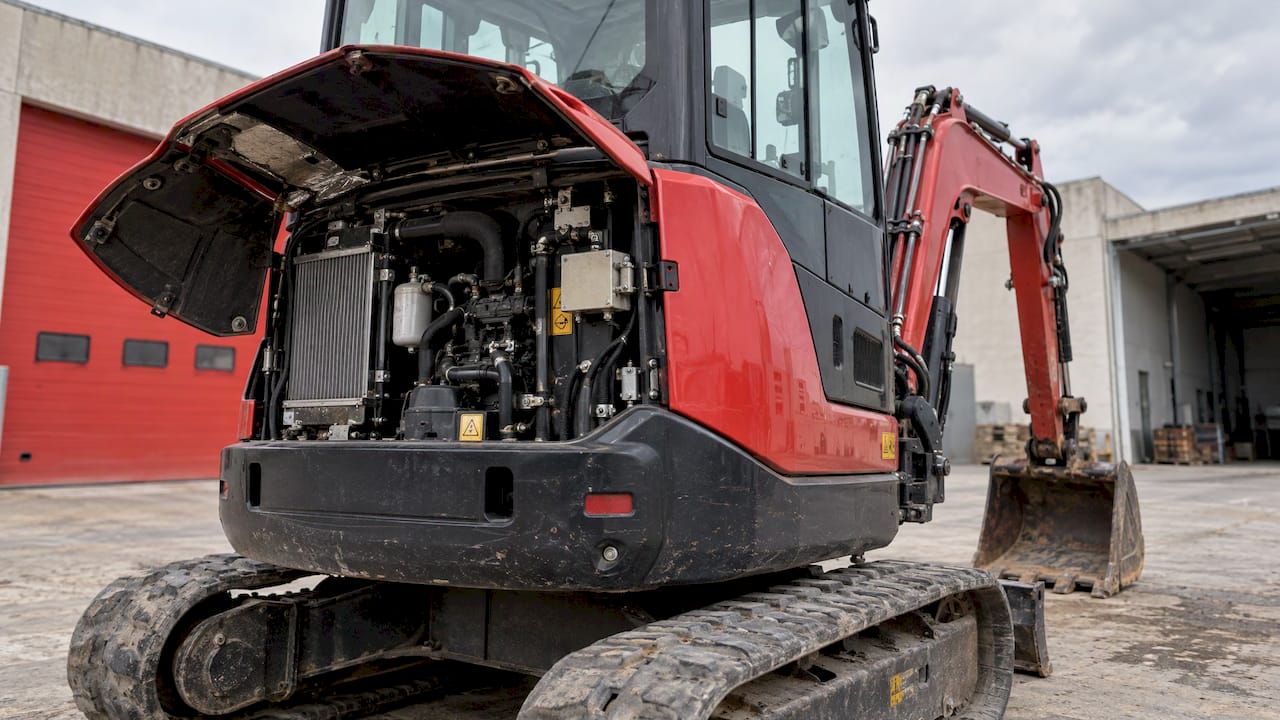
Construction and compact equipment. Yanmar engines power excavators, skid steers and compact loaders, and the same engine is often fitted to several machine models with different mounting and cooling arrangements. Give the machine model and the engine model together.
Agriculture. Tractors and implements carry engines that may have been repowered or modified over years of service. Confirm the plate on the engine itself and check its serial number against the catalog before ordering.
Marine. Raw-water pumps, impellers, heat exchangers and exhaust elbows are specific to marine variants and often to the transmission or drive attached. State whether the engine drives a shaft or a saildrive.
Power generation. Gensets run for long hours at steady load, so service parts such as filters, belts and injectors need to meet the original specification. Record running hours alongside the order.
Material handling. Forklift engines are built for frequent starts and stops, and the application listing matters for governors, filters and cooling parts.
Promo: sourcing the matched part
Once the part number is confirmed, the remaining task is getting that part quickly. Iberspares supplies spare parts for Yanmar and Sensei engines and equipment across construction and industry, agriculture, marine, power and generators, material handling and compact equipment. We focus on application-specific components and hold extensive in-stock inventory for rapid dispatch, so that routine service parts and emergency repairs both reach you without long waits.
Send the engine model, the serial number and the part number you have, and browse the range at Genuine Yanmar and Sensei Parts.
Perspective
Cross referencing is a discipline more than a lookup. The number is the end of the process, not the start. What we have built our approach on is knowing the applications: which engine goes into which machine, how the same base engine is configured for a boat, a generator or a compact loader, and which parts follow from that.
That is why we ask for the model and serial number first. It lets us match the part to the engine in front of you, rather than to a number that happens to look similar. For a workshop with a machine waiting, a confirmed match on the first order is worth more than any saving on a part that has to be sent back.
We keep stock of Yanmar and Sensei parts for the sectors our customers work in, so that when the match is confirmed the part can leave quickly. Our aim is simple: the right part, identified correctly, delivered while the machine still has work to do.
Duarte
Keeping a cross-reference record
For workshops, rental companies and maintenance teams, the value of a verified match grows when it is written down. A simple record for each engine saves repeated research:
- Engine model and serial number
- Machine, location or vessel the engine belongs to
- Part name, catalog number and any superseding number
- Date fitted and running hours or service interval
- Notes on anything that differed from the catalog, with photos
Fleet operators and multi-brand service providers benefit most. When a machine returns, the record turns a long identification exercise into a quick reorder. It also shows when a part was substituted, so the next technician knows the starting point.
FAQ
Can I use a part number from another brand’s cross-reference table?
Treat it as a lead, not a confirmation. Take the number back to the parts catalog for your engine model and serial range and check that the application matches. Compare the specification as well, because a shared number does not guarantee identical performance.
What does it mean when a Yanmar part number is superseded?
It means Yanmar replaced the old number with a newer one, usually after a design or supplier change. Following a supersession from the old number to the new one is the safe direction. The reverse is not guaranteed, because an older part may not match the new one in every condition.
What do I need to send when ordering a Yanmar part?
Send the engine model, the engine serial number, the name and number of the part, and a photo of the old part and plate if you can. Yanmar’s own catalog instructs buyers to record the model and serial number together with the part name and number, and that is the information a supplier needs to confirm the match.
Does the same part fit every machine with the same Yanmar engine?
Not always. The same base engine may be fitted to different machines or built for marine, generator or industrial use, each with its own mounting, cooling and accessory parts. Give the application along with the engine data so the correct variant is selected.
Sources
- Yanmar parts catalog 3TNV84T-GKM, 0CV10-M95900EN
- Huggins Cross Reference help
- Yanmar to universal skid loader listings
Content strategy and optimisation for Google and AI-powered search platforms by Velveteen SaaS — specialists in online visibility and customer acquisition.