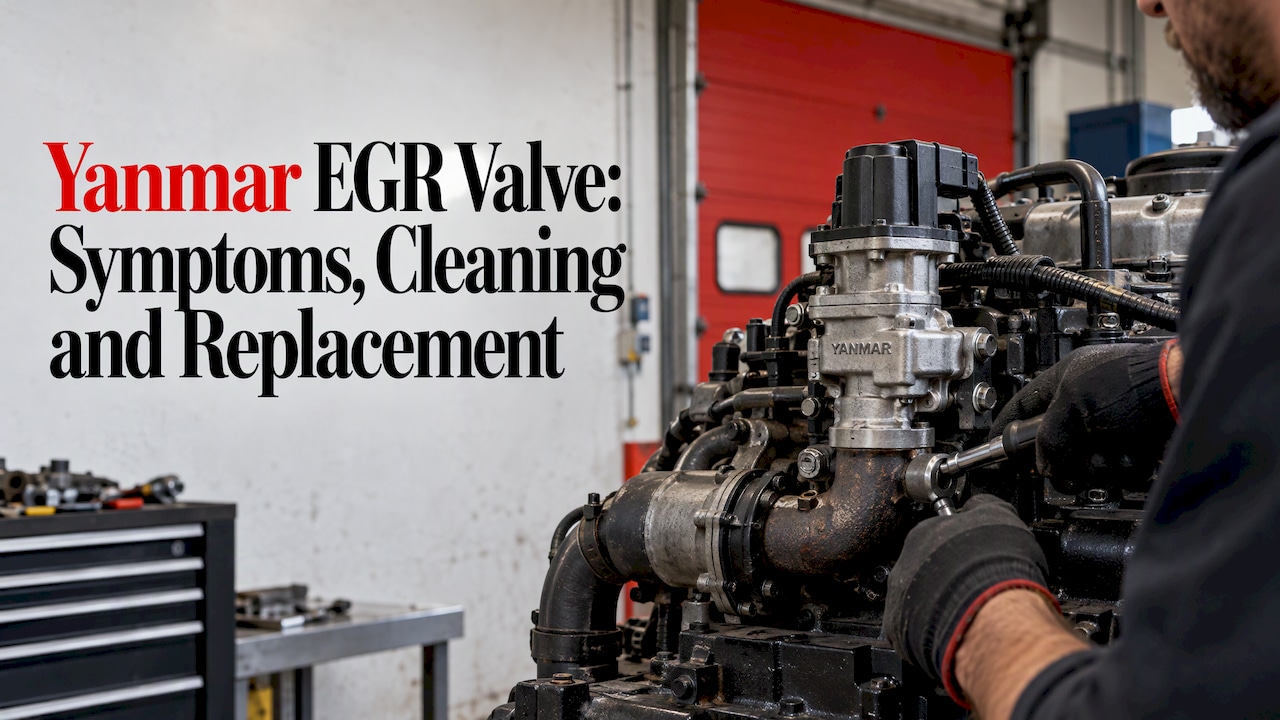
A Yanmar EGR valve meters cooled or hot exhaust gas back into the intake so the engine meets its NOx limits. When it sticks or clogs with carbon, you see black smoke, rough running or fault lights. The fix is to confirm the cause, clean the valve if the manual allows it, and replace the whole assembly when deposits will not come off. Ordering the right assembly for your exact engine and application is where most delays start, and it is the part we handle at Iberspares, where Yanmar and Sensei parts are our focus.
This guide is written for workshops, fleet and maintenance teams, rental companies, marine and generator service providers and farm operators who keep Yanmar engines running.
TL;DR
- The EGR valve electronically controls how much exhaust gas returns to the intake, lowering combustion temperature and NOx on Tier 4 and Stage IV/V era engines.
- Yanmar’s own troubleshooting guide lists a faulty EGR valve as a probable cause of black exhaust smoke, so check it early on a smoking TNV.
- The 3TNV88C service manual calls for cleaning every 3,000 hours with low-pressure air and a soft brush; if carbon will not come off, replace the whole valve assembly.
- Not every Yanmar has the same system: some models have no EGR, some use hot EGR and common-rail models use cooled EGR with a DPF, so match the part to the engine, not just the family.
- Do not delete or disconnect the valve: it can trigger faults, affect engine performance and run against emissions law.
Table of Contents
- What the EGR valve does on a Yanmar engine
- Symptoms of a failing Yanmar EGR valve
- Can you clean a Yanmar EGR valve, and when must you replace it?
- How to identify the correct replacement valve
- Running without an EGR valve: emissions and engine risks
- Planning EGR service across a fleet
- Where to buy Yanmar EGR valves for your application
- Our view: the part is half the repair
- FAQ
- Sources
What the EGR valve does on a Yanmar engine
Exhaust gas recirculation (EGR) sends a controlled portion of exhaust back into the air intake. That lowers the oxygen concentration and the combustion temperature, and NOx forms mostly at high temperature. Yanmar’s European diesel catalogue describes cooled EGR this way: an EGR cooler lowers the gas temperature, and the EGR valve electronically controls the volume flow.
The valve is not a simple on/off device. On common-rail TNV engines it is commanded by the electronic control unit, which varies flow with load and conditions. Yanmar’s 2015 Technical Review explains that the control restricts the EGR ratio when the diesel particulate filter (DPF, the filter that traps soot) is loading with particulate matter, because too much EGR raises soot and clogs the filter faster. It does the same at high altitude, where atmospheric pressure is low.
Which Yanmar engines use one
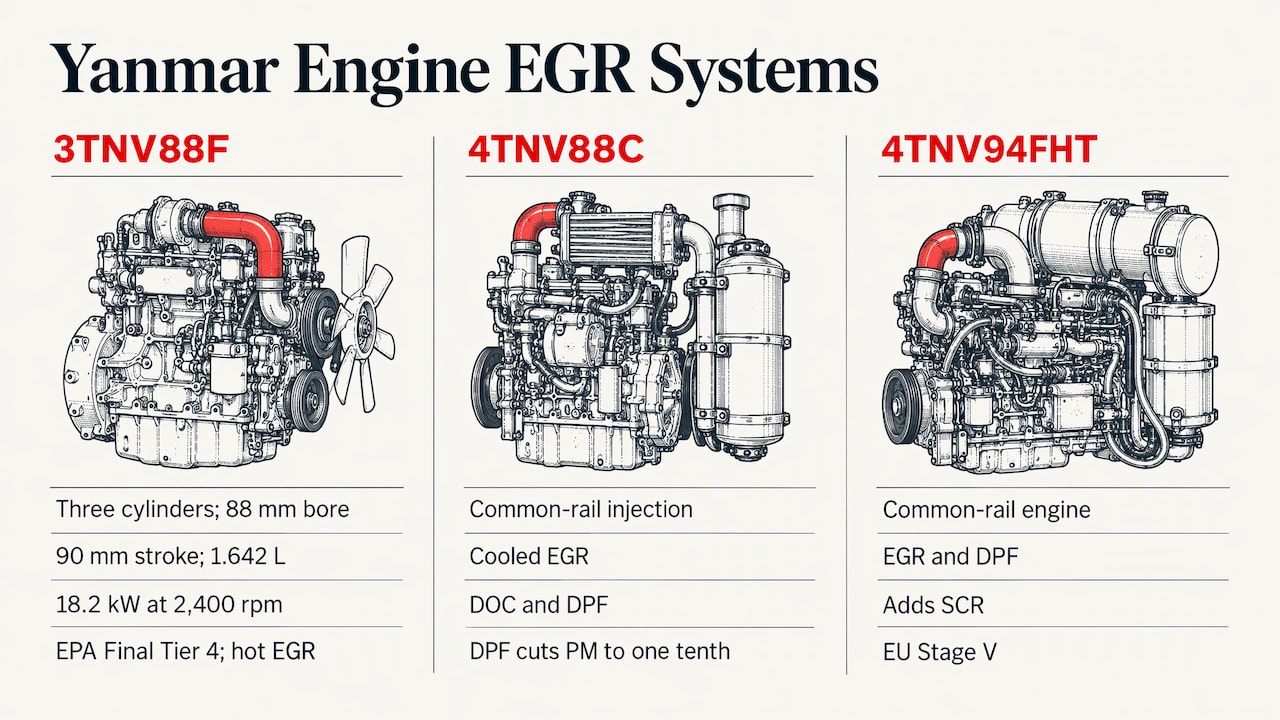
Not all of them. Yanmar’s catalogue spec tables show some models with the EGR system marked N/A, a 3TNV88 variant with hot EGR and common-rail models with cooled EGR plus DOC and DPF aftertreatment. The 3TNV88F is listed as an EPA Final Tier 4 engine with a hot EGR system: three cylinders, 88 mm bore, 90 mm stroke, 1.642 L displacement and 18.2 kW (24.4 hp) maximum output at 2,400 rpm.
The path to Tier 4 explains why. In the same Technical Review, the Tier 3 4TNV88-B exceeded Tier 4 limits for NOx plus NMHC and for PM. Adding common-rail injection and cooled EGR in the 4TNV88C cut NOx plus NMHC without raising PM, and the DPF then reduced PM to one tenth of the previous level. Larger engines go further: Yanmar’s 4TNV94FHT announcement describes a common-rail engine with EGR and DPF that adds SCR for EU Stage V.
The practical point: the EGR valve on a hot-EGR 3TNV88F, a cooled-EGR 4TNV88C and a 4TNV98 common-rail engine are different assemblies. Treat them that way when you order.
Symptoms of a failing Yanmar EGR valve
A valve can fail mechanically (stuck with carbon), electrically (motor, position feedback, connector) or by restriction in the passages behind it. What you notice depends on where it sticks.
- Black exhaust smoke. Yanmar’s TNV Series Electronic Control Troubleshooting Guide lists a faulty EGR valve among the probable causes of black smoke.
- Warning lamp or fault code. The same guide covers electronic control faults and tells operators to stop the engine immediately if any indicator illuminates during operation.
- Clicking or heat from the valve. In one excavator case on a 3TNV88F-ESSY the symptom discussed online was a clicking, hot valve, which points to a stuck or electrically faulty unit. Treat that as a clue, not a diagnosis.
- Rough idle, loss of power, more frequent DPF regeneration. Because the control strategy ties EGR to DPF loading, a valve that cannot deliver commanded flow can show up as aftertreatment complaints as well.
The guide directs owners to an authorized Yanmar industrial dealer or distributor for repair of the EGR valve itself. For workshops that service many engines, that means the diagnosis is yours and the parts supply has to be quick and correct.
Confirm the cause before you replace
A healthy-looking valve is not proof of a healthy system. A diagnostic article points out that soot and breather oil vapor can build deposits, and that a valve can be electrically fine yet unable to reach commanded flow because the passage behind it is restricted. It also warns that simply unplugging the valve to see what happens is not a reliable test: it usually stores extra fault codes and can push the ECU into a substitute strategy.
A sensible order of work:
- Read the fault codes with the correct Yanmar diagnostic tool and note them before clearing anything.
- Inspect the connector, wiring and the valve’s position feedback.
- Inspect the EGR pipe, cooler and intake side for carbon and oil residue.
- Only then decide: clean, replace the valve or address the passages.
If you replace a valve and leave a blocked pipe or cooler behind it, the new part meets the same restriction.
Can you clean a Yanmar EGR valve, and when must you replace it?
Yes, within limits set by the manufacturer. The Yanmar 3TNV88C service manual (page 169) instructs cleaning the EGR valve every 3,000 hours of operation to prevent carbon deposits that degrade EGR performance. It specifies compressed air at 0.19 MPa (2 kg/cm²) or less and says that if carbon cannot be removed with a brush, the entire EGR valve assembly must be replaced.
The same page lists what not to do:
- Do not disassemble the EGR valve.
- Do not use wash fluid or a hard metal brush.
- Do not expose the motor and coupler terminals to solvent or cleaner.
A worked example: a 3TNV88C in a compact loader reaches 3,000 hours. You remove the valve, blow it out with air held under 0.19 MPa and brush the carbon with a soft brush, keeping solvent away from the motor and connector. If the flap still sits in a crust of carbon, you do not keep working it. You fit a new assembly.
For engines with a cooled system, a service document for Yanmar common-rail generator sets from Trane Technologies describes removing the EGR pipe between cooler and valve, inspecting and cleaning it for carbon, and reinstalling it with new gaskets only. It requires safety glasses, rubber gloves and a respirator for the cleaning, and refers readers to a service bulletin for maintenance intervals. Order the gaskets with the valve so the job does not stall on a reused seal.
How to identify the correct replacement valve
This is where most wrong orders happen. “Yanmar EGR valve” covers several assemblies that look alike and are not interchangeable. Work through these checks before you order.
- Read the engine nameplate. Record the full model (for example 4TNV98 or 3TNV88F, including suffix) and the serial number. The model tells you cylinder count and bore; the suffix and emissions family tell you which aftertreatment and EGR layout it has.
- Establish the EGR type. Hot EGR, cooled EGR and no EGR are all used across the range. The catalogue’s spec tables show this model by model, so confirm yours rather than assuming it from the family.
- Note the application. The same engine family sits in excavators, generator sets, tractors and marine installations. Yanmar’s TNV application manual says the EGR valve must go through an installation assessment as specified by Yanmar to confirm it suits the intended machine, and that the valve motor must not be exposed to ambient temperatures above 80°C. If the application changed an installation detail, say so when you ask for the part.
- Copy the part number from the old valve. Use the number on the label or casting, and check it against the engine serial. Do not rely on a photo match: connectors, arms and cables vary.
- Order the small parts with it. Gaskets, bolts and any connector or sensor your fault tracing pointed to.
If any step is uncertain, resolve it before payment. A wrong valve costs more in machine downtime than in the part price. This is the step we take off your hands: send us the engine model, serial number and application, and our team identifies the correct part from our Yanmar application knowledge, which is how we aim to cut errors and delays.
Why not just fit any valve that bolts on
The electronic control expects a particular valve response. Yanmar’s application manual notes that intended engine performance is not assured when the electronic control unit operates in a failure condition. A valve with the wrong characteristics can put the engine in exactly that condition, with fault codes, restricted EGR strategy and extra DPF loading as the result.
Running without an EGR valve: emissions and engine risks
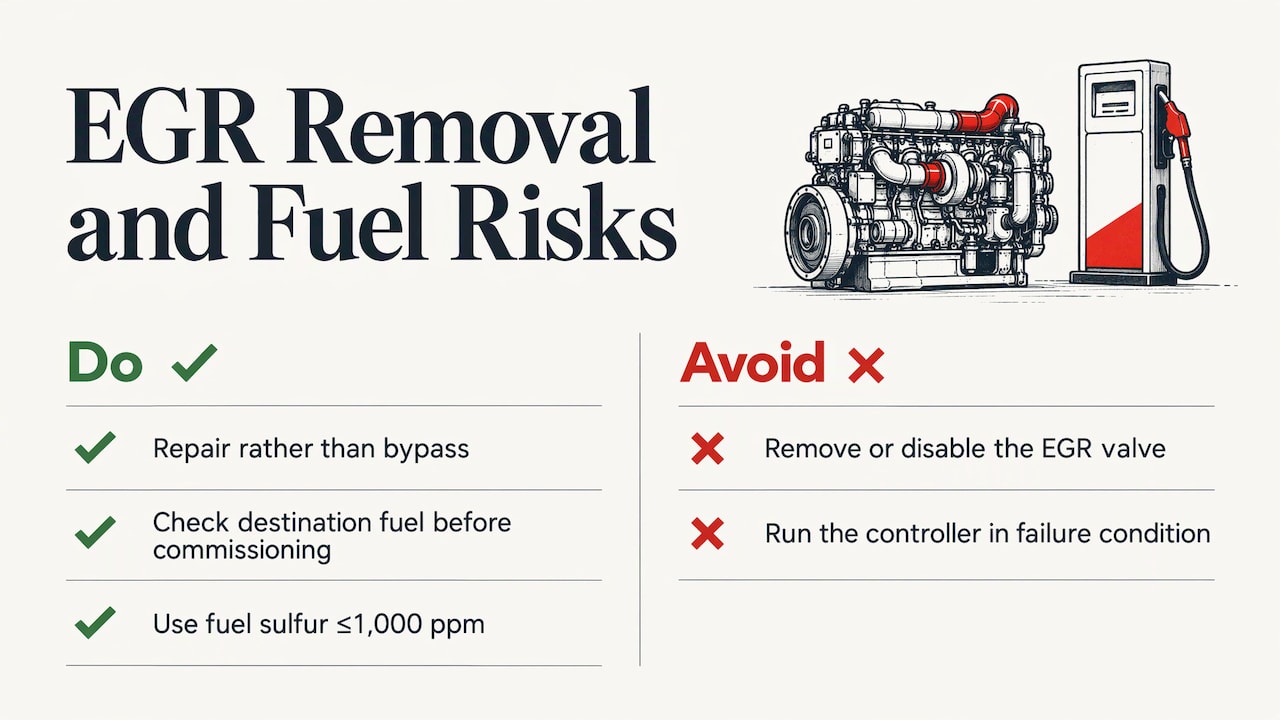
It is tempting on a stubborn machine to disconnect or remove the valve. Do not. Yanmar’s TNV application manual warns that a customer’s removal of sensors or actuators may be deemed an infringement of exhaust-emission-control laws, and that intended performance is not assured if the controller runs in a failure condition.
In the United States, the Clean Air Act prohibits removing or disabling emission control devices including EGR on street-legal vehicles, and similar rules exist in Canada, the EU and Australia. That source also notes that unplugging the connector triggers immediate fault codes and that a deleted EGR on a turbo diesel can raise exhaust temperatures and risk turbo damage. Treat that as a reason to repair, not to bypass.
Fuel matters too. A Yanmar 3TNM74F-NHGE specification sheet warns that engines with an EGR valve can suffer cylinder liner corrosion with high-sulfur fuel and should be sold and used only where fuel sulfur is limited to 1,000 ppm or less. It lists Japan, the USA, the EU, Australia, New Zealand, Israel and Turkey as confirmed areas. If you service engines that travel or are exported, confirm fuel quality in the destination before commissioning.
Planning EGR service across a fleet
For rental companies, farm operators and maintenance contractors, the EGR valve is a scheduled item, not a surprise.
- Track hours. Log each engine’s hours against the 3,000-hour cleaning point in the service manual for your model and book the valve inspection with a routine service.
- Keep a model and serial register. When a fault appears, you can order from a list instead of reading a nameplate in a muddy field or an engine room.
- Stock for the engines you run most. Valves, gaskets and bolts for your most common model are the cheapest insurance against a machine sitting idle.
- Watch the surrounding system. Breather oil vapor, a restricted cooler or a loaded DPF all affect how the valve behaves, so a repeat failure usually points beyond the valve.
- Mind safety. Let the engine cool, wear the protective equipment the service literature requires for cleaning, and stop the engine at once if an indicator lights during operation.
Where to buy Yanmar EGR valves for your application
We are Iberspares, an online supplier of spare parts for Yanmar and Sensei engines and equipment. Our catalog covers construction and industry, agriculture, marine, power and generators, material handling and compact equipment, so the same shop serves a loader fleet, a vessel and a standby generator.
What we put behind an order: deep technical knowledge of Yanmar and Sensei applications, efficient identification of the correct part and an extensive in-stock inventory for rapid dispatch, aimed at shortening downtime. Browse the Yanmar parts range or place your order from the Iberspares store, with your engine model and serial number to hand.

Our view: the part is half the repair
Most EGR complaints we hear about are not really about the valve. They are about time: the machine is down, the diagnosis is done, and the wrong part arrives or takes too long to find.
That is why we built our approach around application knowledge. A Yanmar engine is not one product. The same family can carry hot EGR, cooled EGR or none, and the machine around it changes the installation. We think the right question is never just “do you have an EGR valve” but “which engine, which serial number, which machine”.
We would rather identify the part correctly once than ship two. Our aim is to keep a deep in-stock range for rapid dispatch so a routine service and an emergency repair both start from the right assembly.
Clean on schedule, follow the manual, replace the assembly when the carbon will not come off, and never bypass the emission system. Do that, and the valve is a planned cost instead of a breakdown.
Duarte
FAQ
Can a diesel run without an EGR valve?
Most EGR complaints we hear about are not really about the valve. They are about time: the machine is down, the diagnosis is done, and the wrong part arrives or takes too long to find.
That is why we built our approach around application knowledge. A Yanmar engine is not one product. The same family can carry hot EGR, cooled EGR or none, and the machine around it changes the installation. We think the right question is never just “do you have an EGR valve” but “which engine, which serial number, which machine”.
We would rather identify the part correctly once than ship two. Our aim is to keep a deep in-stock range for rapid dispatch so a routine service and an emergency repair both start from the right assembly.
Clean on schedule, follow the manual, replace the assembly when the carbon will not come off, and never bypass the emission system. Do that, and the valve is a planned cost instead of a breakdown.
Duarte
Can a diesel run without an EGR valve?
Physically it may run, but on a Yanmar TNV it should not be operated that way. Yanmar warns that removing sensors or actuators may infringe emission-control laws and that intended performance is not assured when the controller is in a failure condition. Repair or replace the valve instead.
Can I clean my Yanmar EGR valve without removing it?
The 3TNV88C service manual describes cleaning the valve as a removed-component procedure with low-pressure air and a soft brush, and forbids disassembly, wash fluid and hard metal brushes. If carbon cannot be brushed off, the manual calls for replacing the entire assembly.
What are the symptoms of a bad EGR valve on a Yanmar?
Black exhaust smoke is the one Yanmar’s TNV troubleshooting guide names, alongside warning indicators and fault codes. Rough running and extra DPF regeneration can follow. Confirm with fault codes and a check of the passages and cooler before replacing anything.
How often should the EGR valve be cleaned?
For the 3TNV88C, the service manual says every 3,000 hours of operation. Intervals differ by model and application, so check the manual for your engine and the relevant service bulletin for generator sets.
Sources
- Yanmar Technical Review 2015: Tier 4 TNV engines
- Yanmar water-cooled diesel engines 5-155 kW catalogue
- Yanmar 3TNV88F product page
- Yanmar 4TNV94FHT announcement
- Yanmar TNV Series Electronic Control Troubleshooting Guide
- EGR valve testing before you replace parts
- Yanmar 3TNV88C service manual, cleaning the EGR valves
- EGR system service literature for Yanmar generator sets
- Yanmar 3TNM74F-NHGE specification sheet
- Can the EGR valve be disabled or deleted?
Content strategy and optimisation for Google and AI-powered search platforms by Velveteen SaaS — specialists in online visibility and customer acquisition.