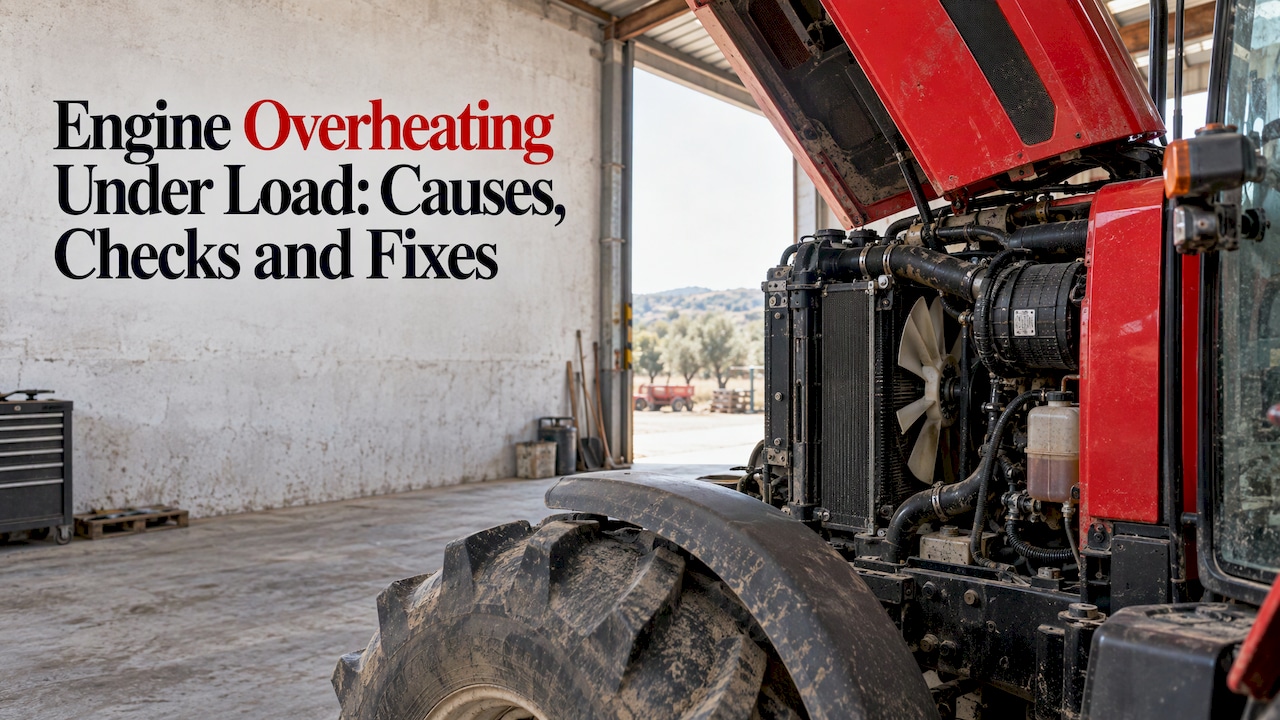
An engine that sits at a normal temperature at idle and climbs toward the red only when it works hard does not have a mystery fault. Its cooling system is marginal, and load is the first thing that exposes it. The restriction, weak pump, slipping fan or fouled heat exchanger was already there. Work through the circuit in order, change one component at a time, and match each replacement to the exact engine and application. That is how you stop the repeat breakdown, and it is where correct part identification saves the most downtime.
This guide is written for people who keep diesel engines working: workshops, fleet and rental maintenance teams, farm operators, marine engineers and generator technicians.
TL;DR
- Heat rejection requirement rises with power output, so a cooling system that copes at idle can fail at full load. Overheating only under load points to a flow or heat-transfer restriction, a weak pump, a fan problem, or a load that does not match the engine’s rating.
- Take the load off first. Never open a hot radiator or expansion cap: pressurized coolant can scald.
- Check in order: coolant level and leaks, radiator fins and core, belts and fan, hoses, cap pressure, thermostat, then water pump. Change one thing at a time so the evidence stays intact.
- Marine and generator engines add raw-water and heat-exchanger items to the list: strainers, impellers, sea cocks and tube stacks.
- Order parts against the engine’s serial and application data. A wrong thermostat, cap or impeller sends you back to the same fault.
Table of Contents
- Why an engine overheats under load but not at idle
- What to do the moment it starts
- A diagnosis order that saves parts and time
- Oil, load and operating conditions
- Marine and generator engines: extra checks
- Prevention: keep the margin the engine was built with
- Why the right part matters as much as the right diagnosis
- Promo
- Perspective
- FAQ
- Sources
Why an engine overheats under load but not at idle
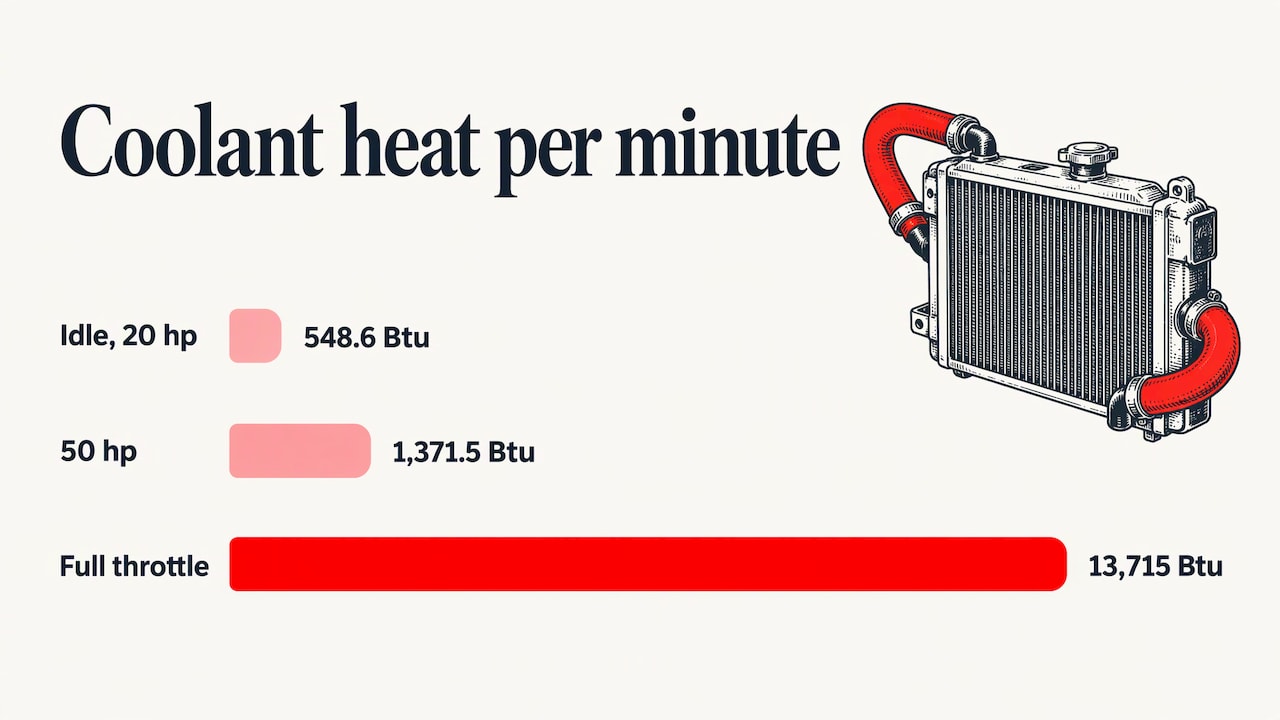
Heat output follows power. Automotive writer Ray Bohacz works through the numbers in Hemmings: a 500-hp engine rejects about 548.6 Btu per minute to the coolant at 20 hp of idle power, about 1,371.5 Btu per minute at 50 hp, and 13,715 Btu per minute at full throttle. That is a 25-fold jump. A radiator, pump and fan that are partly degraded can handle the idle figure with ease and have no margin at the full-load figure.
Bohacz’s conclusion is worth keeping on the workshop wall: an engine that runs hot below full load has a mechanical problem or mismatched parts. A healthy, correctly specified cooling system should hold temperature at the engine’s rated output.
The same logic applies to off-road duty. A loader digging all day, a tractor on a long baling run, a generator carrying a full load bank and a boat at cruising rpm all sit at high heat input for hours. There is no light-load phase in which the coolant, oil and metal can shed heat. Under that kind of continuous duty, any shortfall in the cooling system shows up sooner and stays there.
What the symptoms tell you
The pattern of when it overheats narrows the search before you open anything:
| Pattern | What it usually points to |
|---|---|
| Overheats only at idle or at low speed, cools when moving | Fan, shroud or airflow problem |
| Overheats only under heavy load or sustained high rpm | Partly restricted radiator or heat exchanger, weak water pump, belt slip, or overload |
| Rapid rise soon after start-up | Thermostat stuck closed, low coolant, or air in the system |
| Steady coolant loss with no visible leak | Head gasket or internal leak |
| Overheats only above a defined load threshold | Fuel, timing or air-supply issue, or an engine rated below the job |
The first two rows and the last follow the diagnostic pattern described by MechanicRank, which also notes that a worn pump impeller can cavitate at high rpm and that a lower hose can collapse under pump suction. Treat the table as a starting point, not a verdict.
What to do the moment it starts
Safety comes before diagnosis. The steps below come from operator manuals.
- Reduce load. A U.S. Army technical manual for construction equipment tells operators to ease off the throttle or shift to a lower gear, or both, when overheating begins, and to shut the engine off if the temperature does not return to normal. Scania’s operator manual for its D11 engines gives the same instruction: reduce load, and if the temperature does not fall, stop the engine and look for the fault.
- Do not shut down from full load straight away if you can avoid it. The same Army manual advises idling for three to five minutes after full-load operation before shutdown, so heat can leave the engine evenly.
- Do not open a hot cap. Mazda’s owner’s manual warns that scalding coolant and steam can shoot out under pressure if either cooling-system cap is removed while hot. It also says to confirm the fan is not running before working near it. These are road-vehicle instructions, but the physics is identical on a diesel excavator or a marine engine.
- Note what you saw. Write down the load, rpm, ambient temperature, gauge reading and any warning code. This is the evidence you will diagnose from.
One caution on gauges. A cooling system can have local hot spots where coolant boils against the metal. Steam insulates, so local cooling collapses while the dashboard gauge may still read normal, as TAVEA’s heat-management article explains. If you have repeated overheating with a normal-looking gauge history, check the sensor and the coolant condition as well as the circuit.
A diagnosis order that saves parts and time
The most expensive mistake is replacing several components at once. It may clear the symptom, but you never learn which part was at fault, and the real cause can come back. Work from the cheapest, most common faults to the least.
1. Coolant level, leaks and cap
Low coolant is the most common cause. The Army troubleshooting procedure for tracked equipment starts the same way: inspect the radiator fins for dirt, debris and damage, clear the debris, straighten bent fins or replace the radiator, and check the coolant level, topping up as required.
With the engine cold, check the level, then look at hoses, clamps, the water pump weep hole, the radiator seams and the cap. A cap that no longer holds its rated pressure lowers the boiling point of the coolant and lets it vent early. Match any replacement to the pressure rating for your engine, not to whichever cap fits the neck.
2. Radiator or heat exchanger, airflow and fins
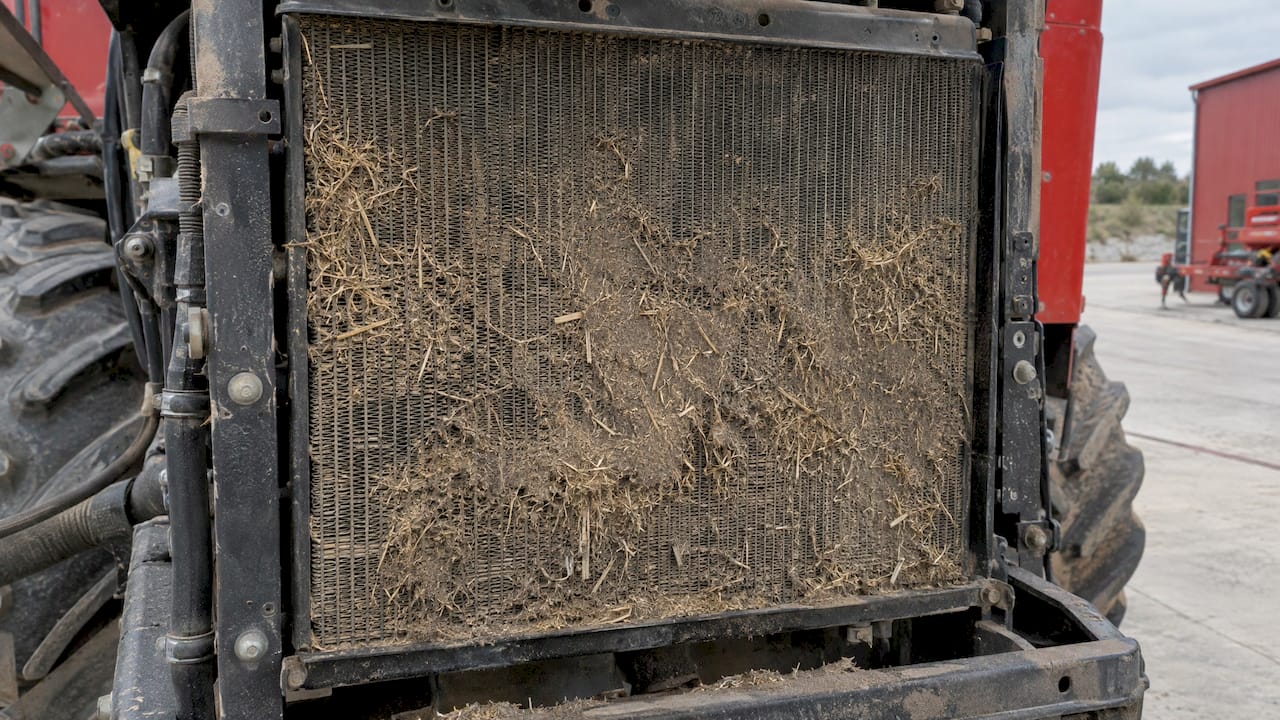
A partly clogged core often shows up only under heavy load. Look for chaff, dust, oil film and packed mud between fins on farm and construction machines. Blow from the engine side outward. In dusty work, the radiator may need cleaning during the shift, not just at service time.
Check the shroud too. A missing or loose shroud lets the fan draw air from the wrong place and cuts the airflow through the core.
3. Belts, fan and fan clutch
A slipping belt reduces water pump and fan speed exactly when you need them. It slips more under load, which is why it can pass an idle check. Check tension, glazing and cracks. On clutch-driven fans, confirm that the fan locks up when it should. A weak clutch can mimic a radiator or pump fault, so confirm fan engagement before you condemn other parts, as the specialists at Diesel Diagnostic and Repair point out.
4. Thermostat
A thermostat stuck closed usually shows up fast: the upper hose gets hot, the lower hose stays cool, and the temperature rises soon after start. A thermostat that is only sluggish is harder to catch. Check its opening temperature against the engine manual, not against a general figure. Different engines use different ratings, and the wrong one will either run the engine too cool or too hot.
5. Water pump
Bohacz notes that a centrifugal pump driven faster than its design speed actually loses flow, and that cavitation is a high-load failure. A worn impeller or bearing can reduce circulation with no puddle under the machine. If belts, fan, core and thermostat all check out and the engine still overheats only under load, the pump moves to the top of the list.
6. Head gasket and combustion side
Steady coolant loss with no external leak, milky oil or bubbles in the coolant point to a head gasket or other internal leak. Treat that as a workshop job, not a roadside fix.
If the cooling circuit is sound, look at what is producing the heat. Excess fuel delivery, incorrect injection timing, worn injector spray patterns and restricted intake air all raise combustion temperatures. The engineering firm SFRM advises comparing actual load, speed, boost pressure, exhaust temperature and fuel consumption against the manufacturer’s operating data when temperature climbs only above a certain load.
Oil, load and operating conditions
Oil carries part of the heat away. One fire-investigation guide lists low or degraded oil as behind 8 to 10 percent of overheating cases and excessive load behind 5 to 7 percent. Check the oil level and condition as part of the same inspection, because both problems often sit together.
Then ask whether the engine is being asked to do too much. Africa Automotive News notes that towing, heavy cargo and climbing force more intense combustion and can overwhelm a cooling system not calibrated for it. In the field this looks like:
- A tractor lugging in too high a gear while mowing or baling. Drop a gear and keep revs up so the fan and pump turn faster.
- A generator carrying more than its continuous rating.
- A propulsion engine with a propeller that loads it beyond rated rpm.
- A pump drive whose process resistance has crept up as the system fouled.
In each case, check against the manufacturer’s rated output and operating data before you replace anything.
Marine and generator engines: extra checks
On raw-water-cooled marine engines, a good deal of the circuit is outside the engine block. Check the sea cock is fully open, clean the raw-water strainer, inspect the pump impeller for missing vanes or cracks, and look at the heat exchanger for fouling or a blocked tube bundle. Any of these can cut cooling with no leak to see. On a closed-circuit engine, the coolant side has its own thermostat and pressure cap, so the checks above still apply.
On generators, ask when the problem appears. A standby set that overheats only during a load-bank test is a different case from one that overheats on its first hour of real duty. Ventilation, room temperature and exhaust restriction around the enclosure matter as much as the radiator. Sustained load is where a generator’s cooling margin is used up.
Prevention: keep the margin the engine was built with
The aim is to keep the cooling system at its original capacity, because a rated engine has no spare margin to give away.
- Clean the core on a schedule that matches the dust. Daily in harvest or demolition, weekly elsewhere.
- Replace coolant on the engine maker’s interval, and use the type it specifies. Aged coolant protects less against corrosion and scale that restrict the core.
- Replace belts, hoses, thermostat, cap and impeller as service items, not only when they fail. A hose that looks fine can collapse under pump suction at high rpm.
- Treat the gauge as a warning, not a measurement of every part of the engine. Log temperature under load so you can see a trend before it becomes a stop.
- Idle down before shutdown after hard work, as the Army manual advises.
- Keep a small kit of the wear parts that fail under load for each engine type you service: thermostat, cap, belts, impeller and hoses.
Why the right part matters as much as the right diagnosis
Cooling parts look alike and are not. A thermostat with the wrong opening range, a cap with the wrong pressure rating, an impeller for a different pump housing or a belt a few millimeters off can leave you with the original fault and a second one. For Yanmar and Sensei engines in construction, agriculture, marine, generator, material handling and compact equipment, the part is tied to the engine model and the way it is used.
Promo
When the diagnosis points to a part, the job is to get the right one fast. Iberspares supplies spare parts for Yanmar and Sensei engines and equipment across construction and industry, agriculture, marine, power and generators, material handling and compact equipment. Our focus is on application-specific components, and we keep a broad stock for rapid dispatch, so a down machine does not sit waiting on the wrong part. Browse the categories at Iberspares genuine Yanmar and Sensei parts.

Have your engine model and serial number to hand when you order, so the part can be identified correctly the first time.
Perspective
Overheating under load is rarely one dramatic failure. It is a system that lost a few percent of its capacity in several places, and the first heavy day adds them up.
What we see in the way Yanmar and Sensei engines are specified is that the application decides the part. The same engine family can sit in a compact excavator, a generator set or a workboat, and each asks something different of the cooling circuit. That is why we focus on application-specific components and on identifying the correct part efficiently: a wrong thermostat or cap costs more in lost hours than the part costs on the shelf.
Our advice is the one in this article. Take the load off, find the restriction, change one thing at a time, and put back a part that matches the engine. We hold stock for rapid dispatch so the repair takes the time of the repair, not the time of the search.
Duarte
FAQ
Why does my engine overheat under load but run fine at idle?
Heat output rises sharply with power, so the cooling system has to reject many times more heat under load. A marginal part, such as a partly blocked radiator, a weak pump or a slipping belt, can cope at idle and fail at work. Check those first.
Can low oil cause an engine to overheat?
Yes. Oil carries friction heat away from moving parts, so low or degraded oil raises operating temperature. Check level and condition alongside the coolant, and change the oil on the engine maker’s schedule.
How do I tell a stuck thermostat from a clogged radiator?
With a stuck-closed thermostat the upper hose is hot and the lower hose stays cool, and temperature rises quickly after start. A clogged radiator tends to show only under heavy load, with a large temperature difference between inlet and outlet hoses. Compare readings against your engine manual.
Is it safe to keep working when the temperature climbs?
No. Reduce load or shift down right away, and shut the engine off if the temperature does not recover. Let it cool before you touch the cap: scalding coolant can spray under pressure.
Sources
- U.S. Army TM 5-3810-307-24, Operating the Engine
- U.S. Army TM 5-2410-240-23-1, Engine Troubleshooting Procedures
- Scania Operator’s Manual D11 DC11 DI11
- Mazda 2024 CX-90 owner’s manual, Overheating
- Hemmings, Systems (Ray Bohacz)
- TAVEA, Heat management under load
- MechanicRank, Cooling
- Diesel Diagnostic and Repair, overheating under load
- Blazestack, Engine overheating causes
- Africa Automotive News, What affects your engine temperature
Content strategy and optimisation for Google and AI-powered search platforms by Velveteen SaaS — specialists in online visibility and customer acquisition.