
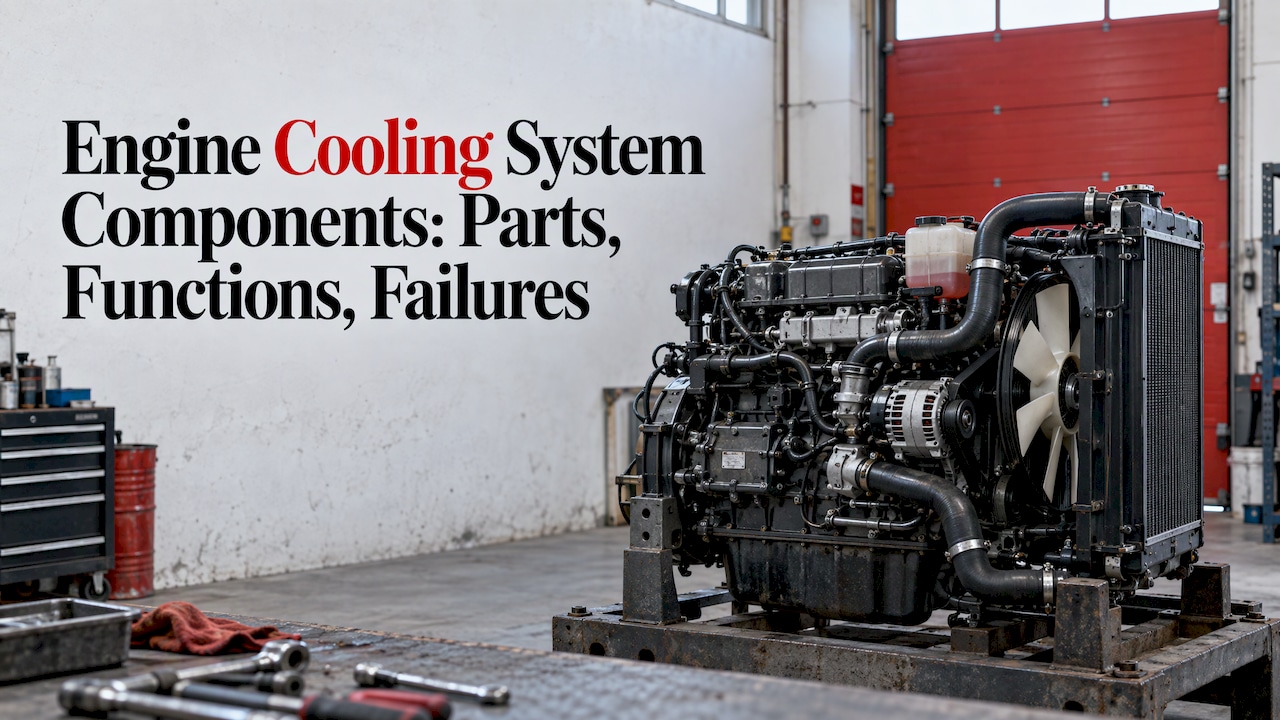
A liquid-cooled diesel engine depends on a short list of parts: radiator or heat exchanger, water pump, thermostat, hoses, fan, pressure cap, expansion tank and the coolant itself. When one fails, the engine overheats, and in a workshop, on a job site or on a boat that means downtime. The fastest way to get the machine back is to name the failed component, then order the exact part for that engine and application. We supply Yanmar and Sensei parts, and the sections below are written for the people who keep those engines running.
TL;DR
- A basic liquid-cooled system has a radiator, pump, hoses, fan and shroud, thermostat, and coolant passages in the block and head, according to U.S. Navy training material.
- Marine engines usually swap the radiator for a heat exchanger and a raw-water circuit, which adds an impeller pump and exhaust parts that corrode.
- Coolant that “disappears” is often leaving through a small external leak that evaporates, a cap that vents, or an internal leak. It is rarely a mystery.
- Never open a hot cap. Stop the engine if you see steam or a leak.
- Order by engine model and application, not by how a part looks. That is where wrong-part delays start.
Table of Contents
- What the cooling system does
- The main components, what each does and how it fails
- Marine cooling: the heat exchanger and raw-water circuit
- Air-cooled engines
- Why coolant seems to disappear
- Safe checks when the system misbehaves
- Maintenance that prevents failure
- Ordering the right cooling parts
- Perspective
- Where to find Yanmar and Sensei cooling parts
- FAQ
- Sources
What the cooling system does
Liquid cooling removes unwanted heat, regulates engine temperature and helps the engine warm quickly after starting, as the U.S. Navy publication on engine cooling systems puts it. A diesel under load throws off a lot of heat. Coolant picks it up inside the block and head, then carries it to a place where it can be released: a radiator in air, or a heat exchanger in water.
Two ideas explain most failures:
- Heat has to be moved and then rejected. Pump, passages and hoses move it. The radiator or exchanger rejects it. A fault in either half overheats the engine.
- The thermostat sets the temperature. Caltech’s explanation of thermostats and coolant flow says the thermostat isolates the radiator during warm-up, then adjusts flow through it to stabilize temperature.
The same Caltech piece makes a point worth remembering at the workshop bench. More coolant flow does not fix poor radiator airflow. If air is not moving through the core, a faster pump only moves more heat into coolant that cannot shed it. A blocked core, a damaged fan or a missing shroud will not be cured by a new pump.
The main components, what each does and how it fails
| Component | Job | Typical failure signs |
|---|---|---|
| Radiator | Passes heat from coolant to air | Overheating under load, external seepage, clogged fins or core |
| Water pump | Circulates coolant through block, head and radiator | Seal leak, noisy or loose bearing, poor circulation |
| Thermostat | Holds temperature during warm-up, opens to allow radiator flow | Slow warm-up (stuck open) or overheating (stuck closed) |
| Hoses and clamps | Carry coolant between engine and radiator | Splits, soft or swollen sections, weeping at clamps |
| Fan, shroud, belt | Pull air through the core | Overheating at idle or low speed, damaged blades, slipping belt |
| Pressure cap | Holds system pressure and vents excess | Coolant pushed into the overflow, boiling at lower temperature |
| Expansion or reserve tank | Takes coolant expansion and holds reserve | Cracked seams, falling level |
| Coolant | Carries heat, resists freezing and corrosion | Old, contaminated or diluted fluid |
| Heat exchanger (marine) | Seawater cools engine coolant | Blocked tube stack, corroded face |
Radiator
The radiator is a core of tubes and fins. Dirt, chaff and debris on the outside and scale on the inside both cut its ability to reject heat. On farm and construction machines the outside is the usual culprit. On older units with contaminated coolant, internal corrosion adds to it.
Water pump
The pump drives circulation. Its seal needs coolant for lubrication, so a trace of seepage at the weep hole can be partly normal, according to MOTOR’s guide to servicing cooling systems. A steady drip, a wobbling pulley or coolant tracks down the front cover mean the pump is due.
Thermostat
A thermostat stuck closed overheats an engine quickly. One stuck open keeps it running cold, hurting warm-up and efficiency. It is a low-cost part that is worth replacing whenever the pump or radiator is changed, since the system is already drained.
Hoses, clamps and pressure cap
Hoses fail from the inside out. Squeeze them cold: a spongy or crunchy hose is finished. The cap matters more than its size suggests. A faulty header-tank or radiator cap is one of the causes Haynes lists for falling coolant levels, because a cap that vents early lets coolant out as vapor or into the overflow.
Fan, shroud and belt
On generators, compressors and compact equipment, the fan often sits inside an enclosure. A cracked shroud lets air short-circuit around the core, and the engine overheats at idle or in slow work even though every part “looks fine.” Check belt tension and blade condition together.
Marine cooling: the heat exchanger and raw-water circuit
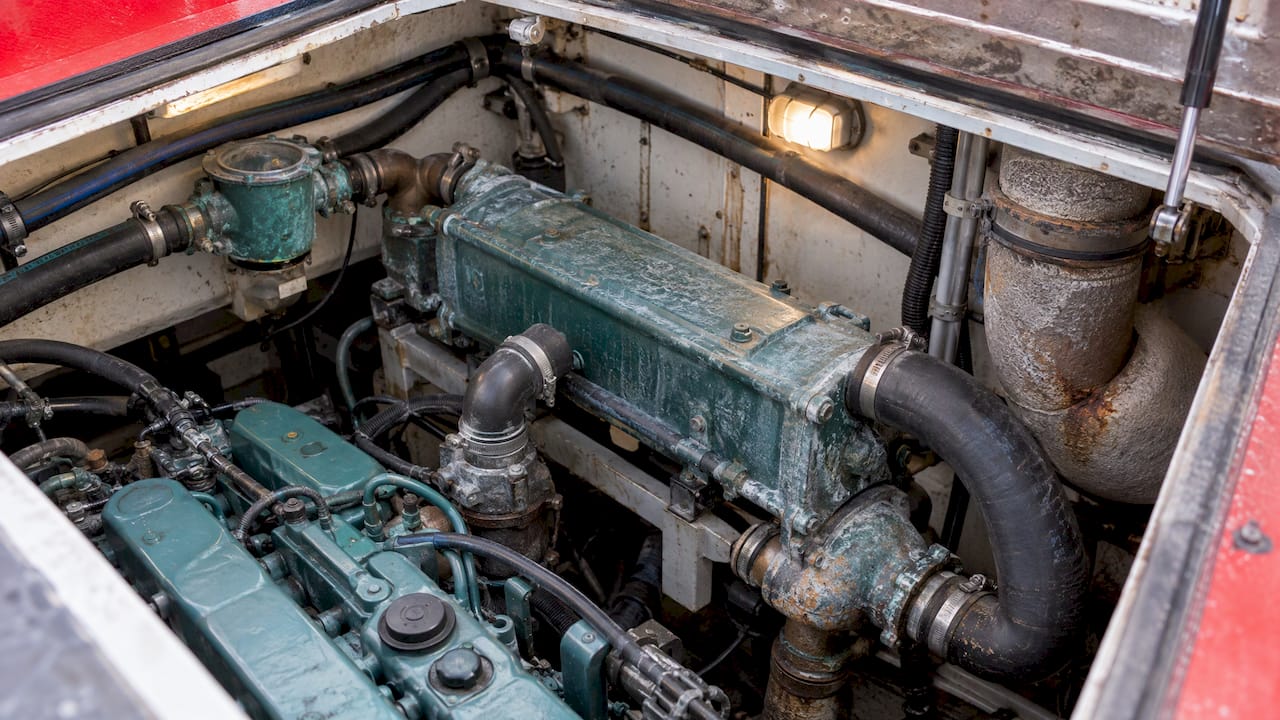
Most marine diesels do not use a radiator. In indirect cooling, raw seawater flows only through bronze tubes in a heat exchanger, while a separate freshwater pump circulates inhibited coolant through the block, as Practical Boat Owner describes. That gives marine operators extra parts to watch:
- Raw-water pump and impeller. A rubber impeller wears and loses vanes. When flow drops, the engine overheats.
- Heat exchanger tube stack. The same Practical Boat Owner article names blocking by weed or salt and scale as a common failure.
- Exhaust elbow, manifold and riser. Where seawater meets mixed metals, galvanic corrosion can eat the exchanger face away. Power & Motoryacht reports that corroded manifolds can clog with rust and scale, restrict cooling-water flow and overheat the engine under load.
- Seawater strainer and hoses. Anything that restricts intake flow looks like a failed pump.
Salt behaves differently from freshwater. mtu’s cooling specialist notes in a piece on marine cooling that salts form deposits above 48°C, which is why parts in seawater contact are made of highly resistant bronze. Keep that temperature in mind when you decide how hot a raw-water circuit can safely run.
Preventive work pays off here. Power & Motoryacht advises flushing raw-water plumbing at least once per season, using a descaling solution rather than water alone, and servicing manifolds and risers before they fail, since waiting can lead to severe engine damage.
Air-cooled engines
Some small engines have no coolant at all. The engine cooling overview on Wikipedia notes that air-cooled designs are simple, need no coolant service and do not suffer freeze damage, while liquid-cooled engines hold more stable, uniform temperatures. For air-cooled engines the “components” are fins, shrouds, fan and ducting, and the main maintenance is keeping them clean and intact.
Why coolant seems to disappear
Coolant loss with no puddle is a common call. The causes fall into three groups.
After service
Levels can drop after a refill as air locks clear. Top up once the engine has run and cooled, then recheck. If it keeps falling, move on.
External leaks that evaporate
On a hot engine, small leaks often vaporize before they drip. The common places:
- Radiator tank seams and tank gaskets. MOTOR says a tank gasket is a more likely leak source than a corrosion-perforated tube, unless the coolant is old and contaminated.
- The thermoplastic reservoir seam, a frequently missed leak where coolant can evaporate before it hits the ground, according to the same MOTOR article.
- Hoses with small splits, clamps, the pump seal and its gasket, and heater-matrix connections (Haynes).
- The cap and overflow. MOTOR reports that hot, tightly packed engine bays can evaporate coolant from the overflow vent. A cap that opens below its rated pressure should be replaced. One diagnostic guide gives the example of a 10 PSI release on a 15 PSI cap and puts replacement caps at $15 to $40.
Look for white or colored crust, wet undertrays and damp spots on hot surfaces. A flashlight and a cold engine find more than guessing does.
Internal leaks
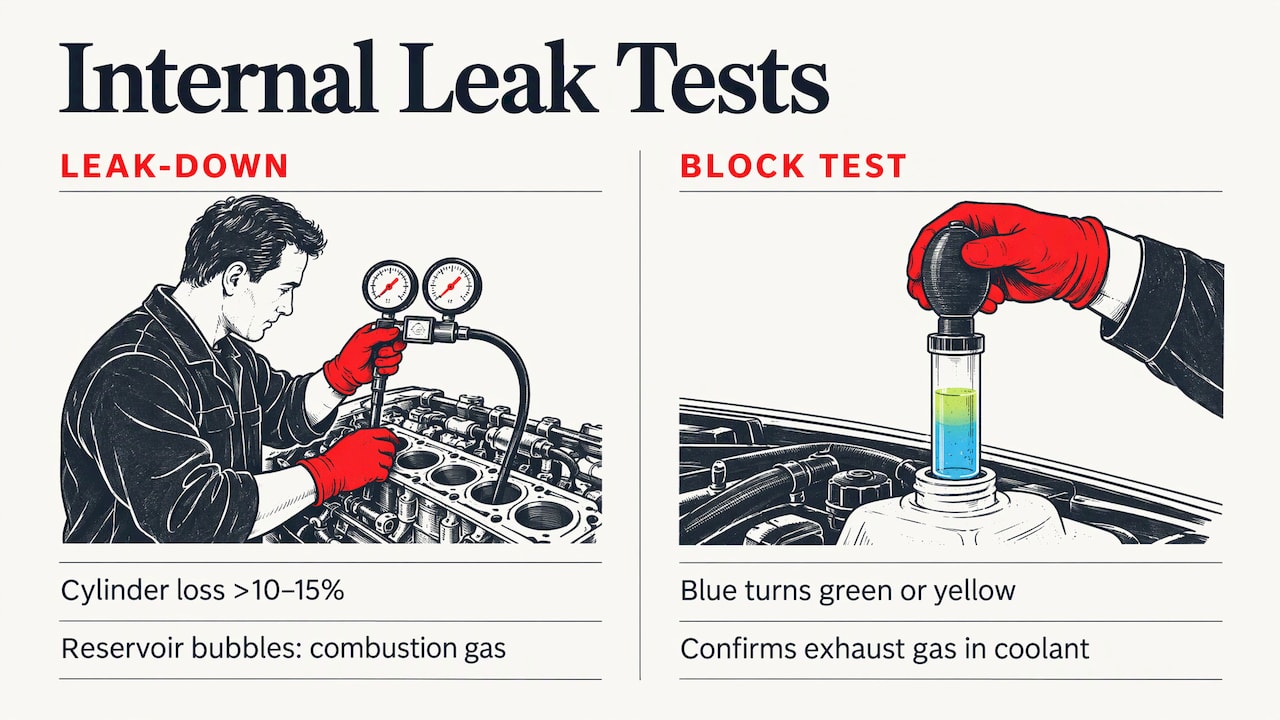
If nothing is visible outside, coolant may be entering the engine. Possible sources include a head gasket or an internally leaking EGR cooler. Coolant loss alone does not prove a blown head gasket, and a UK automotive guide cautions that a major internal repair should rest on test evidence. Two tests are commonly used. A cylinder leak-down test showing more than 10 to 15% loss, with bubbles in the reservoir, points to combustion gas reaching the coolant. A chemical block test that turns from blue to green or yellow confirms exhaust gases in the coolant (source). Confirm before you order a gasket set.
Safe checks when the system misbehaves
Stop the engine if coolant is leaking or steam is present, and never remove the cap or reservoir lid while the engine is hot, because coolant can blow out and cause serious burns. That is the guidance in Kia’s owner-manual overheating instructions, and it applies equally to a loader, a tractor or a generator set. Let the engine cool fully, and treat used coolant as hazardous: it is toxic and should go to a proper disposal point.
A workable order of checks on a cold engine:
- Coolant level and condition: color, oil film, rust or debris.
- Outside of radiator or exchanger: blocked fins, damaged core, crust at seams.
- Belt, fan and shroud.
- Hoses, clamps, cap and reservoir seams.
- Pump seal and weep hole.
- On marine engines: strainer, impeller, exhaust elbow and heat exchanger.
- Pressure test or combustion-gas test if the cause is still unclear.
Work down the list and stop at the first confirmed fault. Replacing several parts on a hunch costs more than a clean diagnosis.
Maintenance that prevents failure
- Replace coolant on schedule. Old, contaminated coolant corrodes tubes and gaskets from within.
- Keep the outside clean. Blow out cores after dusty work. Debris is a leading cause of heat problems on agricultural and construction machines.
- Replace wear parts as a set. Pump, thermostat, belt and hoses share the same drain-down.
- Test the cap. It is cheap and often forgotten.
- Flush raw-water circuits each season and descale, as described above.
- Keep spares on the shelf for the parts that fail first on your fleet: impellers, thermostats, gaskets, caps, belts.
That last point separates a one-hour fix from a week of waiting. Rental fleets, fishing boats and standby generators have no slack for a part in transit.
Ordering the right cooling parts
Cooling parts look alike across models and differ in the details: pump flange, thermostat opening temperature, hose bend, cap rating, impeller vane count. The costly mistake is a part that nearly fits. Before ordering, gather:
- Engine make, model and serial number from the data plate.
- The machine or application: excavator, tractor, genset, auxiliary or main marine engine.
- Part numbers cast or stamped on the old component.
- A photo of the failed part and of its mounting.
With those in hand, matching the part to the engine takes minutes rather than a round of returns.
Perspective
Cooling failures are rarely about the part that finally breaks. A worn impeller, a tired cap or a clogged core is usually the last link in a chain that began with an overdue service.
What we see across Yanmar and Sensei engines is that the application changes the answer. A compact excavator working in dust, a generator running in an enclosure and a sailboat auxiliary in warm seawater all stress the same system in different ways, so the right part depends on the engine and where it works.
That is why we focus on application-specific knowledge and on identifying the correct part the first time, with extensive stock ready for quick dispatch. For a workshop or fleet manager, a correct part in hand is the difference between a short stop and a long one.
Duarte
Where to find Yanmar and Sensei cooling parts
Iberspares sells spare parts for Yanmar and Sensei engines and equipment across construction and industry, agriculture, marine, power and generators, material handling and compact equipment. Our approach rests on knowing how each application uses the engine, so we can identify the right component and keep stock ready for rapid dispatch. Workshops and fleet buyers can order online, for routine maintenance and for urgent repairs alike.

Browse the range at Iberspares Yanmar and Sensei parts and have your engine model and serial number ready.
FAQ
What are the main parts of an engine cooling system?
A basic liquid-cooled system has a radiator, water pump, hoses, fan and shroud, thermostat, and coolant passages in the block and head. Most also have a pressure cap and an expansion tank. Marine engines replace the radiator with a heat exchanger and a raw-water circuit.
Why is my engine losing coolant but I can’t see a leak?
Small leaks on hot parts often evaporate before they drip. Check tank seams, reservoir seams, hoses, the pump seal and the cap. Air locks after service also lower the level. If nothing external is found, test for an internal leak before replacing a head gasket.
What causes an engine cooling system to fail?
Typical causes are a worn pump, a stuck thermostat, split hoses, a weak cap, a clogged radiator or heat exchanger, a failed fan or belt, and old coolant. On boats, a worn raw-water impeller or a blocked exchanger or manifold is a frequent cause.
Is it safe to open the radiator cap on a hot engine?
No. Hot coolant can blow out and cause serious burns. Stop the engine, let it cool fully, and only then open the cap. If you see steam or an active leak, shut the engine down first.
Sources
- Engine Cooling Systems, U.S. Navy training publication
- Caltech: Why does an engine cooling system have a thermostat and hoses?
- Haynes: Coolant leak, where is that fluid coming from?
- MOTOR: Where’s the Leak? Servicing Today’s Cooling Systems
- Practical Boat Owner: Exhaust elbow repair, step by step
- Power & Motoryacht: How to maintain your boat’s manifolds and risers
- mtu: Staying cool
- Wikipedia: Internal combustion engine cooling
- Kia owner’s manual: If the engine overheats
- Car Losing Coolant But No Leak? Hidden Causes and Checks
- Causes of Unexplained Coolant Loss With No Leaks
Content strategy and optimisation for Google and AI-powered search platforms by Velveteen SaaS — specialists in online visibility and customer acquisition.