
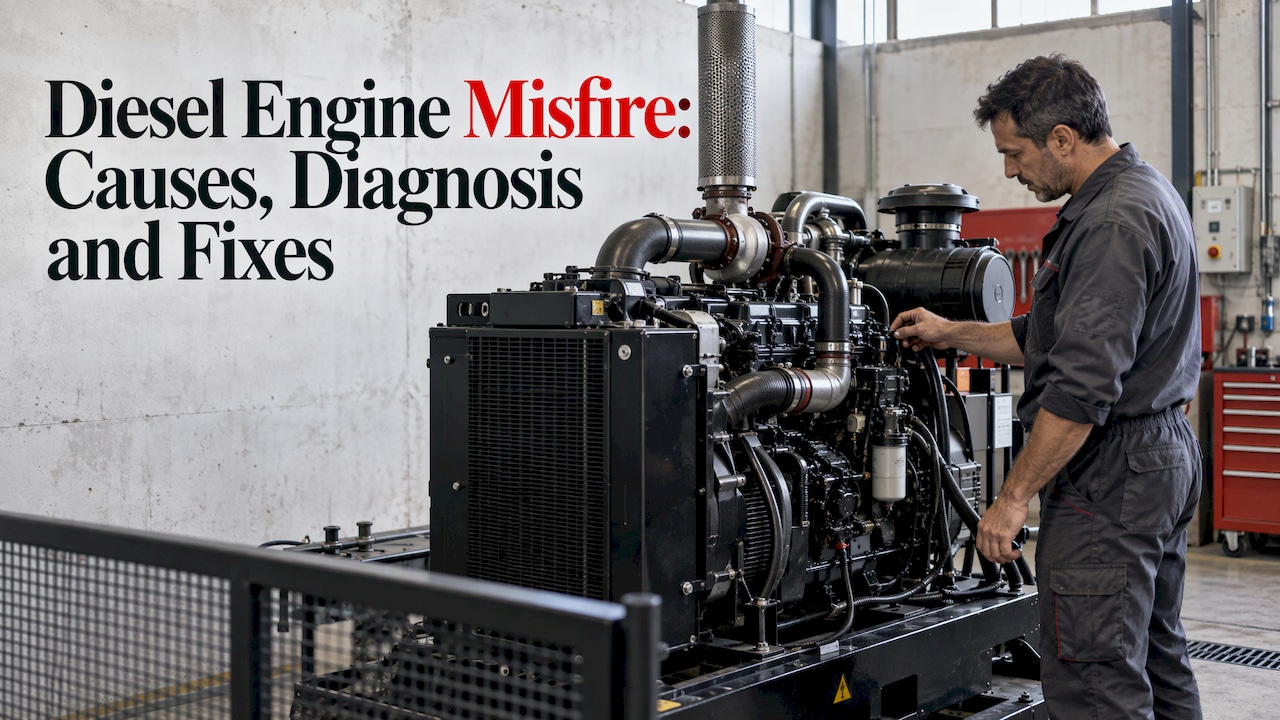
A diesel engine misfire means one or more cylinders are not burning their fuel properly. The cause almost always sits in one of four places: fuel delivery, the injector, the air supply or the cylinder’s compression. The fastest repair is a confirmed diagnosis before any part is replaced. First find out whether one cylinder or all of them are affected, then test that system with a measurement instead of a guess. Once the faulty component is confirmed, you need the exact replacement for your engine model, so the part number and application matter as much as the diagnosis.
TL;DR
- A misfire shows up as rough idle, shaking, hesitation, power loss, an uneven exhaust beat or new smoke. It is a symptom, not a diagnosis.
- Stop the engine for a flashing warning light, violent shaking, loud knocking, overheating or a strong raw fuel smell.
- Work from the cheapest, fastest checks (fuel supply, filters, air intake, codes) toward the invasive ones (injector tests, compression, valve and timing checks).
- Single-cylinder misfires point to that cylinder’s injector or compression. Every-cylinder roughness points to fuel supply, air or sensors.
- Replace only what a test has confirmed, and order by engine model and serial number so the part fits the first time.
Table of Contents
- What a diesel misfire is and how it shows up
- When to stop the engine
- The most common causes, by system
- How to diagnose a misfire step by step
- Tests that confirm the cause
- What a misfire repair costs
- Preventing the next misfire
- Getting the right part once the cause is confirmed
- FAQ
- Sources
What a diesel misfire is and how it shows up
In a diesel, air is compressed until it is hot enough to ignite the fuel the injector sprays in. A misfire happens when that burn is late, partial or missing in a cylinder. The engine loses the push from that cylinder and the others have to compensate, which is why you feel it.
The usual signs on construction machines, tractors, generators, forklifts and marine engines:
- Rough or shaking idle, with the operator’s seat or the generator frame vibrating more than normal.
- An uneven exhaust note, a stumble or chug under light throttle.
- Loss of power under load, slow response, or hard starting.
- Knocking or clattering from the affected cylinder.
- Smoke: white or gray from unburned fuel, black from too much fuel for the available air, blue from oil burning.
Smoke color is a clue about the combustion problem, not proof of which part has failed. Black smoke can come from injection quantity, spray quality, restricted intake, boost or EGR trouble, so treat it as a direction to test, not a verdict.
Symptoms that appear only in certain conditions matter too. Caterpillar’s own troubleshooting guide for its C-10 to C-16 industrial engines says that when a misfire shows up only at certain operating conditions, such as high idle, full load or a certain temperature, the engine has to be tested under those conditions or the results can mislead you. A generator that runs fine unloaded and stumbles at 70% load needs to be tested at 70% load.
When to stop the engine
Some misfires can wait until the end of the shift. Others cannot. Shut the engine down and do not restart it until it is inspected if you see any of these:
- A flashing or rapidly blinking warning light, or repeated fault codes that return immediately.
- Violent shaking that gets worse quickly.
- Loud knocking or harsh mechanical noise.
- A strong raw fuel smell or visible fuel leaks.
- Overheating along with the misfire.
Raw fuel in the exhaust and a cylinder that is not burning properly can wash oil from the cylinder wall and overload the aftertreatment on engines that have it. A leak in a high-pressure fuel line is a safety hazard. Never loosen injector lines on a running or recently running common-rail engine. Fuel injected into skin under that pressure is a serious injury and needs immediate medical attention.
For a steady, non-flashing light with mild roughness, the practical approach is to reduce load, avoid hard acceleration and get the machine to a place where it can be diagnosed properly. On a vessel, apply the same logic with the sea state and your position in mind: a misfiring main engine at idle in a marina is a repair job, the same engine under load offshore is a reliability risk.
The most common causes, by system
Most misfires fall into five groups. Knowing the group tells you which test to run first.
Fuel supply
If every cylinder is affected, or the roughness comes and goes with load, start here. Clogged fuel filters, a weak lift or transfer pump, air leaking into the suction side, water in the fuel and cold, thick fuel all starve injectors. Cold-only misfires often involve glow plug performance, injector spray pattern, compression or fuel that is struggling to flow in the cold.
Fuel quality problems are common on machines that sit between seasons: standby generators, irrigation engines, boats laid up for winter and rental fleet units. Old fuel, condensation and microbial growth in the tank all show up as roughness once the machine is worked again.
Injectors
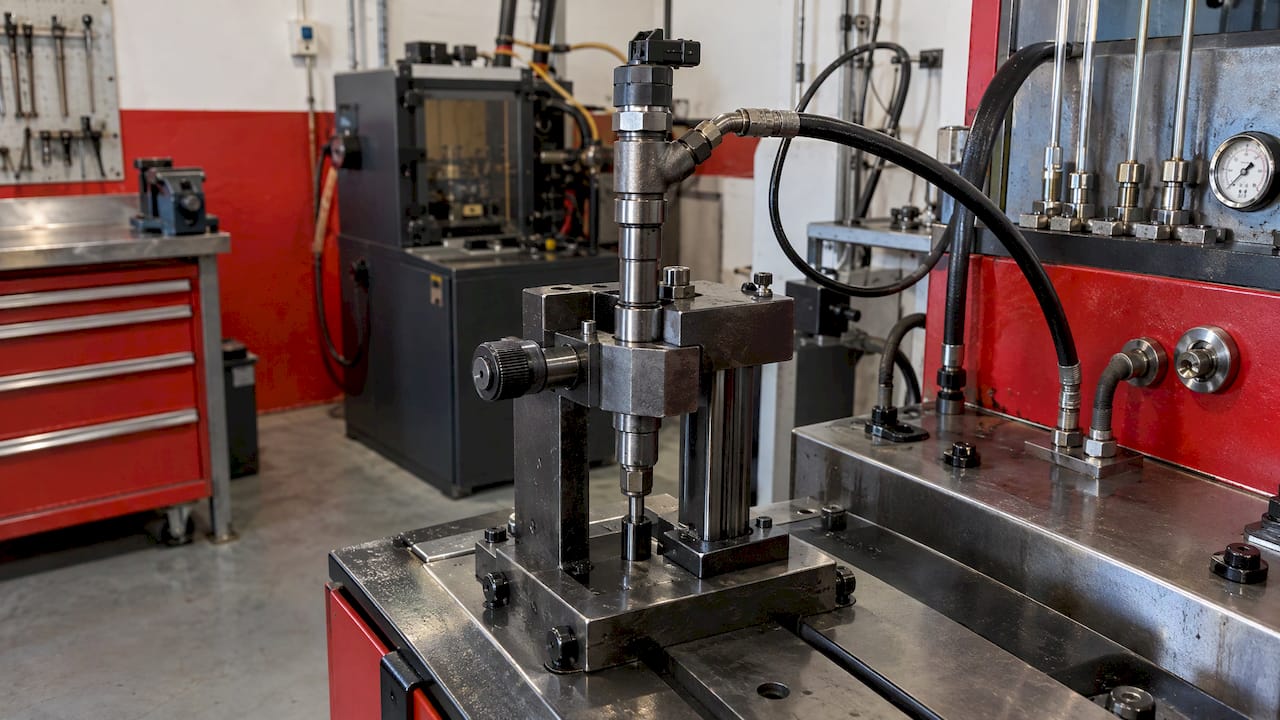
An injector can stick, leak internally, deliver too much or too little fuel, spray a poor pattern or have an electrical fault on engines with electronic injection. Worn needle valves, scored internal surfaces and damaged seals mean the injector needs component replacement, not cleaning. A leaking injector also hurts efficiency: one repair shop’s diagnostic guide puts the extra fuel consumption at 5 to 10%, with faster soot loading on engines with a particulate filter.
Air intake and exhaust
A restricted air filter, a leaking intake hose or charge-air connection, a failing turbocharger or a blocked exhaust all change the air-to-fuel ratio. The same guide says radial turbo shaft play over 0.5 mm often calls for an overhaul. If the roughness comes with black smoke and weak power under load, check intake restriction and boost leaks before you condemn injectors.
Compression and mechanical condition
When cylinder compression falls below specification, the air does not get hot enough to ignite the fuel completely. Worn piston rings, cylinder wear, burned or leaking valves, a damaged piston or a head gasket problem can all cause it. This is a persistent single-cylinder miss that does not improve when you replace the injector. It is more likely after overheating, heavy overload or long periods of severe duty.
Timing and electrical control
Late injection timing gives incomplete combustion, white smoke and rough running that mimics a misfire. On electronically controlled engines, damaged connectors, sensor faults, a throttle signal problem or wrong programmable parameters can do the same. Caterpillar’s guide lists diagnostic codes, programmable parameters, electrical connectors, cold mode, throttle signal, unit injectors, fuel supply and the air inlet and exhaust system among the probable causes. Read the codes and check the harness and connectors before you open the fuel system.
How to diagnose a misfire step by step
The goal is to move from the broad question (which system?) to the narrow one (which part?) with measurements. Replacing injectors because the engine runs rough can fix the problem, but it can also leave you with a large bill and the same misfire.
- Write down the conditions. Note when it happens: cold start, idle, light throttle, full load, one speed range only. Note smoke color, any recent fuel fill, filter changes, overheating or repairs. Recordings of the sound help document the complaint, but they cannot identify a failed part.
- Read codes and live data. On electronic engines, pull stored and active codes and look at the data that matters: rail pressure, injector corrections, coolant temperature, boost, throttle signal.
- Decide: one cylinder or all of them? A single-cylinder pattern points to that injector, its wiring or the cylinder’s compression. An all-cylinder pattern points to fuel supply, air, sensors or control settings.
- Check the cheap basics. Fuel level and quality, water in the fuel, primary and secondary filters, air leaks on the suction side, air filter restriction, intake and charge-air connections, exhaust restriction, battery and glow plug function on cold starts.
- Test the injectors. Use the cylinder cut-out or balance test and the return-flow test (details below).
- Test the cylinder. If the injector is healthy, run a compression test and, when needed, a leak-down test or a borescope look at the liner.
- Check valves and timing. Valve clearance, injection timing or pump timing, and any mechanical wear the compression result points to.
- Repair, then retest. Replace the confirmed part, clear codes, and repeat the test conditions that showed the fault in step 1.
Tests that confirm the cause
The numbers below come from published diagnostic guides. Always compare them against your engine manufacturer’s service manual, because specifications differ by engine and by injection system.
| Test | What you do | What it tells you |
|---|---|---|
| Injector cut-out or balance | Disable one injector at a time at idle and watch the RPM | A healthy cylinder causes a noticeable RPM drop when disabled. Little or no change means that cylinder was not contributing. |
| Injector return (leak-off) flow | Collect the return fuel from each injector during a 30-second idle test | Most engines should return less than 20 to 30 ml per injector. An injector returning 2 to 3 times its siblings’ volume has failed. |
| Compression test | Crank the engine and read each cylinder | Diesel cranking pressures typically run 300 to 500 psi. A cylinder well below its siblings or the spec points to rings, valves or the head gasket. |
| Borescope inspection | Look into the cylinder with a camera | Shows liner scoring and combustion-chamber condition. |
| Turbo shaft play | Measure radial movement | Over 0.5 mm often means overhaul. |
| Rail pressure observation | Watch pressure behavior in live data | Common-rail systems run between 20,000 and 26,000 psi at idle, so a pressure that is unstable or low points to the supply side. |
The return-flow, cut-out and rail pressure figures come from Heavy Duty Journal’s injector failure guide. The compression, turbo and fuel-consumption figures come from ASAP Diesel Repair’s tractor diagnostics guide. Use them as a reference range, not as a replacement for your engine’s own specification.
One caution applies to every injector test on high-pressure systems: the work is done with the system depressurized by a qualified technician, with eye protection and with the manufacturer’s procedure in hand.
What a misfire repair costs
Cost depends on what the tests find. As a US reference point, the same Heavy Duty Journal guide, last updated in December 2025, gives professional injector cleaning at roughly $75 to $150 per injector. It puts complete injector replacement jobs, with all components considered, at $3,000 to $8,000. Those figures describe pickup and light truck-size common-rail systems, so larger industrial, marine and generator engines vary with injector count, labor access and the parts each engine needs.
Three things drive the bill on any machine:
- How many cylinders are involved. One failed injector is a smaller job than a fuel system contaminated by water or debris, which can damage all of them.
- Cleaning or replacing. Worn needle valves, scored surfaces and damaged seals cannot be cleaned back to spec.
- Downtime. For a generator on standby, a crane on a job site or a boat in the fishing season, the hours the machine is out of service often cost more than the part. This is why the first thing to settle is the diagnosis and the second is how quickly the right part reaches you.
Preventing the next misfire
Most repeat misfires come back to maintenance gaps:
- Change fuel filters on schedule and drain water separators regularly.
- Use clean fuel and keep tanks full on equipment that sits idle, to limit condensation.
- Replace air filters before restriction becomes a problem and keep intake connections tight.
- Don’t ignore small symptoms. A slight roughness at idle often precedes a bigger failure under load.
- Keep a record of codes, hours and repairs per machine so patterns show up early.
Fleet operators and workshops benefit from keeping the common service items (filters, seals, injectors for the engines they run most) on hand, so a confirmed diagnosis becomes a same-day repair.
The view from our side of the parts counter
Most misfire calls we hear about start with the same sentence: the engine runs rough, so replace the injectors. Sometimes that is right. Often the real cause is a filter, an air leak or a worn cylinder, and the injectors get swapped first because they are the easiest suspect.
Our approach to parts is built around application knowledge. Yanmar and Sensei engines turn up in construction, agriculture, marine, power generation, material handling and compact equipment, and the same engine family can be fitted with different components depending on the machine it powers. Getting the right part means starting from the engine model and the application, not from a guess at a symptom.
That is where we aim to save you time. Our team identifies the correct component to minimize errors and delays, and we keep extensive stock ready for rapid dispatch. A confirmed diagnosis and the right part in the same week is what keeps downtime short.
Duarte
Getting the right part once the cause is confirmed
Once your tests point to an injector, a filter, a seal or another wear item on a Yanmar or Sensei engine, Iberspares supplies engine and equipment parts for these brands across construction and industry, agriculture, marine, power and generators, material handling and compact equipment. Our team has deep technical knowledge of Yanmar and Sensei applications, so you can find the part that matches your engine and your machine, and we hold extensive inventory for rapid dispatch, for routine maintenance and for emergency repairs.

Have the engine model, serial number and the machine it powers ready when you order. Browse the Yanmar and Sensei parts catalog to start from your application.
FAQ
Why is my diesel engine running rough at idle?
The usual causes are a restricted or contaminated fuel supply, a weak or leaking injector, an air intake leak, or low compression in one cylinder. Check the fuel filters, air filter and intake connections first, then read codes and test the injectors. If the roughness smooths out under load, injector or fuel supply problems are more likely than a mechanical fault.
Can I keep running a misfiring diesel engine?
Only if the symptoms are mild and the warning light is steady. Reduce load, avoid hard acceleration and get it diagnosed promptly. Stop immediately for a flashing warning light, heavy shaking, loud knocking, overheating or a strong fuel smell, because continued running can turn a small repair into major engine damage.
Is a diesel misfire expensive to fix?
It depends entirely on the cause. A filter or an air leak is inexpensive, while injector replacement can reach thousands of dollars. Published US figures put injector cleaning at $75 to $150 each and full replacement jobs at $3,000 to $8,000. A confirmed diagnosis is the best way to avoid paying for parts you did not need.
How do I tell an injector problem from a compression problem?
Run the injector cut-out or return-flow test first. If the injector shows normal behavior and the cylinder still does not contribute, run a compression test. A cylinder with low cranking pressure compared to its siblings points to rings, valves or the head gasket, and a new injector will not cure it.
Why does my diesel only misfire when cold?
Cold-only misfires often involve glow plug performance, injector spray pattern, poor compression or thick fuel that flows slowly. Test the glow plugs and fuel supply first, then check injector spray and compression if the problem persists.
Sources
Content strategy and optimisation for Google and AI-powered search platforms by Velveteen SaaS — specialists in online visibility and customer acquisition.