
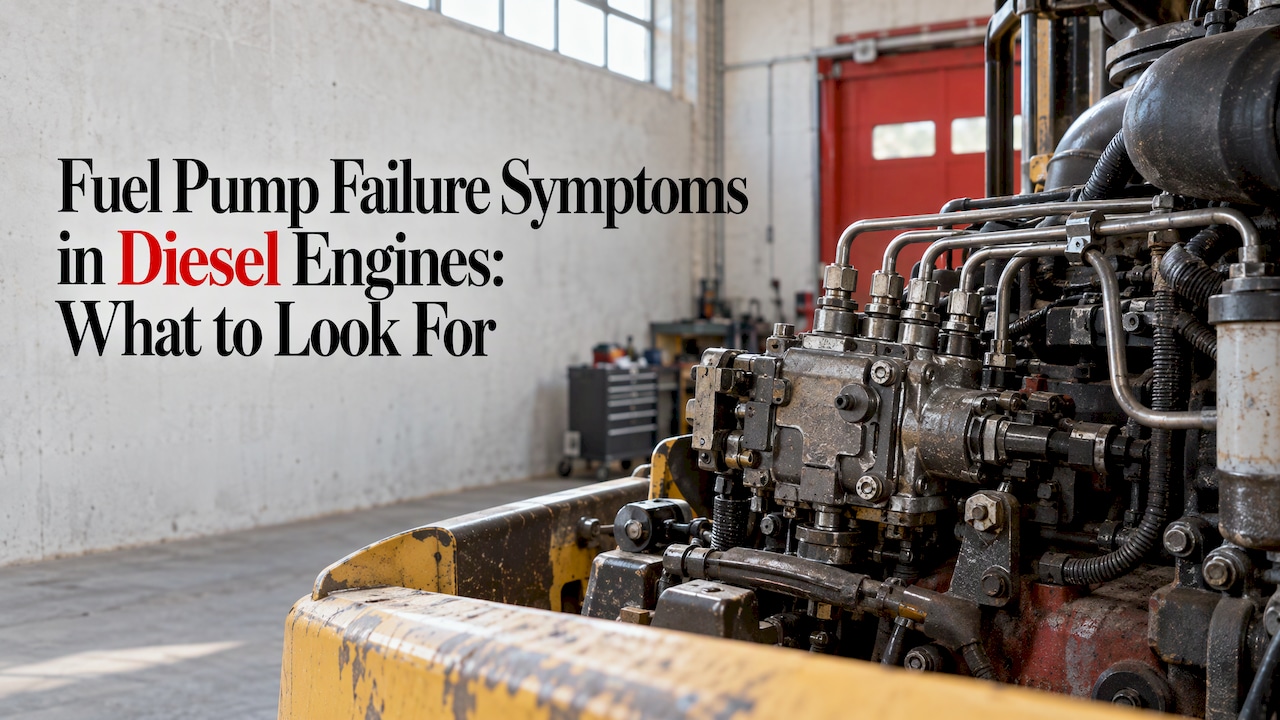
A failing diesel fuel pump usually announces itself the same way: the engine cranks longer than it used to, starts hard when hot or cold, loses power when you load it, runs rough, or stalls. These are clues, not proof. A clogged filter, air in the line, a sensor fault or a leaking injector can produce the same complaints, so the job is to read the pattern, rule out the cheap causes, and only then replace the pump. When it is the pump, we supply the Yanmar and Sensei parts for it, matched to the application the engine sits in.
This guide is written for people who keep engines working: repair workshops, rental fleets, farms, marine operators, generator maintenance teams and forklift shops. It covers the symptoms, the difference between low-pressure and high-pressure pump trouble, the checks that separate a pump fault from everything else, and what to do while a machine is down.
TL;DR
- The most common signs of a failing diesel fuel pump are extended cranking, hard starting, rough idle, hesitation, loss of power under load, stalling and, in later stages, a no-start.
- A running pump can still be a bad pump. Early wear shows up as longer cranking, hesitation and a slow decline in fuel economy before anything fails outright.
- Filters, air ingress, electrical faults, sensors and injectors mimic pump failure. Check supply pressure, air and voltage before condemning the pump.
- Grinding, squealing or metallic knocking from the pump means shut the engine down immediately.
- Once the pump is confirmed, order by engine model and application so the right part arrives the first time.
Table of Contents
- What a diesel fuel pump does, and why symptoms overlap
- The symptoms of a failing diesel fuel pump
- Can a fuel pump run and still be bad?
- Low-pressure versus high-pressure pump symptoms
- Rule out the look-alikes before you replace the pump
- A sensible testing order
- What to do while the machine is down
- Getting the right pump for Yanmar and Sensei engines
- Our perspective
- FAQ
- Sources
What a diesel fuel pump does, and why symptoms overlap
A diesel engine needs fuel delivered clean, free of air and at the right pressure. On many engines two pumps share that work. A supply (lift or transfer) pump pulls fuel from the tank through the filters on the low-pressure side. A high-pressure pump then raises that fuel to injection pressure. On older mechanical engines that is an injection pump; on common-rail engines it feeds the rail that every injector draws from.
Because everything downstream depends on what the pump delivers, almost any fault in the fuel path looks like a pump fault from the operator’s seat. The engine does not know why it is starved. It only hesitates, stumbles or quits. That is why Heavy Duty Journal’s diagnosis guide treats hard starting, power loss, stumbling, rough idle, stalling and low rail-pressure codes as starting clues rather than proof, since supply, sensor, wiring or injector faults can cause similar complaints.
The symptoms of a failing diesel fuel pump
Passenger-car articles talk about a whine from the fuel tank and sputtering at highway speed. On diesel equipment the picture is different, because machines work under sustained load and many have no in-tank electric pump at all. These are the signs worth acting on.
Hard starting and long cranking
This is usually the first sign. Heavy Duty Journal reports that a healthy high-pressure pump builds rail pressure within about 2 to 3 seconds of cranking, while progressive internal wear can stretch cold starts to 8 to 10 seconds. If operators start saying the machine “takes a while” in the morning, time it. A change from a couple of seconds to eight or ten is a measurable warning.
Heat matters too. A worn rotary-type mechanical pump tends to give trouble when hot, with hard starting after a short shutdown, because internal leakage climbs with temperature. If a tractor or excavator restarts badly after a fuel stop but fine after sitting overnight, note that pattern.
Rough idle and hesitation
An engine that idled smoothly last month and now hunts or stumbles is telling you delivery is unstable. Hesitation when you open the throttle points the same way: the pump cannot raise output fast enough to match demand.
Loss of power under load
Power fade is where fuel-pump trouble earns its keep as a downtime problem. The engine idles acceptably, then sags when the loader digs, the baler pulls, the generator picks up a load or the boat climbs onto plane. On a mechanical pump, wear can show up as fade on long pulls. On a common-rail engine, the pump cannot hold required rail pressure and the control unit may cut power to protect the engine.
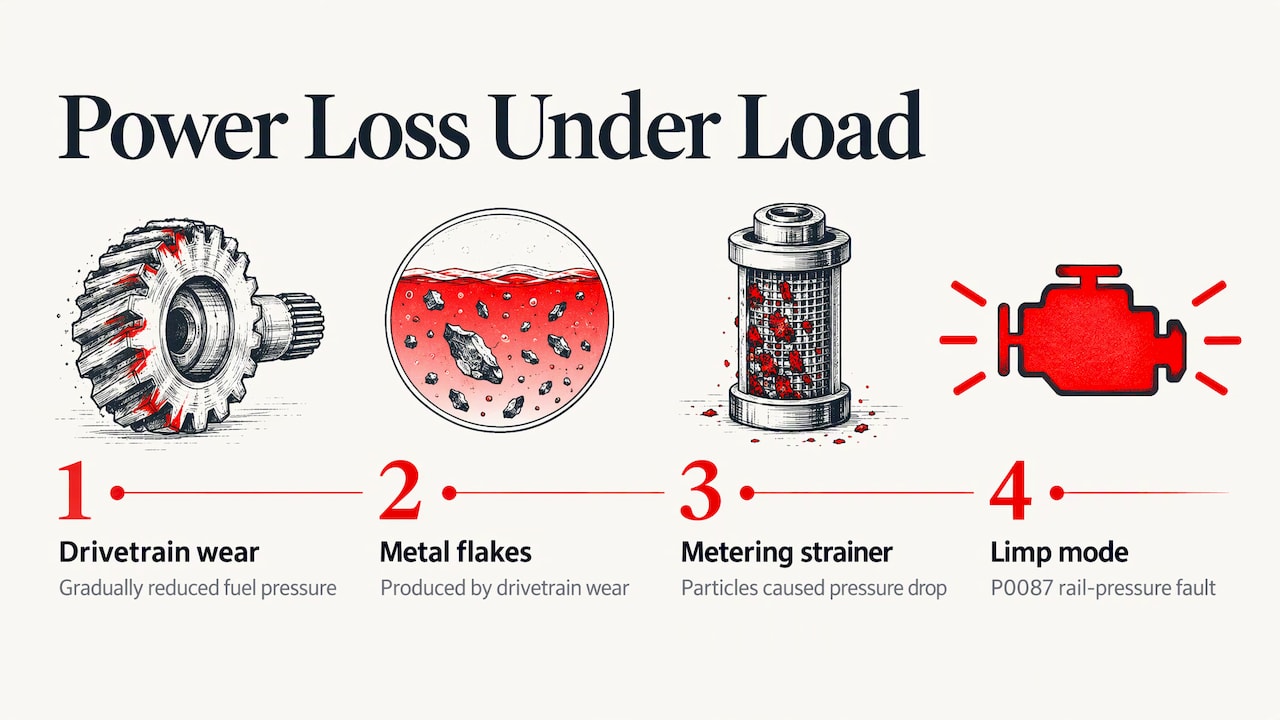
The NHTSA’s closing report on a common-rail diesel investigation describes how it plays out. Volkswagen attributed the problem to drivetrain wear that gradually reduced fuel pressure and produced metal flakes. Particles caught in the metering-unit strainer caused a pressure drop, a P0087 rail-pressure fault and limp-home mode. One complaint vehicle fell from 70 mph to 50 mph before entering limp mode within a minute of the warning lights. The lesson for equipment owners: power loss can arrive suddenly after a long quiet period of wear, so do not wait for it.
Declining fuel economy and smoke
Heavy Duty Journal puts the early fuel-economy decline at roughly 10 to 15 percent, for example 6.5 MPG slipping to 5.5 MPG, before other symptoms become obvious, and lists black or white smoke among the early signs. If you track fuel burn per hour or per mile across a fleet, this is the metric that flags a problem first. Smoke and fuel burn have other causes, so treat them as a prompt to check, not as a diagnosis.
Stalling and no-start
Later-stage failure brings stalling and a no-start with rail pressure near zero during cranking. Some pump types give little notice: the same DCT pump-type guide notes that a VP44 often stalls without much warning. On inline pumps, other signs include a rising oil level in the sump from fuel leaking past worn plungers, one weak or dead cylinder, and governor or rack faults, including an engine that will not shut down.
Noise
Grinding, squealing or metallic knocking from the pump is not a symptom to monitor. Heavy Duty Journal says these sounds call for immediate engine shutdown. Running on may turn a pump replacement into a pump, rail and injector replacement, because metal debris travels downstream.
Can a fuel pump run and still be bad?
Yes. A pump that turns and moves some fuel can still be worn enough to fall short at the moments that matter: cold cranking, high load, or when hot. That is why the early signs above (longer cranking, slight hesitation, a slow fall in economy) are worth logging. They often show up weeks before a stall.
A practical routine for a workshop or fleet:
- Record cranking time on cold starts for each machine, ideally the same way each time.
- Track fuel consumption per operating hour, and flag drift of around 10 percent.
- Ask operators to report any hot-restart difficulty, surging or power sag, with the load and temperature when it happened.
- Read fault codes at each service and note any recurring rail-pressure codes.
None of this requires special tools, and it gives the technician a history to work from instead of a single bad day.
Low-pressure versus high-pressure pump symptoms
The two pumps fail in related but distinguishable ways.
| Supply (lift/transfer) pump | High-pressure pump | |
|---|---|---|
| What it does | Moves fuel from the tank through the filters at low pressure | Raises fuel to injection pressure |
| Typical pattern | Starvation: power fade under load, hard starting, stalling when fuel demand rises, surging | Cannot build or hold rail or injection pressure: long cranking, no-start, limp mode, rail-pressure codes |
| Often accompanied by | Air in the line, blocked pickup or filter | Metal particles in the fuel, strainer blockage, rising wear noise |
| First check | Low-side pressure under load, filter condition, air | Commanded versus actual rail pressure, then low-side supply |
As the CRANETEC guide summarizes it, a failing supply pump restricts fuel delivery, while a high-pressure pump problem prevents the injection system from reaching the required pressure. The overlap is the catch: a weak supply pump starves the high-pressure pump, which then looks like the culprit. That is why the low side is always checked first.
Rule out the look-alikes before you replace the pump
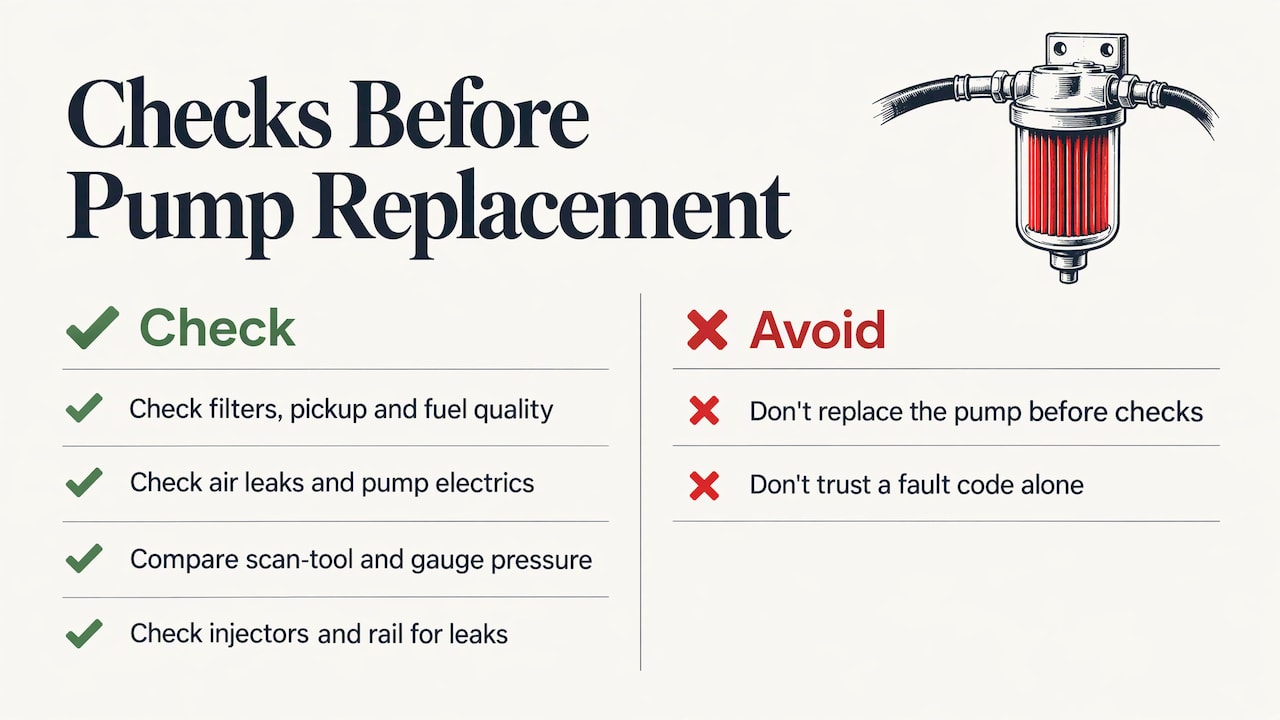
The most expensive mistake in this field is replacing a good pump. Heavy Duty Journal frames common-rail diagnosis as a process of elimination: pressure data has to be read together with supply condition, control commands, sensing and leakage before a pump is condemned. These are the usual impostors.
Clogged filters or a restricted pickup. A plugged filter, restricted strainer or blocked fuel inlet reproduces starvation symptoms exactly. A 2013 Navistar service bulletin hosted by NHTSA says plugged filters, a restricted strainer or inlet, a faulty pressure regulator and low pump voltage should be checked before replacing the electric pump on low-pressure complaints.
Air in the fuel. Air often enters after a filter change, a run-dry or a loose fitting on the suction side. It causes cranking without starting, rough running and surging. Because suction-side leaks draw air in rather than push fuel out, there may be no visible wet spot to find.
Electrical faults. Low voltage at the pump, a bad ground or a failed relay can make an electric supply pump underperform. The same Navistar bulletin advises checking pump voltage and pressure or flow against the diagnostic manual, and notes inlet restriction can cause excessive pump current or erratic shutoff behavior.
Sensors and circuits. Heavy Duty Journal gives a clean test: if the scan tool shows low rail pressure but a mechanical gauge reads normal, suspect the sensor or its circuit. If both read low, you have a real pressure problem.
Injectors and rail leakage. Leaking injectors let pressure bleed away and can mimic a weak pump.
Contaminated fuel. Water, debris and degraded fuel damage pumps and also cause symptoms on their own.
A fault code alone does not name the failed part either. An Australian technical article on a P0089 pressure-control code described a case where poor performance traced to a broken plunger spring inside the high-pressure pump, while other jobs with the same code end up being supply or sensor problems.
A sensible testing order
Follow the engine manufacturer’s procedures for your specific model. In outline:
- Check the basics. Fuel level, filter service history, water in the separator, visible leaks, battery and connector condition.
- Measure low-side supply. Check pressure and flow under load, not only at idle. Look for air with the approved method for that engine.
- Check electrical supply. Voltage and ground at the pump during the complaint.
- Read codes and live data. Compare commanded and actual rail pressure while the fault is happening.
- Check leakage. Injector return and rail leakage that could account for lost pressure.
- Only then judge the pump. If supply, power, sensing and leakage are all sound and pressure still fails, the pump is the likely cause.
On negative-priming diesel systems, Pico’s guided test explains that pressure tending to return to 0 bar (atmospheric) indicates a faulty pump or air ingress. Symptoms include non-start or excessive cranking, erratic idle or running under constant load, and hesitation at high loads, with no external leakage because these systems draw air in.
Safety when you test
High-pressure fuel can injure and can remain in the system after shutdown. Use only the manufacturer’s approved test points and pressure-rated equipment, and never improvise a connection or loosen a high-pressure line on a running engine. Read pressures at the designated ports: the Navistar bulletin warns that a poor test-port connection can produce a falsely low reading. If you do not have the equipment or training for high-pressure work on a given engine, stop at the low-side checks and hand the engine to a qualified diesel technician.
What to do while the machine is down
A pump cannot be repaired by a trick, and driving on a failing one risks the injectors and rail. What you can do to limit downtime:
- Stop at the first metallic noise. Shutting down early protects the rest of the fuel system.
- Fix the cheap causes first. Replace the filters, drain water from the separator, tighten and inspect suction-side fittings, and bleed the system the way the manual describes. Sometimes that ends the complaint.
- Capture the evidence. Cranking times, codes, pressure readings and the load at which the fault appears all shorten diagnosis.
- Identify the part before you order. Engine model, serial number and application decide which pump, kit or seals you need. A wrong part costs more downtime than a slow diagnosis.
- Keep spares for critical machines. For standby generators, rental units and boats working in season, having filters and a supply pump on the shelf turns a lost week into a lost afternoon.
Getting the right pump for Yanmar and Sensei engines
Once testing points at the pump, the next delay is the part. Yanmar and Sensei engines power compact excavators, tractors, generator sets, marine propulsion and auxiliaries, forklifts and more, and the same engine family can carry different fuel-system components depending on the machine it was built into.
Iberspares supplies parts for Yanmar and Sensei engines and equipment across construction and industry, agriculture, marine, power and generators, material handling and compact equipment. Our site is built around identifying the correct application-specific component and dispatching from stock. If you are working on one of these engines, start at our genuine Yanmar and Sensei parts catalog and search by your engine and equipment.

For workshops and fleets that run mixed equipment, the same page covers the category you need, from Yanmar parts and Sensei parts to marine and power generation.
Our perspective
We see fuel pump trouble as a part-identification problem as much as a diagnostic one. The diagnosis is the technician’s craft, and the evidence above is clear that it takes elimination: filters, air, power, sensors, then the pump. What we can do is make the second half fast.
Yanmar and Sensei engines show up in very different machines, and the pump, kit or seal that fits one application may not fit another with the same engine family. Our knowledge of those applications is what we are built around, and it is why we focus on identifying the correct component the first time, so the machine does not wait twice: once for the fault and again for a wrong delivery.
We keep extensive stock for rapid dispatch because downtime is the real cost. A tractor in harvest, a standby generator or a fishing boat in season cannot wait on a back-order. Our aim is that, when your diagnosis is done, the part is already on its way.
Duarte
FAQ
How does an engine act when the diesel fuel pump is going out?
Typically it cranks longer before starting, idles roughly, hesitates and loses power under load. Later it may stall, enter limp mode, or refuse to start at all. Because filters, air and injectors cause similar behavior, confirm with pressure readings before replacing the pump.
Does a diesel fuel pump give warning before it fails?
Often, yes. Early signs include cranking time stretching from 2 to 3 seconds to 8 to 10 seconds, hesitation, rough idle and a fuel-economy decline of about 10 to 15 percent, according to Heavy Duty Journal. Some pump types, such as the VP44, can stall with little notice.
Can a fuel pump still run but be bad?
Yes. A pump can turn and move fuel but fail to deliver enough pressure when hot, cold or under load. Compare commanded and actual rail pressure during the fault, and check low-side supply, voltage and leakage, to see whether the pump is really the weak link.
Can I temporarily fix a diesel fuel pump?
Not reliably. You can remove common look-alike causes: replace clogged filters, drain water, tighten suction-side fittings and bleed air. If the pump is worn, running it risks damage downstream, and grinding or knocking means shutting the engine down at once. Order the correct part and replace the pump.
Sources
- High-Pressure Fuel Pump Diagnosis: A Comprehensive Guide, Heavy Duty Journal
- Diesel Fuel Pump Problems: High-Pressure Fuel Pump Failure, Heavy Duty Journal
- Engineering Analysis Closing Report, NHTSA
- Navistar service bulletin, hosted by NHTSA
- Fuel pressure, negative priming (diesel), Pico Technology
Content strategy and optimisation for Google and AI-powered search platforms by Velveteen SaaS — specialists in online visibility and customer acquisition.