
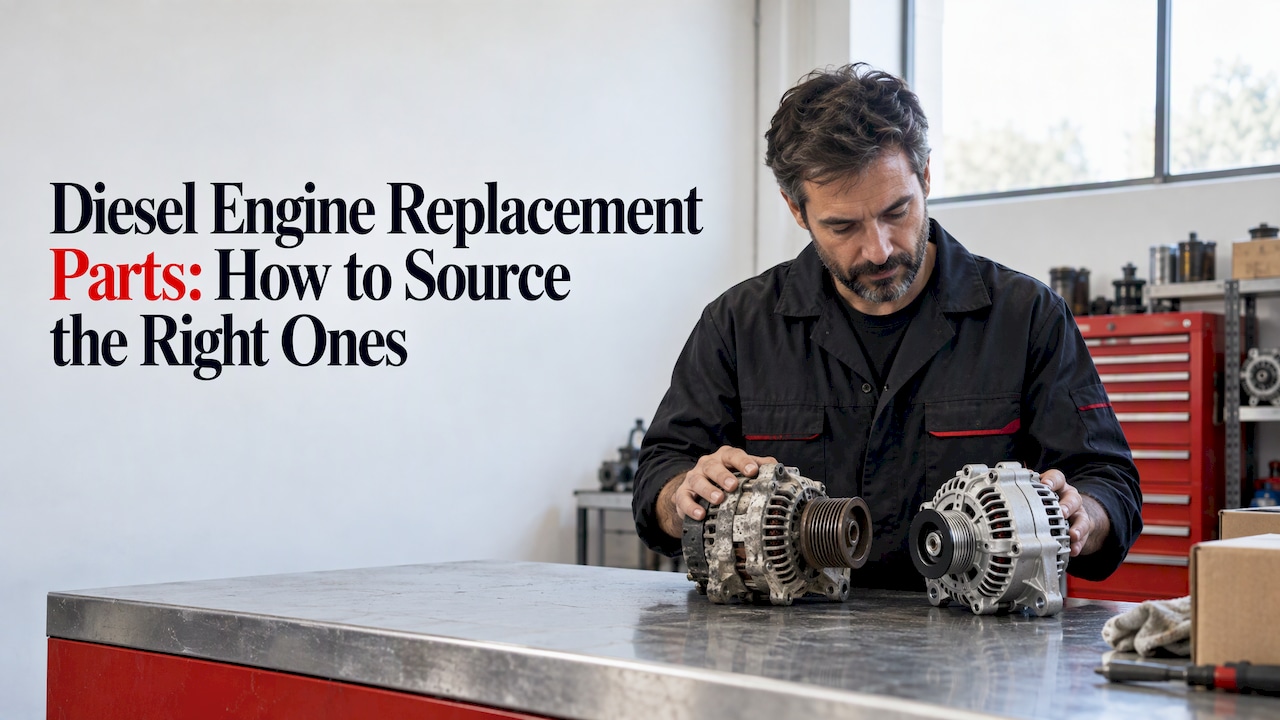
The right diesel engine replacement part is the one matched to your exact engine and application, delivered before the machine has sat idle long enough to cost more than the part. For Yanmar and Sensei engines, that means identifying the part from the engine’s own data rather than from the machine’s name, and buying from a supplier that keeps the application-specific components in stock. We built Iberspares around that job: Yanmar and Sensei parts for construction, agriculture, marine, power generation, material handling and compact equipment, sold online to professional buyers.
This guide is written for workshops, maintenance teams, fleet operators, rental companies and dealers who buy parts for a living. It covers what gets replaced, what a rebuild actually needs, how to identify the correct part, and what to check before you order.
TL;DR
- Most diesel replacement demand falls into three groups: scheduled service items (filters, belts, seals), wear parts (injectors, pumps, turbochargers) and rebuild components (pistons, liners, bearings, gaskets).
- Match parts to the engine model and serial number, then to the application, because the same engine family is often configured differently for a excavator, a generator set or a boat.
- Downtime usually costs more than the part. Stock availability and correct identification matter as much as unit price.
- For a rebuild, decide the scope first (what is replaced as new, what is reused) so quotes and parts lists can be compared like for like.
- Iberspares supplies Yanmar and Sensei parts across eight categories, from compact equipment to marine and generators.
Table of Contents
- What counts as a diesel engine replacement part
- Spares by sector: what each fleet actually needs
- Rebuild components: what an overhaul kit contains
- How to identify the correct part
- Before you order: a pre-purchase checklist
- Stocking strategy for workshops and fleets
- Perspective
- Get Yanmar and Sensei parts from Iberspares
- FAQ
- Sources
What counts as a diesel engine replacement part
The phrase covers anything you fit to a diesel engine to replace something worn, failed or due for service. In practice, buyers sort it into three tiers, and each has a different buying pattern.
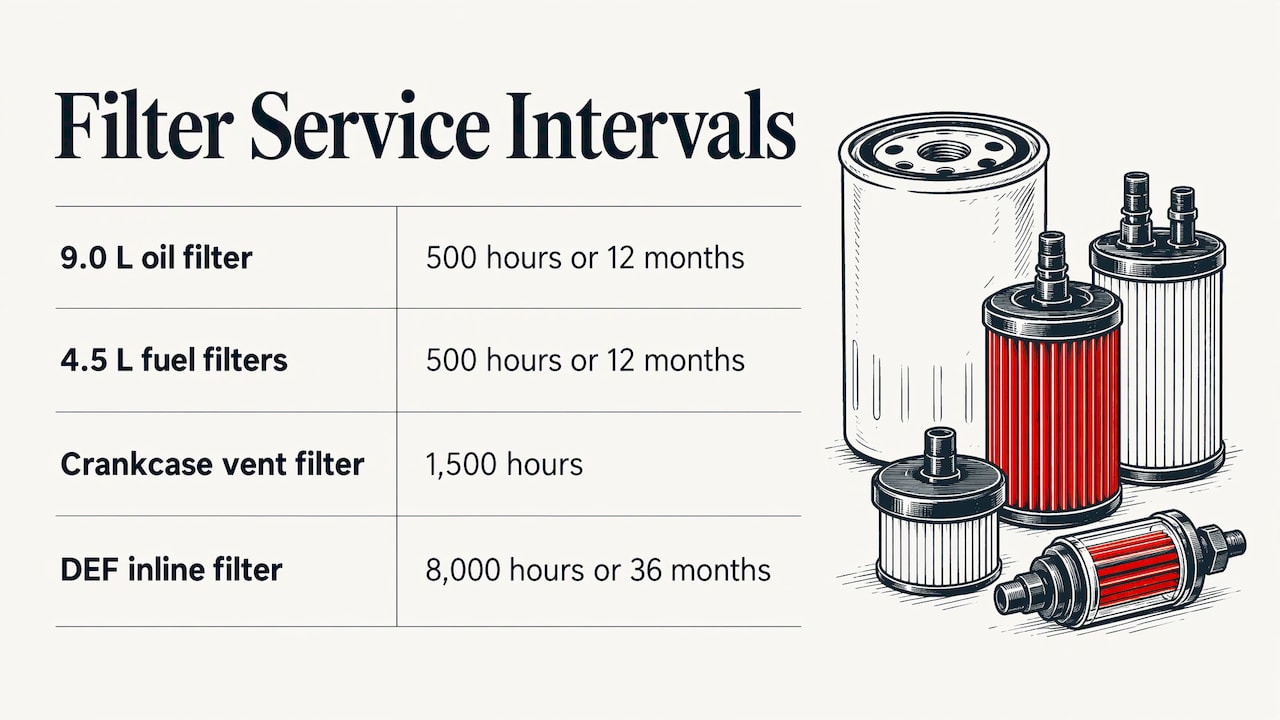
Scheduled service items. These are replaced on a calendar or by hours of operation. A manufacturer’s service guide for one 9.0 L industrial engine, for example, lists an oil filter to be replaced at 500 hours or every 12 months, whichever comes first. Another guide for a 4.5 L Stage V engine puts primary and secondary fuel filters on the same 500-hour or 12-month cycle, while a crankcase ventilation filter runs at 1,500 hours and the DEF inline filter at 8,000 hours or 36 months. The intervals differ by engine, so the service schedule for your exact model is the reference, not a general rule.
Wear and failure parts. Injectors, fuel pumps, turbochargers, water pumps, starters, alternators and sensors. These fail unpredictably, which is why availability matters more here than anywhere else. UK light commercial vehicle claims data for 2025 shows diesel injectors and alternators each accounting for 6% of claims, with average claim costs of £782.67 and £508.90, and turbochargers averaging £800.90. That is road-vehicle data from the United Kingdom, but it shows where the money goes when a diesel ages: fuel system and boost components.
Rebuild components. Pistons, rings, liners, bearings, gaskets, oil pumps, cylinder heads and seals, bought when the engine is opened up. We cover these in their own section below.
Spares by sector: what each fleet actually needs
The same wear pattern does not apply across industries. Duty cycle drives what you stock.
Construction and compact equipment
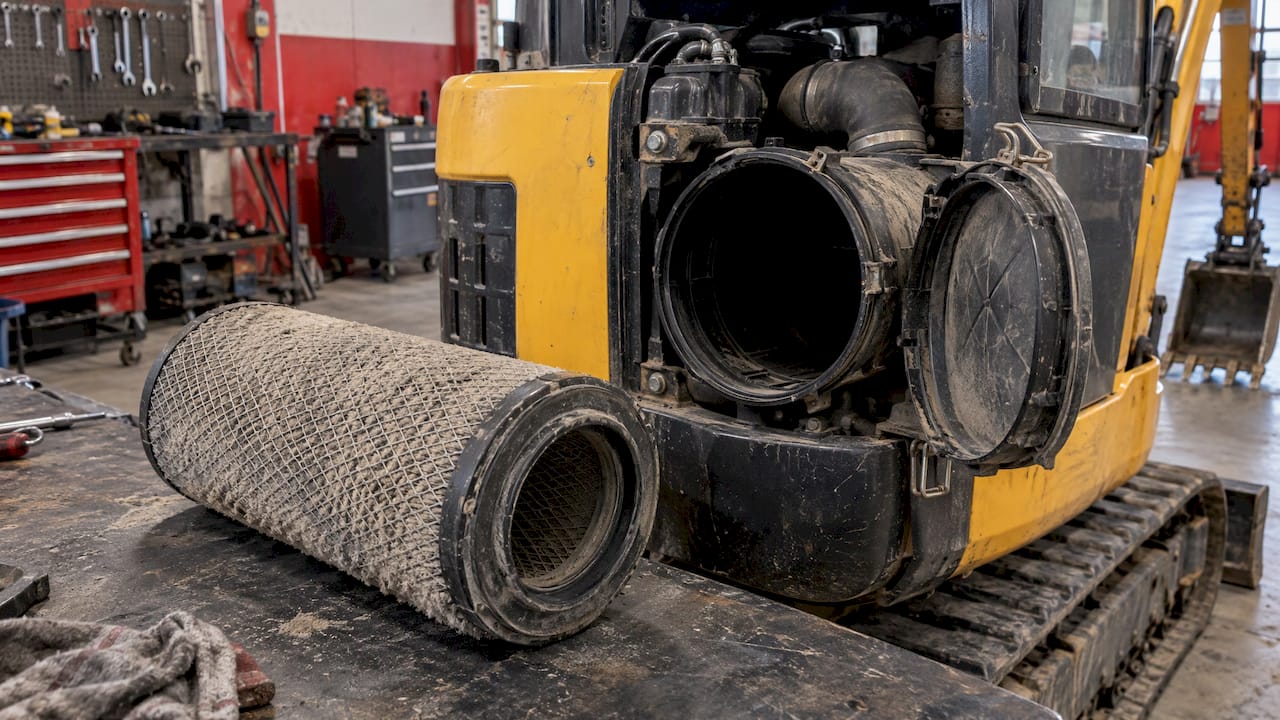
Excavators, loaders and compact machines spend long hours at partial load and idle, in dust. Air and fuel filters, injectors, starters, alternators, cooling parts and hoses see the most turnover. Compact equipment tends to run small engines hard, so service kits for routine maintenance are the first thing to keep on the shelf.
Agriculture
Harvest and planting seasons make downtime expensive in a way no invoice shows. Fuel filtration, water pumps, belts, injectors and starters are the usual suspects, and the smart move is to buy service parts for the whole season before it starts.
Marine
Salt water and constant load make cooling system parts the focus: impellers, heat exchanger components, thermostats, gaskets and anodes alongside fuel and oil filters. Commercial fishing boats and shipyards cannot wait weeks for a pump, so supplier stock position matters.
Power generation
Generators sit idle, then must start on demand. Fuel filters, batteries, starter motors, belts, coolant hoses and governor-related parts are the typical replacements. For emergency power providers, the part that fails is usually the one nobody exercised or serviced on schedule.
Material handling
Forklifts and similar machines running multiple shifts need filters, belts, starters and cooling parts on a predictable cycle. In-house maintenance teams at logistics operations benefit from consolidating these into one reorder routine.
Rebuild components: what an overhaul kit contains
An overhaul is where the parts list grows, and it is where mismatched scope causes the most trouble. A trade article on overhaul practice describes one heavy-duty engine’s tiered programme: the basic step covers cylinder kits (pistons, rings, pins, bushings, liners and seals), connecting rods, oil pump, filters, gasket sets, bearings and a head bolt set. The next step adds items such as a high-pressure fuel pump, cylinder head assembly and thermostat, and the top step adds the turbocharger, water pump and fuel injectors.
Two practical lessons come out of that structure.
- Scope is a decision, not a default. The article quotes a powertrain product manager who says the right package depends on the type of wear the technician sees and how long the fleet plans to keep the engine in service. A short-life engine and a ten-year engine justify different parts lists.
- Skipping components carries risk. A service supervisor quoted in the same piece typically pushes customers toward the highest overhaul level, because a component left unreplaced can fail and destroy the freshly overhauled engine, and skipping parts can have warranty implications.
When the inspection findings and the intended engine life are clear, writing the parts list is straightforward. Work from the measured wear: bore and liner condition, bearing clearances, head flatness, injector and turbo condition. Then add the gasket and seal sets that should never be reused.
New, remanufactured or reconditioned
Remanufactured is not the same as reconditioned. One engine maker’s reman handbook describes a process in which the core is fully disassembled, sorted by part number, cleaned without removing metal and inspected, with only parts restorable to original specification reused. That is a controlled industrial process. A “rebuilt” part from an unknown source may mean anything from a full reman to a quick clean and repaint, so ask what was replaced and what was measured.
Warranty terms also differ between new and reman. One manufacturer states that new and remanufactured parts carry a 12-month, unlimited-mileage limited warranty that can vary by model and application. Whatever you buy, read the warranty for coverage, duration and whether labor is included.
If you are replacing a part that is no longer catalogued, the engineering side matters too. Shops that fabricate or reconstruct parts need fit and function intent before dimensions, and reverse engineering replacement parts without drawings lays out how that works. For any engine still in the catalog, though, a correctly identified stock part is faster and carries a clear warranty path.
How to identify the correct part
Wrong parts cause more lost days than slow shipping. Follow this sequence.
- Start from the engine, not the machine. Machine makers change engines mid-production. Record the engine model and serial number from the engine data plate. If the plate is oily or corroded, clean it carefully until the characters are legible, and photograph it.
- Record the application. The same engine family can be set up differently for a marine propulsion installation, a generator set and a construction machine. Cooling circuits, governors, exhaust components and mounting arrangements differ. Note the machine make, model and year, plus the sector.
- Pull the original part number if you can. If the old part is on the bench, the number cast or stamped on it is the strongest lead. Photograph it before cleaning off any markings.
- Compare dimensions and connection details. Before you pay, check the new part against the old one: mounting points, port positions, thread sizes, connector shape, length. A photo from your supplier helps.
- Confirm quantity and companion parts. Gaskets, O-rings, bolts and clamps are single-use on many jobs. Order them with the main part so the machine is not stuck waiting on a seal.
- Keep a record. Write the engine serial number, part numbers and date next to the machine’s record. The next replacement becomes a five-minute job.
This is where specialist knowledge of Yanmar and Sensei applications pays off. Our team identifies application-specific components, which is meant to cut the errors and delays that come from guessing between near-identical variants.
Before you order: a pre-purchase checklist
A rebuild or major replacement should not start until the diagnosis is certain. A rebuild-cost guide recommends confirming that the problem is internal wear through tests such as compression testing, blow-by measurement, oil analysis, coolant pressure testing, injector and turbo checks and electronic diagnostics. Replacing parts on a hunch is how teams pay twice.
Once diagnosis is settled, check these points:
- Exact scope. Which parts are new, which are reconditioned and which are reused? Compare supplier lists and workshop quotes on identical scope.
- Parts brand and quality. Make sure the parts are meant to meet original specifications for your engine.
- Warranty. Length, coverage, and whether labor is covered.
- Lead time. Ask for a realistic delivery estimate and what could extend it, such as back-orders.
- Fluids and consumables. Oil, coolant, filters and sealants belong on the same order.
- Timing. If the machine is seasonal, schedule the work for the quiet period.
Planned maintenance protects you from emergency buying. Manufacturers also package routine maintenance kits, such as injector cup and exhaust manifold kits, so that commonly overlooked items are handled during a scheduled stop rather than a breakdown.
Stocking strategy for workshops and fleets
A small, disciplined shelf beats a large, random one. Build it in layers.
Layer one: consumables. Filters, belts, gaskets, seals and fluids for every engine model you service. These are predictable and should be reordered by hours, not by running out.
Layer two: high-failure items. Starters, alternators, water pumps, thermostats and injectors for the engines that carry the most hours. Keep one of each for your critical machines, particularly generators on standby duty.
Layer three: kits. Complete service kits per engine model, so a technician pulls one box instead of assembling a list.
Layer four: a supplier for the rest. Even a well-stocked shelf will miss something. The final layer is a supplier that carries both routine and emergency parts for your engine brands, so the unpredictable failure becomes an order and not a search. For Yanmar and Sensei equipment, that is the role Iberspares plays.
Multi-brand technical service providers and parts distributors can apply the same logic: keep a standard stock by brand, track which engine serial numbers you service, and consolidate reorders so that identification work is done once.
Perspective
Every week, the hardest part of a parts order is not the price. It is knowing which of three near-identical parts belongs on this particular engine in this particular machine.
That is why we focus on Yanmar and Sensei. Our approach is built on knowing how these engines are applied across construction, agriculture, marine, power generation, material handling and compact equipment, so we can help identify the right component quickly and keep the order moving. We keep extensive stock for rapid dispatch, because a machine that is down is the most expensive line on your books.
Our advice to workshops is simple: record the engine serial number, note the application, and order service parts together with the main component. If you do that, the process is fast and the first fit is far more likely to be right.
Duarte
Get Yanmar and Sensei parts from Iberspares
If you maintain Yanmar or Sensei engines or equipment, our online catalog covers Yanmar parts, Sensei parts, construction and industry, agriculture, marine, power and generators, material handling and compact equipment. It is built for professional buyers: repair workshops, maintenance companies, dealers, rental fleets and operators who need routine and emergency parts without delay. Browse the range at Iberspares Genuine Yanmar and Sensei Parts and order online.
FAQ
What are the most commonly replaced diesel engine parts?
Filters (oil, fuel, air) are replaced most often, on hours-based or calendar schedules. Beyond those, injectors, fuel pumps, turbochargers, water pumps, starters, alternators and sensors are the usual failure items. Rebuild parts such as pistons, liners and bearings are replaced only when the engine is opened for overhaul.
How do I find the right part for my engine?
Start with the engine model and serial number from the data plate, then note the machine and its application. Add the original part number if the old part is available. Comparing the new part against the old one for mounting points, ports and connections before fitting prevents most returns.
Are remanufactured parts as good as new?
A true remanufacturing process involves full disassembly, cleaning, inspection and reuse of only parts that can be restored to specification, as described in one engine maker’s remanufacturing handbook. Warranty terms vary by part and application, so read the coverage before you order.
What should I replace during a diesel engine rebuild?
The parts list follows the measured wear and how long you plan to keep the engine. A basic overhaul covers cylinder kits, rods, bearings, pumps, filters and gaskets; higher levels add the fuel pump, cylinder head, turbocharger, water pump and injectors, as laid out in this overhaul practice article. Always replace gaskets and seals rather than reusing them.
Sources
- John Deere Replacement Part Guide, 6090HFL75 PowerTech 9.0L
- John Deere Replacement Part Guide, 4045HN056 PowerTech PSS 4.5L
- Commercial Market View Report 2025
- Best practices for performing an engine overhaul, Fleet Maintenance
- ReCon Engine Introduction and Reference Handbook
- A Broad Range of Repair Options, Cat
- Reverse engineering without drawings for shops
Content strategy and optimisation for Google and AI-powered search platforms by Velveteen SaaS — specialists in online visibility and customer acquisition.