
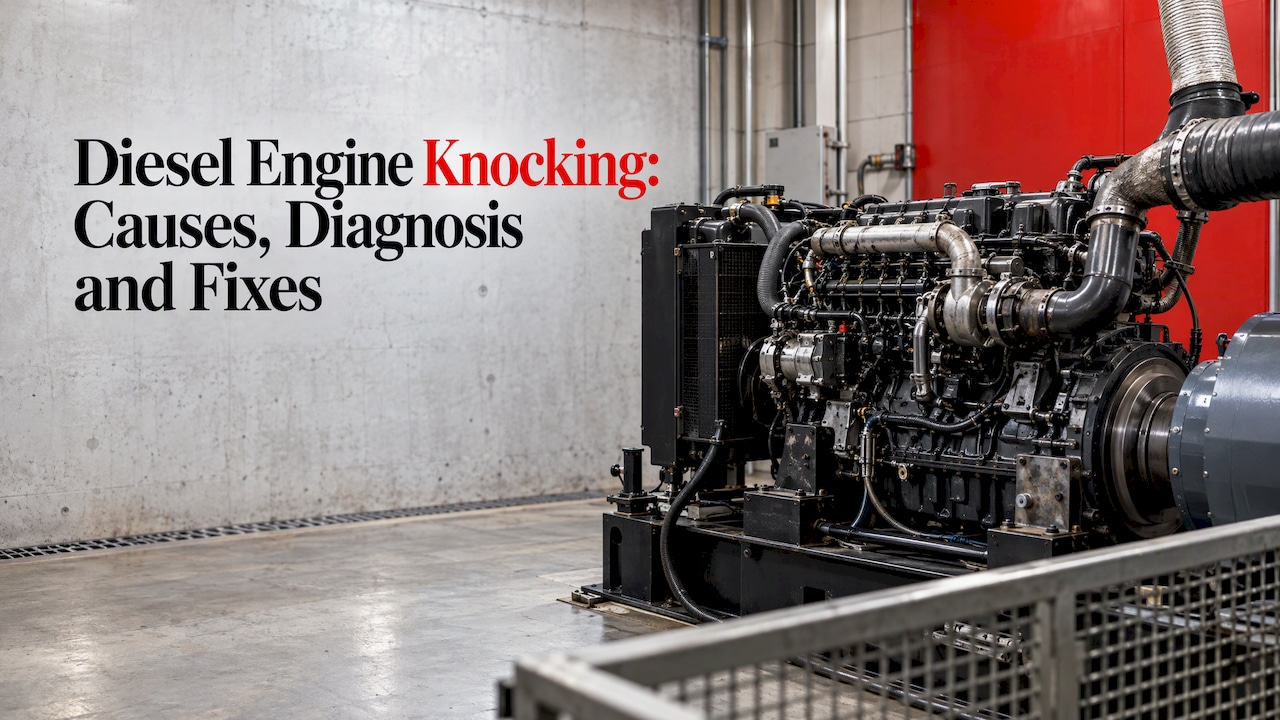
A diesel always makes some combustion noise, so the first job is to tell normal clatter from a knock that is hurting the engine. A harmful knock usually comes from ignition starting late: fuel injected, then burning all at once. The usual culprits are poor or contaminated fuel, a leaking or badly spraying injector, wrong injection timing, or low compression. A deeper pounding from the bottom of the engine is a different problem and means shutting down. If the fault turns out to be a worn injector, seal or fuel-system part for a Yanmar or Sensei engine, we supply those parts at Iberspares.
TL;DR
- Diesel knock is the sound of fuel igniting after an abnormally long delay, so a lot of it burns at once and sends a sharp pressure wave through the cylinder.
- Start with the cheap, likely causes: fuel quality, air in the fuel, a leaking or sticking injector, then timing and compression.
- A light, sharp clatter that fades as the engine warms is often not the same fault as a heavy, rhythmic pounding that gets worse under load.
- Mechanical pounding or hammering means stop the engine. Continued abnormal combustion can fracture piston crowns and ring lands.
- Work in order, confirm the repair with a test under load, and replace the part the diagnosis points to, not the one that is easiest to reach.
Table of Contents
- What diesel knock actually is
- Normal clatter, combustion knock or mechanical knock?
- The most common causes of diesel knock
- Why it knocks under load
- Can knocking damage the engine?
- How to diagnose it step by step
- Getting the right part the first time
- Preventing diesel knock
- Promo: parts for Yanmar and Sensei engines
- Perspective
- FAQ
- Sources
What diesel knock actually is
A diesel has no spark plug. Air is compressed until it is hot enough to ignite fuel the moment it is sprayed in. Between the start of injection and the start of burning there is a short gap called the ignition delay. When that gap is normal, fuel burns progressively as it arrives and the engine runs with its familiar clatter.
When the delay stretches, more fuel collects in the cylinder before it lights. Research on diesel knock and its detection describes knock as high pressure-rise rates when this accumulated, premixed fuel auto-ignites together. The result is high-amplitude pressure waves that ring around the combustion chamber. That is the sharp, metallic rap you hear.
So “knock” is a combustion problem, not a loose part. The same paper links excessive knock to poor or contaminated fuel and to injection-system faults, which is why most diagnosis starts at the fuel side.
Normal clatter, combustion knock or mechanical knock?
Before you pull anything apart, decide which of three things you are hearing.
| Sound | Typical behavior | Likely family of causes |
|---|---|---|
| Normal diesel clatter | Steady, even, same as when the engine was healthy | None, this is the engine’s own sound |
| Combustion knock | Sharp rap, often in time with firing, can change with load, fuel or temperature | Fuel quality, injectors, timing, compression, intake |
| Mechanical knock | Heavy pounding or hammering, often from the lower engine, tied to engine speed | Worn bearings, loose or damaged internal parts, piston-related wear |
Three practical points sharpen this.
Know the engine’s normal. Normal clatter has to be judged against that particular engine at its speed and load. Navy engine-room guidance says operators should learn the normal sounds and investigate abnormal changes promptly. On a fleet or a rental pool, that means someone who has heard each unit healthy.
Cold-only noise is a clue, not a verdict. An acoustics study on combustion noise and piston slap reports that piston slap is most noticeable when the engine is cold, because piston-to-bore clearances are wider, and that it decreases as the engine warms. If your noise fades with temperature, do not assume it is injector knock.
Pounding is not clatter. The same troubleshooting material separates mechanical pounding or hammering from fuel knock, and it advises immediate shutdown if detonation is occurring.
The most common causes of diesel knock
No single cause dominates across all engines, so it helps to group them by what they do to the ignition delay or to the amount of fuel in the cylinder.
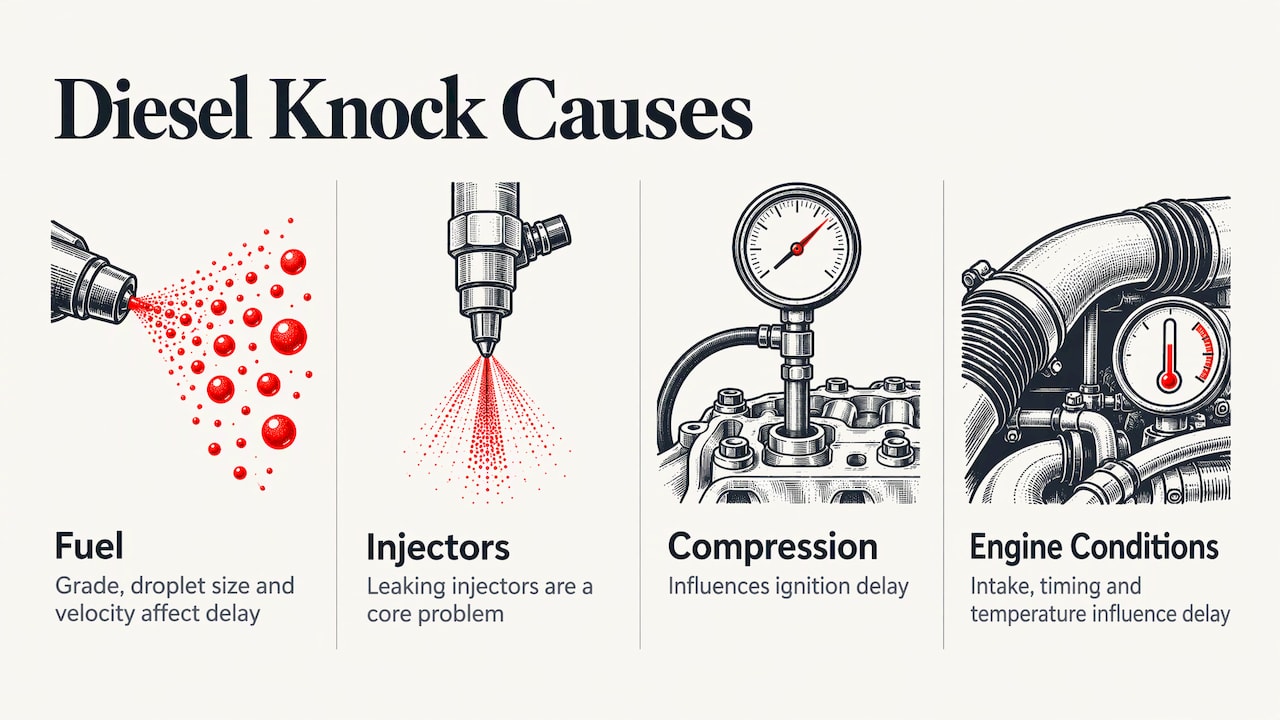
An engineering bulletin on diesel combustion names delayed ignition, incomplete combustion and leaking injectors as the core of the problem. It adds that ignition delay is influenced by fuel droplet size and velocity, compression, fuel grade, intake conditions, injection timing and engine temperature. Each of those is a place to look.
Fuel quality and air in the fuel
Low-cetane (slow-igniting), stale or contaminated fuel lengthens the delay directly. Air in the fuel does something similar by upsetting how much fuel reaches the injectors. A manufacturer’s diagnostic bulletin for a common-rail diesel puts fuel quality and air in the fuel at the very start of its procedure, ahead of any component swap.
On equipment that sits, such as standby generators, seasonal farm machinery, and boats laid up for the winter, fuel age and water are the first suspects. On a work site, a recent fill from a different supplier is worth a note.
Injectors
Injectors are the most frequent hardware cause. A leaking or dribbling injector puts extra fuel in the cylinder at the wrong time. A worn nozzle with a poor spray pattern produces large droplets that burn late. A stuck-open injector overfuels one cylinder, and a diesel that is overfueled can give a deep bottom-end sound that mimics a bearing problem, as one widely read technician tip describes. Treat that as a reason to test injectors before you condemn the crankshaft.
Injection timing and the supply side
The manufacturer’s bulletin also lists supply-pump or fuel-pulsation faults, rail-pressure sensing problems and ECM-related issues. On older mechanical engines, timing that has drifted advanced or retarded changes the delay. On electronic engines, a sensor reading wrong can cause the controller to inject at the wrong moment.
Compression and the air side
Low compression makes the air less hot at injection, so the delay lengthens. Worn rings, leaking valves and a damaged head gasket all do this. The same bulletin includes intake-system leakage or blockage, EGR (exhaust gas recirculation) and intake-shutter faults among the possible causes, which is why a restricted air filter or a leaking intake hose belongs on the checklist.
Heat, oil and cooling
Engine temperature affects the delay, so a thermostat stuck open or a cooling problem can change the sound. Low or wrong oil is also on the diagnostic list, partly because oil in the wrong place or at the wrong level can itself make noise and cause damage.
Why it knocks under load
A knock that appears only when the engine works hard points to causes that need high fuel delivery or high cylinder pressure. Our reading of the combustion mechanism above is that load raises the amount of fuel injected per cycle, so any weakness in fuel delivery, atomization or air supply is exposed.
Symptoms alongside the knock narrow the cause:
- Black smoke with the knock: more fuel than the air can burn. Look at the air filter, intake leaks, the turbocharger and injector spray quality.
- White or grey smoke, rough running when cold: unburned fuel, which is common with a weak injector, low compression or cold, slow-igniting fuel.
- Loss of power, hunting or surging: air in the fuel, a blocked filter, a tiring supply pump or low rail pressure.
- Knock disappears when you lift off: points to combustion, not an internal mechanical part.
- Knock constant at all loads and rises with engine speed: treat it as possibly mechanical and stop.
- Coolant loss, milky oil or overheating: stop and investigate the head gasket or cooling system before running again.
On generators, under-load knocking often shows up when the set picks up its first real load after long idling. On marine engines, it can appear at cruising rpm when a fouled fuel filter starves the engine. On compact equipment and forklifts, it tends to appear during hydraulic or lifting demand. In each case the pattern is the same: the engine needs more from a part that is already marginal.
Can knocking damage the engine?
Yes, and the damage scales with how long you keep running. An engineering bulletin warns that continued abnormal combustion can overload components and fracture piston crowns and ring lands. It adds that incomplete combustion can wash away cylinder-wall lubrication, leading to overheating, scuffing, wear and eventually ring-land or skirt damage.
A short, mild knock on a cold start that goes away is not the same as a heavy knock under load. Use this rule:
- Shut down at once if the sound is a pounding or hammering, if it gets louder under load, or if it comes with a sudden drop in oil pressure, overheating or heavy smoke.
- Stop working the engine if the knock is combustion-type but persistent. Idle it only as long as needed to find the problem.
- Keep it in service briefly only for a light, steady clatter that matches the engine’s known normal, and then only while you schedule an inspection.
On a boat offshore or a generator in an outage, the pressure to keep running is real. A damaged piston costs far more downtime than a planned injector change, so decide in advance who has the authority to shut a unit down.
How to diagnose it step by step
The sequence below follows the order used in a manufacturer’s diagnostic procedure, which moves from cheap, quick checks to component-level work.
1. Check fuel first
Look at the fuel in a clear container for water, sediment or haze. Check for air by inspecting the fuel lines and filter housing. The bulletin directs checking fuel for air early. Replace a dirty filter, and if the fuel is old or suspect, drain and refill.
Where it goes wrong: swapping injectors while the real problem is a tank of poor fuel.
2. Check the basics around the engine
The same procedure covers the air filter, oil level and condition, coolant, idle speed and maximum speed, and the vacuum pump. A restricted air filter or low oil is a five-minute check that saves hours.
3. Locate the sound
Use a mechanic’s stethoscope or a sounding bar to find where the noise is loudest, as both the bulletin and the Navy guidance recommend. Move along the block, injectors and valve cover. A sound that is loudest at one injector points to that cylinder. A sound that is loudest low on the block points to the bottom end.
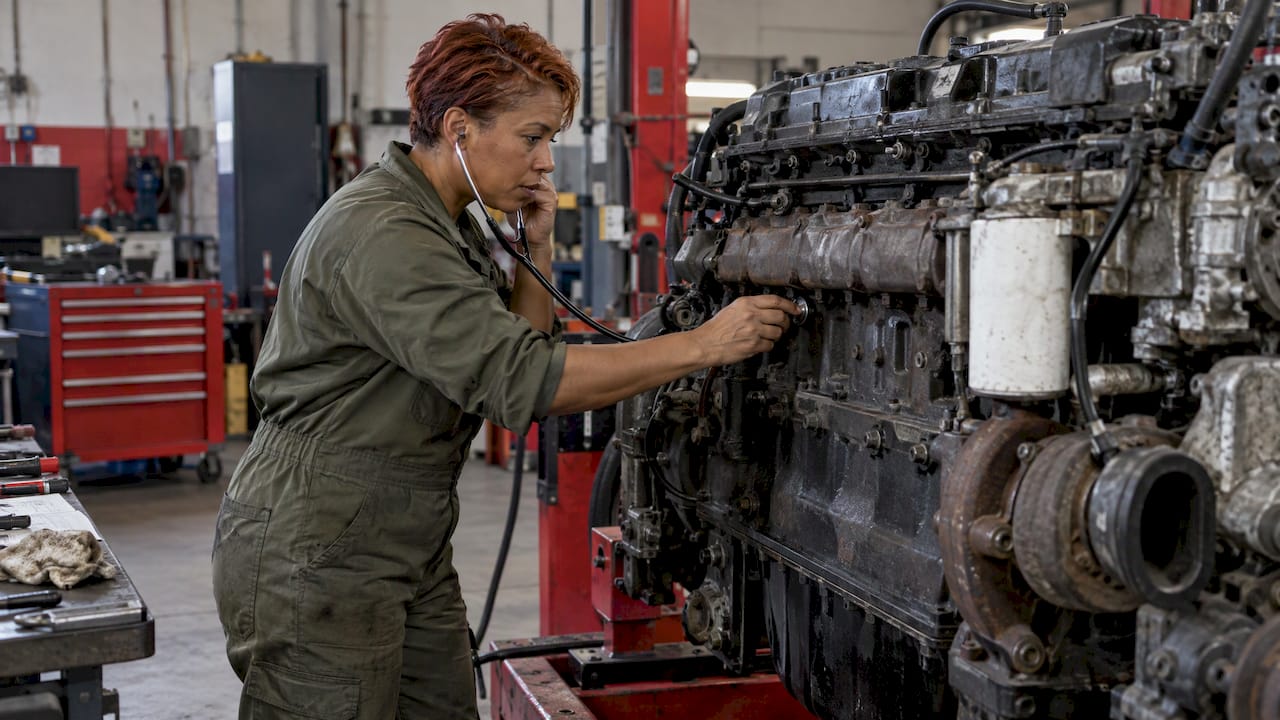
Where it goes wrong: judging by ear from the operator’s seat. Sound carries through metal and misleads.
4. Isolate the cylinder
On engines where it is safe and the design allows, check each injector’s contribution by testing them one at a time against the service manual. A cylinder that makes no difference when its injector is cracked open, or that smells strongly of fuel, is a lead. Compression testing separates a combustion-side fault from a hydraulic one.
5. Move to the fuel system and sensors
Then come the supply pump, common rail, injectors, sensors, the electronic driver unit, the turbocharger, and intake and exhaust. On electronic engines read fault codes first, because a sensor reading can explain a timing error without any worn parts.
6. Repair, then confirm under load
The bulletin calls for repairing or replacing the component the diagnosis indicates, then confirming with a driving test. For equipment, that means working the machine at the load where it knocked: a loaded generator, a full-throttle run, a lift cycle. Silence at idle proves little.
For serious analysis, researchers find that cylinder-pressure sensors are the most effective direct way to detect knock, while acoustic-emission sensors can monitor multiple cylinders without opening the engine. Most workshops will not need either to find a leaking injector, but they explain why a reading beats a guess when a fleet shows a recurring problem.
Getting the right part the first time
Diagnosis is only half the job. The repair stalls when the part ordered is almost right: an injector for a different application, a seal kit from a neighboring model, a filter that fits but flows differently. On knocking jobs this matters more than usual, because injectors, nozzles, seals and fuel components are specific to the engine and its application, whether construction, agriculture, marine or power generation.
Before you order, have these ready:
- Engine model and serial number from the data plate, not just the machine model
- The application (generator set, excavator, marine propulsion, tractor, forklift)
- The faulty part’s number, if it is stamped or labeled
- Any modifications or earlier replacements
Replace injectors and seals as sets where the manual calls for it, and renew fuel filters at the same time so the new parts are not fed the contamination that caused the problem.
Preventing diesel knock
Most prevention is routine:
- Buy and store fuel carefully. Use fuel of the grade the engine specifies, keep tanks closed, drain water regularly, and do not leave standby fuel for years without checks.
- Change fuel and air filters on schedule, and sooner after a bad fill.
- Inspect injectors on a schedule suited to the hours and duty cycle, not only when the engine complains.
- Warm up and cool down properly, and avoid long idling, which leaves unburned fuel and deposits.
- Log the sound. A short note on each unit’s normal noise, with a phone recording if you like, gives the next technician a baseline.
- Keep critical wear parts on the shelf for engines that cannot be down: a spare injector set, seals and filters.
Promo: parts for Yanmar and Sensei engines
If your diagnosis points to an injector, seal, filter or other fuel-system part on a Yanmar or Sensei engine, Iberspares supplies parts for those engines across construction and industry, agriculture, marine, power and generators, material handling and compact equipment. We maintain an extensive in-stock inventory for rapid dispatch, and we identify application-specific components so the part you order matches the engine in front of you.

You can browse the full range on our Yanmar and Sensei parts store and order online.
Perspective
Most knocking jobs we hear about start the same way: a machine is down, the noise is loud, and someone wants a part today. The temptation is to guess.
Our view is that a knock is information. Fuel, injectors, timing, compression and air each leave a different signature, and the quickest repair is the one where the cause was identified before the order went in. That is where application knowledge matters. A Yanmar in a generator set, a marine auxiliary and a compact excavator can share a family of components but not the same part, and a near match costs you a second day of downtime.
That is why we focus on identifying the correct part efficiently and keeping stock ready to ship. For workshops and fleets, the goal is not only fixing the noise. It is making sure the replacement is right, so the engine returns to work and stays there.
Duarte
FAQ
Why do diesel engines make a knocking sound?
Because fuel ignites by compression, a small amount of knock is part of normal diesel combustion. It becomes a problem when a long ignition delay lets too much fuel burn at once, creating a sharp pressure wave. Poor fuel, injector faults and low compression are the usual triggers.
Does diesel knock cause damage?
It can. Continued abnormal combustion can overload components and fracture piston crowns and ring lands, and incomplete combustion can strip lubrication from cylinder walls. A heavy knock, or any pounding, calls for shutting the engine down and finding the cause before restarting.
Why does my diesel knock under load?
Load increases the fuel injected per cycle, so any weakness in fuel delivery, spray quality or air supply shows up. Check for black smoke, power loss and hunting. Begin with fuel quality, filters and air in the fuel, then injectors and the intake system.
How do I prevent knocking in a diesel engine?
Use fuel of the specified grade, keep it clean and dry, and replace fuel and air filters on schedule. Inspect injectors at intervals matched to the engine’s hours. Avoid prolonged idling and keep spare wear parts available for critical equipment.
Sources
- Diesel Knock Combustion and its Detection Using Acoustic Emission
- Combustion Noise and Piston Slap Noise: Identification
- Symptoms of engine trouble
- Engine Australia diesel combustion bulletin SB003
- Toyota troubleshooting bulletin EG-4010
Content strategy and optimisation for Google and AI-powered search platforms by Velveteen SaaS — specialists in online visibility and customer acquisition.