A cylinder head job is rarely just a head. On a diesel engine in a excavator, tractor, generator set or marine installation, the parts you order together decide whether the machine goes back to work once or comes back in a month. The reliable approach is to identify the engine and application first, then order the head, the sealing set, the fasteners and the valve train components as one matched list. That is how we approach it at Iberspares for Yanmar and Sensei engines, and this guide gives you the list and the reasoning behind it.
TL;DR
- A replacement head job involves four groups of parts: the head itself (bare or equipped), the sealing set, the fasteners, and the valve train components.
- An equipped head, which arrives with valves, springs, guides and seats fitted, can save parts cost and assembly time compared with a bare head.
- Some damage means replacement rather than repair: cracks, badly worn valve seats and sealing surface damage are not repairable by welding or stitching under the U.S. guidance for newer emissions engines.
- Fit depends on engine model, serial range and application, so work from the exact model’s parts catalog, not from the engine family name.
- Order the gasket set, bolts and seals in the same order as the head, so the machine is not stuck waiting for a small part mid-job.
Table of Contents
- What the cylinder head does, and why it matters for parts selection
- The four groups of replacement components
- When the head must be replaced rather than repaired
- Inspection limits to measure before you order
- A worked example: building the order for a marine diesel head job
- Matching components to the exact engine and application
- Where we fit: identification first, then the right parts in stock
- Perspective
- Order your head job components together
- FAQ
- Sources
What the cylinder head does, and why it matters for parts selection
The cylinder head closes the top of the combustion chambers and carries the parts that control what goes in and out of them. According to FPT Industrial’s cylinder head guide, the head is the seat for the valve train: intake and exhaust valves, cones, springs, rocker arms, tappets and camshaft. On a diesel it also carries the injectors, and it routes coolant to the block. The head gasket keeps coolant and oil out of the combustion chambers. The same guide notes that heads are aluminum alloy for light applications and cast iron for medium and heavy engines.
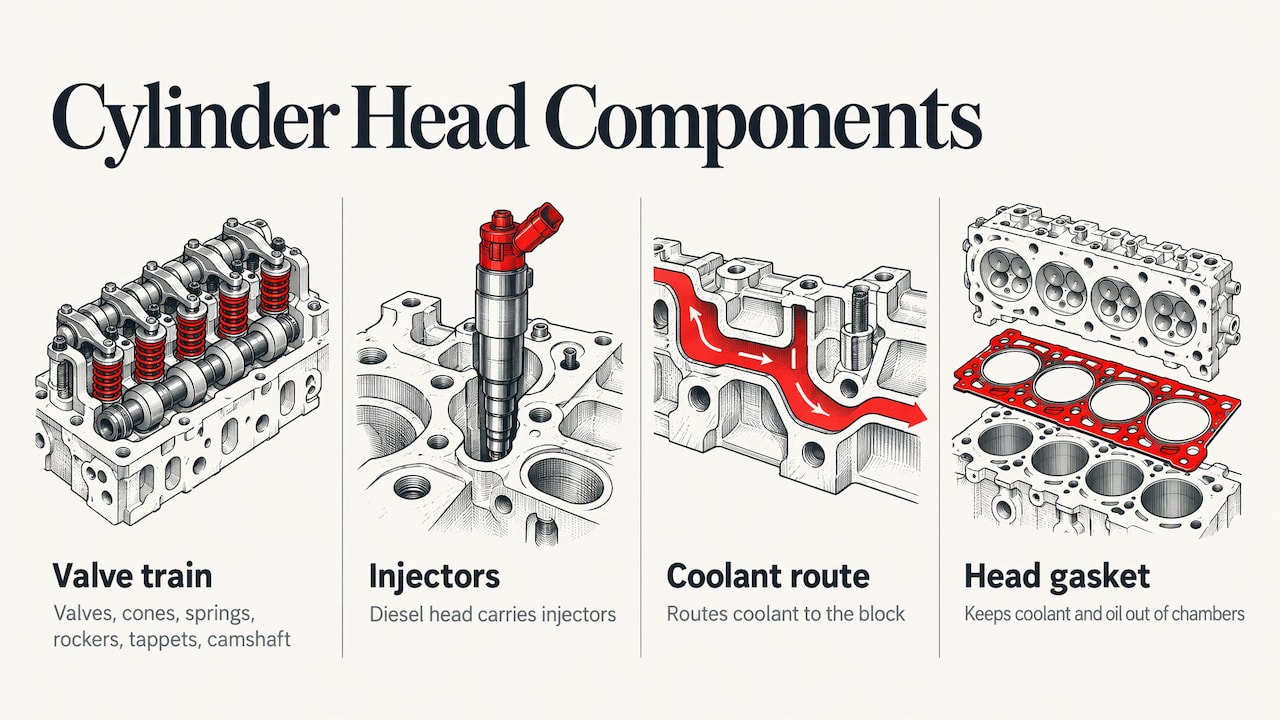
That list is the parts list. Every item the head carries is a wear item or a sealing item, and each can be damaged by the failure that made you pull the head, or by the removal itself.
The four groups of replacement components
1. The head: bare or equipped
A bare head is the casting alone. An equipped head comes with valve guides, valve seats, bushings, caps, O-rings, valves, springs and valve cones already fitted, along with injector holder cases. FPT Industrial describes this in its own range and says an equipped head saves the cost of buying those components one by one and up to one hour of assembly compared with a bare head, per the same FPT guide.
For a workshop billing by the hour, or a fleet with a machine down, that trade-off is worth working out before you order. If the head is cracked and everything on it is worn, an equipped head replaces a long list of separate lines with one. If the casting is sound and only the wear parts need attention, individual components make sense.
2. The sealing set
The gasket set is where small omissions cause big delays. A typical head gasket set for a diesel includes:
- the head gasket itself, made to withstand high temperatures, high pressures and metal expansion
- the valve cover gasket
- valve stem seals
- injector seals, sleeves or O-rings, depending on the design
- intake and exhaust manifold gaskets
- thermostat housing and coolant passage seals where the design calls for them
Sets are specific to the engine model. A set for one three-cylinder model will not cover a four-cylinder of the same family, and different thickness grades of head gasket exist on some engines. Order by the engine’s exact model and serial number, not by displacement.
3. Head bolts and fasteners
Head bolts are the component most often reused when they should not be. Many modern engines use bolts designed to stretch to a specified clamp load when tightened, and the manufacturer’s procedure tells you whether they are single-use. Follow the service manual for your engine: it gives the tightening sequence, the torque and any angle steps, and whether the bolts are replaced. Reusing a bolt that the manual marks as single-use puts the new gasket at risk of losing clamp load.
Order the bolt set with the head. It is a cheap line item compared with doing the job twice.
4. Valve train and related parts
These are the parts that sit in or on the head and wear with hours:
- Valves: intake and exhaust, replaced or reconditioned depending on face and stem condition.
- Valve guides: worn guides let the valve run off-center, which wears the seat unevenly.
- Valve seats: the surface the valve closes on, subject to wear and recession.
- Valve springs: checked for free length and pressure.
- Valve stem seals: replaced with every head job.
- Rocker arms, tappets and camshaft components: inspected for wear and clearances.
- Injector sleeves and seals: on diesels, the sealing surfaces here matter for compression and fuel system integrity.
When the head must be replaced rather than repaired
Not every damaged head is a candidate for rework. The NHTSA-published cylinder head reuse and replacement guideline for U.S. 2004 and newer emissions engines, commonly 2007 model year and later, requires replacement of the head for:
- any cracks
- damaged or excessively worn valve seats
- damage from rotated valve springs
- fretting under the head bolt flange or in the camshaft bearing housings
- pitting of the injector sleeve O-ring sealing surface
The same document states that welding or metal stitching of any part of the head is not an approved repair. This applies to the engines it covers, so check your engine’s service documentation for its own limits, particularly outside the U.S. market.
For workshops, this is a useful screening list. If a head fails one of these checks, the question is no longer whether to replace it but which head and which components to order with it.
Typical reasons heads come off
Vehicle Service Pros notes that head work is typically required because of a failed head gasket, worn or damaged valves and valve guides, or cracks in the casting, and that a head warped beyond acceptable limits may be corrected or replaced. Overheating is a common root cause behind warpage and cracking, so a head job should come with a look at the cooling system: thermostat, water pump, hoses and the coolant itself.
Inspection limits to measure before you order
Measuring the removed head tells you what you need to buy. The limits differ by engine, so the figures in your service manual govern. To show the kind of checks involved, one published passenger-car service manual, the 2010 Toyota Prius repair manual, sets maximum head warpage at 0.05 mm on the block side and 0.10 mm on the manifold sides. It calls for dye-penetrant crack checks, gives a spring free length with a maximum deviation, and specifies camshaft thrust clearance. It also requires new spark plug tubes with a new head. Those numbers belong to that gasoline engine and are not a diesel specification, but the checklist structure carries over:
- Flatness: lay a straightedge along and across the head face and measure with feeler gauges against the manual’s limit.
- Cracks: inspect between valve seats, around injector bores and in coolant passages; use dye penetrant where the manual calls for it.
- Valves and guides: measure stem-to-guide clearance and check for off-center wear.
- Seats: check width, recession and condition.
- Springs: measure free length, squareness and, where specified, load.
- Camshaft and bearing surfaces: check clearances and look for fretting in the housings.
Each failed check maps to a part number you add to the order.
A worked example: building the order for a marine diesel head job
Take a raw-water-cooled marine diesel that has overheated after an impeller failure, with white exhaust smoke and coolant loss. The head comes off and shows a warped face and a seat that has recessed on one exhaust valve.
The order list becomes:
| Need | Component | Why |
|---|---|---|
| Head fails flatness limit and seat is worn | Replacement head, equipped if the guides, valves and springs are also worn | Seat damage is a replacement trigger under the U.S. guidance above for the engines it covers |
| New seal | Head gasket set | Gasket, valve cover gasket, valve stem seals, injector seals |
| Clamp load | Head bolt set | Replace per the service manual |
| Overheating cause | Cooling system parts, such as thermostat and impeller | Prevents a repeat failure |
| Reassembly | Manifold gaskets, O-rings, sealing washers | Typically opened during the job |
The point of building the list before ordering is that a boat or generator set that is stripped down cannot wait for one forgotten seal.
Matching components to the exact engine and application
This is where most wrong-part orders start. A head for one engine family can look identical to another and still differ in port layout, valve count, gasket thickness or injector bore. Engines with more than two valves per cylinder can use shared (siamese) ports, and cross-flow designs place intake and exhaust on opposite sides of the head, which is one reason a visual match is not enough.
Work through these identifiers:
- Engine model and serial number from the engine’s data plate, not the machine’s plate.
- Application: the same engine block can be fitted with different heads, turbochargers, manifolds and cooling arrangements in marine, generator and industrial versions.
- The exploded parts catalog for that model. A good example of the structure is the Yanmar 4JH2 marine diesel parts catalog, which as described by this catalog listing runs to 110 pages of exploded figures with numbered parts lists, covering the cylinder head, camshaft and driving gear, injection pump and governor, turbocharger and gasket set across several 4JH2 variants.
- Part number cross-checks: confirm the number on the removed part against the catalog entry before ordering.
For marine work specifically, regional equipment and industry resources can help when you are sourcing across suppliers, for instance marine industry equipment and local parts support in Mexico.
Where we fit: identification first, then the right parts in stock
Iberspares supplies parts for Yanmar and Sensei engines and equipment across construction, agriculture, marine, power generation, material handling and compact equipment. Our focus is knowing which component belongs to which application, because that is the step where orders go wrong. We keep extensive stock for rapid dispatch, so a head job order can leave as one complete list instead of a head now and the small parts later.
If you are a repair workshop, a rental fleet, a dealer or a maintenance team, this is the practical benefit: one source that identifies the application, then supplies the head, the sealing set and the valve train parts together.
Perspective
A head job is decided before the first bolt comes out. When a machine is down, the expensive mistake is not the price of a gasket set. It is the second teardown, the wrong head for the application, or a day lost waiting for the one seal nobody listed.
Our work is built around Yanmar and Sensei applications: construction, agriculture, marine, power generation, forklifts and compact equipment. The same engine family can be configured differently from one application to the next, and we focus on identifying the right component for the right machine. That is what lets us keep the order short, the list complete and the dispatch quick from stock.
My advice to any workshop: write the complete list first, head, gasket set, bolts, valve stem seals and cooling parts, and send it as one order.
Duarte
Order your head job components together
A head job is decided before the first bolt comes out. When a machine is down, the expensive mistake is not the price of a gasket set. It is the second teardown, the wrong head for the application, or a day lost waiting for the one seal nobody listed.
Our work is built around Yanmar and Sensei applications: construction, agriculture, marine, power generation, forklifts and compact equipment. The same engine family can be configured differently from one application to the next, and we focus on identifying the right component for the right machine. That is what lets us keep the order short, the list complete and the dispatch quick from stock.
My advice to any workshop: write the complete list first, head, gasket set, bolts, valve stem seals and cooling parts, and send it as one order.
Duarte
If you are planning a head replacement on a Yanmar or Sensei engine, start from the engine model and application, then build the complete list described above. You can browse our full range of genuine Yanmar and Sensei parts, including categories for construction and industry, agriculture, marine, power and generators, material handling and compact equipment.

Ordering the head, gasket set, fasteners and valve train components in one go keeps the job to a single teardown and one reassembly.
FAQ
Are cylinder heads part of the engine?
Yes. The head is bolted to the top of the engine block and closes the combustion chambers. It carries the valves and, on diesels, the injectors, and it routes coolant between the block and the head through the head gasket.
What is a cylinder kit, and how is it different from head components?
A cylinder kit generally refers to the parts of the cylinder bore side of the engine, such as the liner, piston and rings. Head components are the parts above that: the head, gasket set, bolts and valve train. A full overhaul can involve both, but they are ordered as separate groups.
Is it worth replacing a cylinder head?
It depends on what the inspection finds. Cracks and badly worn valve seats call for replacement under the U.S. guidance for newer emissions engines, and a head warped beyond its limit may be corrected or replaced. On a machine that earns its living, an equipped replacement head can shorten the assembly work and return the engine to service sooner.
Do I need a new head gasket set with every head?
Yes. The gasket set seals the head to the block and the surrounding systems, and valve stem seals and injector seals are normally replaced when the head is serviced. Order the set together with the head and the bolts specified by your service manual.
How do I know a replacement head fits my engine?
Use the engine model and serial number from the engine data plate, confirm the application, and match the part number against the exploded parts catalog for that model. A visual match is not enough, because ports, valve count and gasket thickness can differ within a family.
Sources
Content strategy and optimisation for Google and AI-powered search platforms by Velveteen SaaS — specialists in online visibility and customer acquisition.