
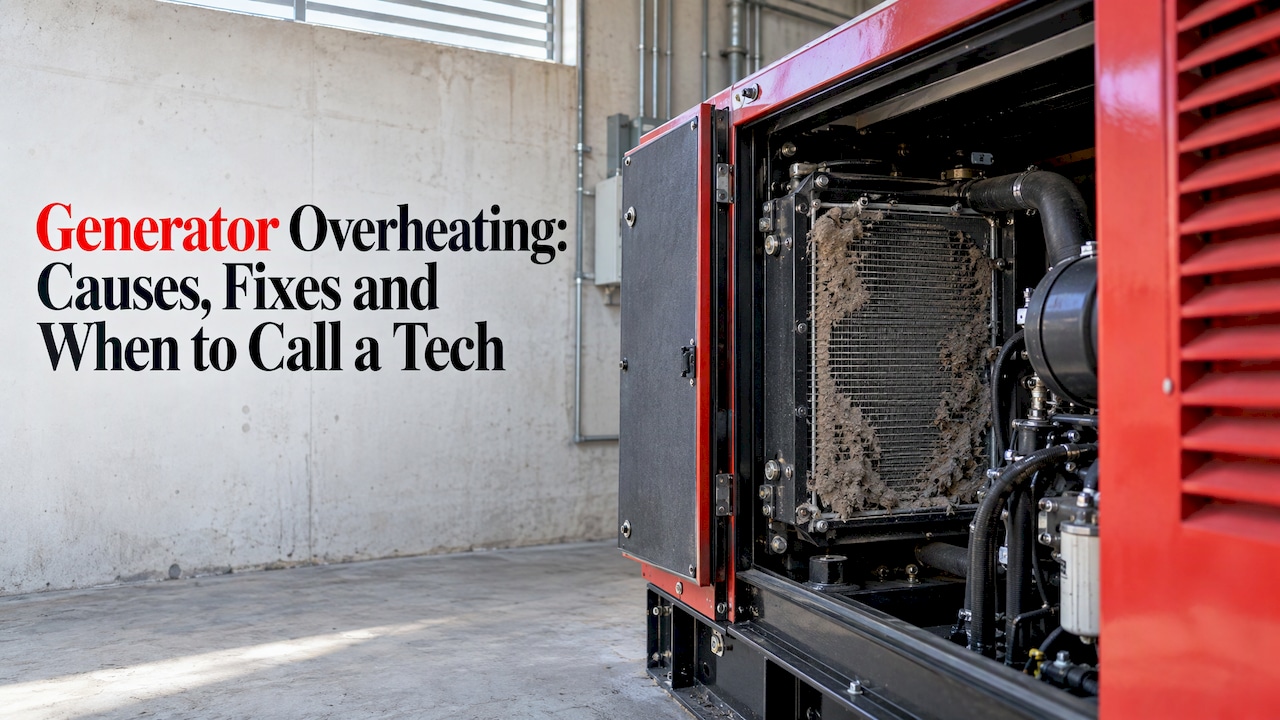
When a generator overheats, shut it down safely, let it cool, and then work through the cooling path in order: coolant level, radiator and airflow, fan and belt, thermostat, water pump, and load. Most overheating comes from one of those six things, and the first three cost almost nothing to check. This guide gives you the safe first steps, the causes behind a trip when the coolant looks full, what voltage swings and high fuel use can tell you, and the point where a technician should take over.
TL;DR
- Unload the engine and let it idle briefly if it is safe to do so, then stop it and wait. Never open a hot radiator cap.
- Check in this order: coolant level and leaks, radiator face and air inlet and outlet, fan and belt, thermostat, water pump, then load.
- A full coolant tank does not rule out overheating. A stuck thermostat, failed pump, air lock or bad sensor can all do it.
- Overheating, voltage fluctuation and high fuel consumption can share causes such as overload and unstable engine speed, but each also has separate causes.
- If it overheats again after the basic checks, stop and get a qualified technician. Do not keep restarting it.
Table of Contents
- What to do the moment a generator overheats
- Why a generator overheats
- Overheating with a full coolant tank
- A diagnostic sequence that saves time
- Overheating, voltage swings and fuel use
- Construction equipment engines that overheat
- What to check on a Sensei generator
- Preventive maintenance rhythm
- Perspective
- Getting the right parts for the repair
- When to stop and call a technician
- FAQ
- Sources
What to do the moment a generator overheats
The first job is safety, not diagnosis. A cooling system at operating temperature is pressurized, and its coolant sits well above its normal atmospheric boiling point. Opening the pressure cap on a hot engine can cause flash-boiling and throw scalding coolant at whoever is standing there. So the sequence is simple.
- Take the load off. Kubota’s engine manual tells operators to unload the engine and idle it for about five minutes before stopping. If steam keeps coming out, keep clear.
- Stop the engine and wait. The same manual says to wait more than 30 minutes before working on the cooling system, and never to remove the radiator cap while it is hot.
- Write down what happened. Note the load and the temperature at the moment of the trip. That detail often points straight at the cause.
- Do not shock the engine. Do not pour cold water into a hot engine and do not wash a hot radiator.
One reference point helps with reading the gauge. The Wacker G25 operator information gives a normal operating temperature of 170 to 190°F and directs the operator, after a high-coolant-temperature shutdown, to stop above 221°F, allow cooling, then inspect coolant level and leaks, check fan-belt tension, and test the temperature sender and wiring. Your own unit’s manual gives the figures that apply to your engine, so use those first.
Warning signs before the shutdown
A generator rarely goes from fine to tripped without hints. Watch for a temperature gauge climbing toward the warning band, a dashboard alert, coolant on the ground under the set, steam or vapor, a fan that sounds wrong or a belt that squeals, and a drop in performance. Heavy-equipment guidance lists the same signs, and they apply equally to a genset in a trailer or a plant room.
Why a generator overheats
Heat has to leave the engine as fast as it is made. Overheating means either the engine is making more heat than usual or the cooling system is removing less. Almost every cause fits one of those two.
Too little cooling
- Low coolant or a leak. The most common cause, and the cheapest to check.
- Blocked radiator fins or core. Dirt, dust, chaff and debris between the fins cut airflow. Kubota lists dirt between radiator fins and tubes and a clogged radiator water pipe among its overheating checks.
- A loose or worn fan belt. A slipping belt turns the fan and often the water pump too slowly.
- A thermostat stuck closed. Coolant never gets to the radiator.
- A weak water pump. A worn impeller or seal moves less coolant.
- A defective radiator cap. It can no longer hold pressure.
- Wrong coolant mix. The U.S. Army excavator maintenance manual lists plain water used instead of the correct coolant mixture as a cause.
Too little air
A generator needs air to cool its radiator and often its alternator. Carrier’s troubleshooting table lists clogged vents or baffles, high surrounding temperature, and insufficient or recirculated air among the causes of generator overheating. In practice:
- Canopy doors left open can pull air through the wrong path.
- A set pushed against a wall or inside a room with no outlet duct re-breathes its own hot exhaust air.
- Missing shrouds or baffles let hot air loop back around the fan.
Scania’s cooling guidance stresses preventing hot-air recirculation, locating the fan and fan ring correctly, and keeping a radiator safety margin for fouling. That margin matters on dusty farms and job sites, where fouling is constant.
Too much heat produced
- Overload. Running above rated output makes the engine work harder than the radiator was sized for. Carrier lists overload and unbalanced load as causes.
- Hot, high or humid sites. Power ratings assume certain conditions. Hot air, altitude and humidity all reduce what the set can deliver, so a load that was fine in spring can trip it in August.
- Fuel and air faults. The U.S. Army manual also lists a plugged air filter, injection pump timing that is off, and excessive fuel delivery.
- Low oil. Oil carries heat away as well as lubricating.
Overheating with a full coolant tank
This is the question that stalls most people: the reservoir is full, so why is it hot? A full tank only proves coolant is there, not that it is moving or reaching the radiator. Causes that remain possible include:
| Cause | What happens | How you might notice |
|---|---|---|
| Thermostat stuck closed | Coolant stays in the engine and never reaches the radiator | Upper radiator hose stays cool while the engine runs hot |
| Failed water pump | Little or no coolant circulation | Radiator coolant relatively cool while engine overheats |
| Air lock after refilling | Effective coolant volume is lower than it looks | Overheating soon after a coolant service |
| Blocked radiator fins | Heat cannot leave the coolant | Dirt visible on the radiator face |
| Failed fan or belt | No airflow across the core | Squeal, slack belt, fan not turning |
| Collapsed hose | Flow restricted | Hose soft or flattened when hot |
| Faulty sensor or gauge | False reading, or a real overheat not shown | Gauge disagrees with how the engine feels |
The causes in that table come from a troubleshooting list covering a full reservoir, and a failed pump or thermostat can leave the radiator coolant cool while the engine overheats. Test the temperature sender and wiring before replacing expensive parts, as the Wacker procedure suggests.
A diagnostic sequence that saves time
Work from cheapest and fastest to slowest. Every step below assumes the engine is stopped and cool.
- Coolant level. Check the expansion tank, and the radiator itself only once fully cold. Look for wet spots, crusty residue and drips under the set.
- Radiator face and air path. Look for debris, bent fins and blocked inlets or outlets. Check that canopy doors are closed and that hot air is ducted out of any enclosure.
- Fan and belt. Check for cracks, glazing, oil contamination and tension. Huaquan Power’s maintenance guide gives 10 to 15 mm of deflection under moderate thumb pressure as a typical belt check, though your manual’s figure comes first.
- Hoses and cap. Squeeze them for softness, look for bulges, and check the cap seal.
- Thermostat. If the engine runs hot but the upper hose stays cool, suspect it.
- Water pump. Look for weeping at the weep hole, shaft play or noise.
- Load. Compare actual load to the set’s rating and to the derating for site conditions.
Air-cooled sets
Air-cooled units have no coolant, so the checks change. Look at cooling fins and the engine shroud for packed debris, check the air inlet and the flywheel fan for damage, and confirm the exhaust side moves air freely. Also check oil level, the air filter and the load. A guide to overheating on small portable units adds fuel problems that cause lean running, carburetor and fuel flow, and the spark plug to the list. Never refuel a hot engine or touch the muffler and covers until they cool.
Liquid-cooled sets
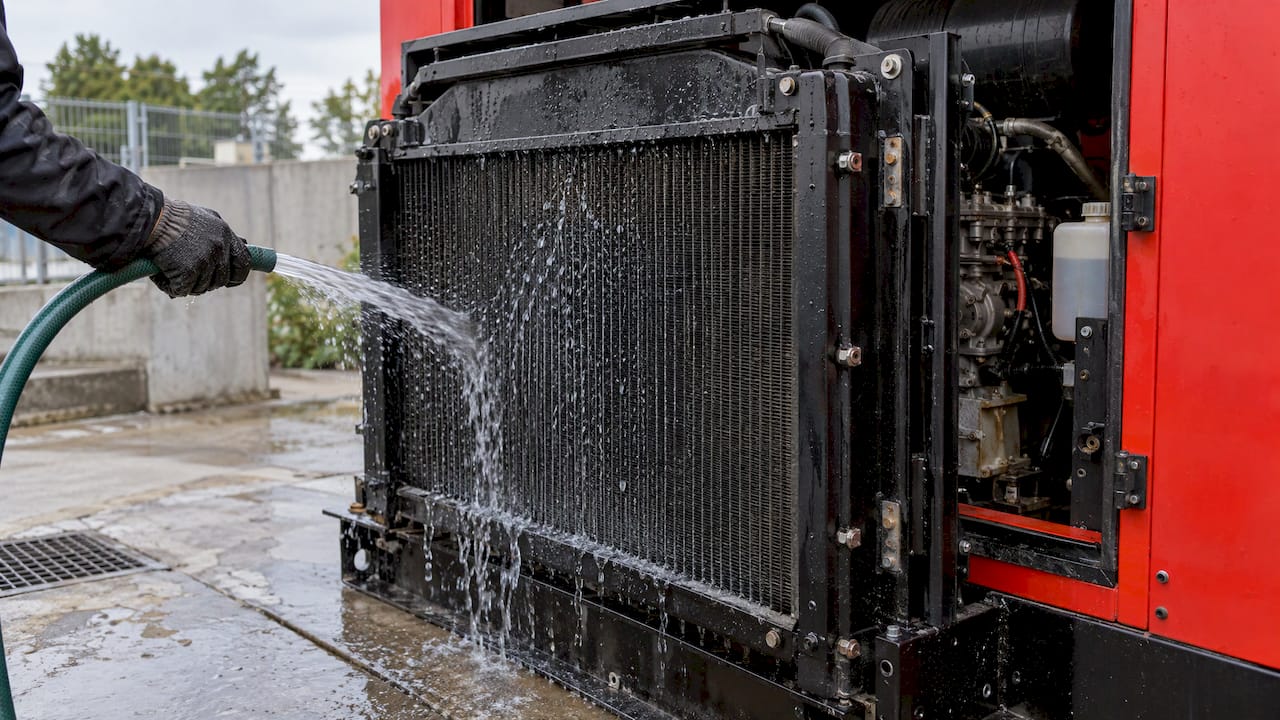
PowerTech’s operator manual calls for a 50/50 mix of coolant and clean, soft water, checking the radiator level only after the engine has fully cooled, and checking the reservoir between FULL and LOW at least every 25 operating hours. It also says to clean the radiator core with running water and never with hard objects. Follow the coolant specification in your own engine’s manual, since it differs between makers.
Overheating, voltage swings and fuel use
Readers often arrive with two symptoms at once: the set runs hot and the voltage wanders, or it burns more fuel than before. They are sometimes connected and sometimes not.
Voltage fluctuation
Carrier’s table lists fluctuating or irregular engine speed, loose terminals or load connections, or a bad bearing as causes of fluctuating voltage. A dry or bad bearing appears on both its overheating and fluctuating-voltage lists, which is one place the two symptoms can meet. Low voltage has its own causes there: low engine speed, high-resistance connections that get worse when warm, or loss of rotor magnetism.
Other sources point to a faulty AVR, worn alternator components and inconsistent RPM behind low or unstable output. Overheating itself is hard on the voltage regulator and insulation, so fixing the heat problem early protects the electrical side.
Overheating and voltage faults also appear as separate fault codes. The Cummins operator manual lists engine over-temperature checks of coolant level, blockages and load reduction apart from over-voltage, under-voltage, frequency, voltage-sense and governor faults. Treat them as separate until the diagnosis says otherwise.
High fuel consumption
An engine fighting heat and overload burns more fuel. Other causes sit in the fuel system: fuel leaks, injector over-delivery or inefficient load management. The Army manual also lists excessive fuel delivery and plugged air filters as overheating causes, so a dirty air filter can produce both heat and fuel waste. Rising consumption on the same load is a reason to inspect the set, whatever the fuel.
Light loads count too
Running a diesel set too lightly causes its own trouble. Load-bank guidance says prolonged operation below roughly 30% load can cause incomplete combustion, carbon deposits and dirty turbochargers. The same page says load-bank testing can reveal overheating, unstable voltage, frequency swings and fuel-delivery problems under realistic load, which a simple start-up check cannot.
Construction equipment engines that overheat
The same physics applies to the engine in an excavator, loader or compact machine, with more dust and harder duty. The U.S. Army excavator manual lists the causes in a long, practical sequence: low coolant, a thermostat stuck closed or missing, a plugged radiator screen, cores plugged with dirt or bent fins, a bad gauge or sender, an oily or worn fan belt, missing shroud or baffles, a fan blade on backward, a defective cap, a faulty water pump, and even hydraulic system overheating. A company guide to heavy equipment engines adds that dust, high ambient temperatures and continuous digging or pushing raise cooling demand.
To stop it recurring:
- Clean radiator surfaces at the end of every dusty shift, not when the gauge climbs.
- Check hoses, belts and connections on a schedule.
- Investigate any repeated coolant loss. Topping up again and again hides a leak.
- Service the cooling system before a demanding project or a hot season.
- Keep within the machine’s rated operating limits.
What to check on a Sensei generator
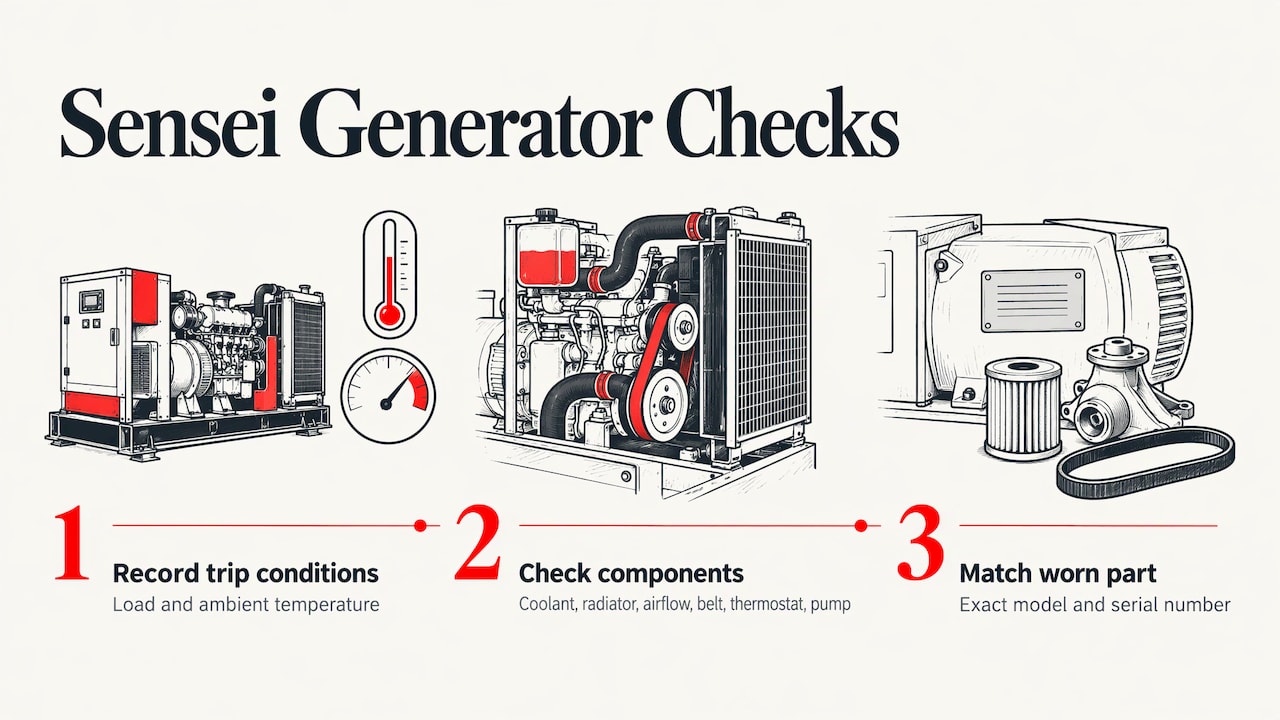
A Sensei set follows the same logic as any liquid-cooled or air-cooled engine-driven generator, so start with the sequence above and your unit’s own manual for coolant type, capacities and temperature limits. Record the load and the ambient temperature when it trips, then check coolant, radiator face, airflow, belt, thermostat and pump in order. If the check points at a worn part, match it to the exact model and serial number before ordering. Fitting a near-match part is how a second failure follows the first.
Preventive maintenance rhythm
Huaquan Power’s cooling guide offers a useful pattern, which you should adapt to your engine’s manual:
- Daily: coolant level in the expansion tank between MIN and MAX when cold, a look for leaks, and a listen for fan noise or belt squeal.
- Weekly or every 50 hours: belt tension, radiator cap seal, clean the fins with low-pressure compressed air.
- Annually or every 2,000 hours: drain and flush the system, replace the thermostat and cap, pressure-test the radiator, and refill with fresh coolant mix.
The full guide lists the details, including pressure ratings and freeze-point checks.
Perspective
Overheating is rarely a mystery part. It is usually a worn consumable that someone postponed: a belt, a thermostat, a cap, a hose. The generators that stay reliable are the ones where those parts are replaced on schedule and with the right fit.
At Iberspares we focus on Yanmar and Sensei engines and equipment, and on how the same engine is used differently in construction, agriculture, marine and power generation. That application knowledge is what lets us identify the right component quickly, which cuts the errors and delays that stretch downtime. We keep an extensive inventory in stock for rapid dispatch, so a routine service part or an emergency repair part does not turn a one-day job into a week.
Our advice to workshops and fleet managers: keep a small set of cooling-system spares for each engine you maintain, and always order against the engine model and serial number.
Duarte
Getting the right parts for the repair
Once you know what failed, the next job is getting the correct part without a wrong delivery. Iberspares supplies spare parts for Yanmar and Sensei engines and equipment across construction and industry, agriculture, marine, power and generators, material handling and compact equipment. We designed our process around identifying application-specific components efficiently, and we hold extensive in-stock inventory for rapid dispatch.

Browse the Yanmar and Sensei parts catalog and have your engine model and serial number ready when you order.
When to stop and call a technician
Some overheating is a ten-minute fix. Some is not. Stop and get a qualified technician when:
- The set overheats again after you have checked coolant, radiator airflow, fan, thermostat, pump and load.
- Coolant keeps disappearing with no visible leak, or oil looks milky.
- Temperature rises quickly with a clean radiator and good coolant. A head-gasket leak, blocked internal coolant passage or faulty ECU sensor can be behind that and needs workshop tools.
- There are electrical symptoms, such as burning smells, tripped protection or unstable output.
The Wacker manual is direct on this: do not restart until the cause is determined and fixed, and have generator repairs done only by a trained electrician familiar with the equipment. That applies to the electrical end of the set. Engine cooling-system repairs belong with a diesel mechanic who knows the model.
FAQ
Can a generator overheat when it runs for long periods?
Yes, if the cooling system is dirty, low on coolant, or the load is above what the set can carry in the site’s conditions. Long runs expose weaknesses that short tests hide. Clean the radiator, check coolant and belt before a long run, and compare load to the rating adjusted for heat and altitude.
Why is my engine overheating but the coolant is full?
The coolant may not be circulating or the air may not be reaching the radiator. A thermostat stuck closed, a failing water pump, an air lock, blocked fins, a slipping belt or a bad temperature sensor can all do it. Check them in that order once the engine is cool.
Can overheating cause voltage fluctuation?
It can contribute, because heat stresses the regulator and windings, but voltage swings also come from unstable engine speed, loose connections, a faulty AVR or a bad bearing. Check the engine speed and connections first, then have the electrical side tested.
Is it safe to open the radiator cap on a hot engine?
No. The system is pressurized and the coolant can flash-boil and spray. Wait at least 30 minutes, and touch-test the upper radiator hose before removing the cap.
Sources
- Wacker G25 operator information
- Kubota engine operation manual
- Generator cooling systems guide
- May Machinery: heavy equipment engine overheating
- Carrier genset troubleshooting
- U.S. Army excavator manual, engine malfunctions
- Scania cooling system guidance
- High coolant temperature troubleshooting
- Generator shutdown on high temperature
- Huaquan Power cooling system guide
- Generator overheating checks
- PowerTech operator manual
- Cummins generator operator manual
- Diesel generator troubleshooting guide
- Load bank testing guide
Content strategy and optimisation for Google and AI-powered search platforms by Velveteen SaaS — specialists in online visibility and customer acquisition.