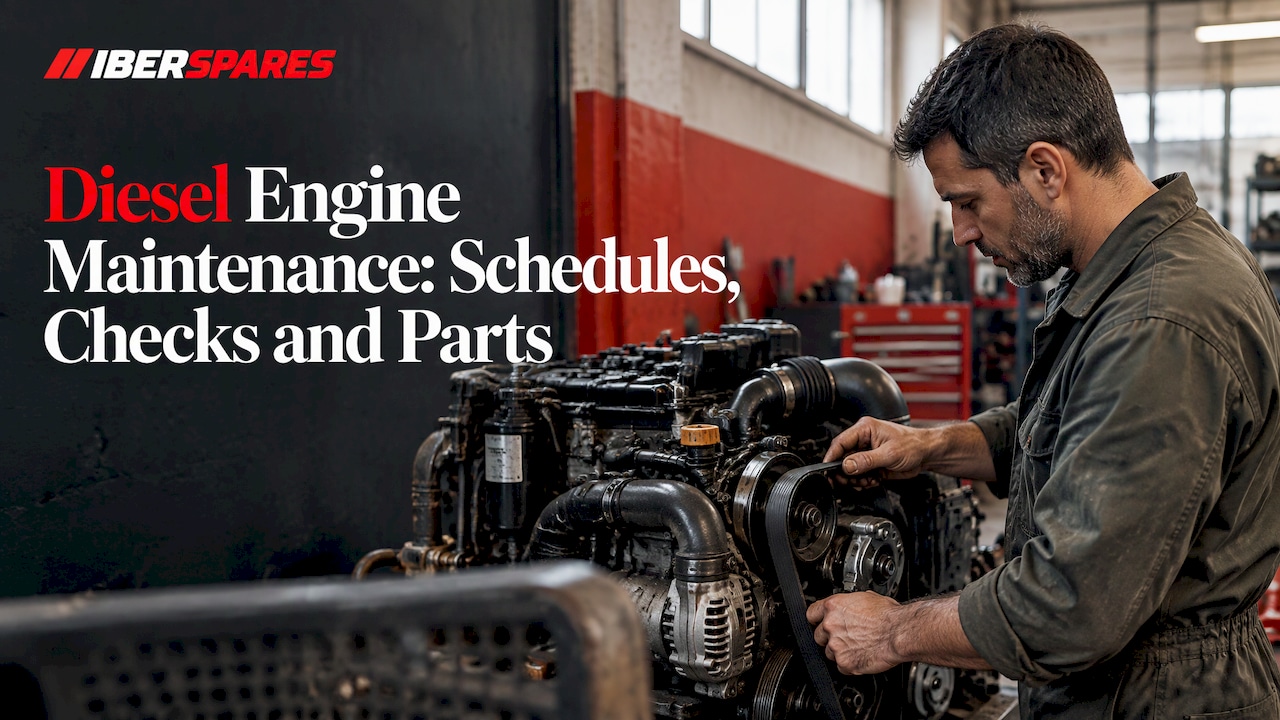
Diesel engine maintenance comes down to three things: clean oil, clean fuel and air, and a cooling system that holds its limits. You do them at the intervals in the manufacturer’s manual, and you shorten those intervals when the work is hard. Most failures traced back to maintenance come from a missed interval or a wrong part, not from a mysterious fault. So the routine is simple. What costs you downtime is having the correct filter, belt or injector part number in hand when the hour meter says it is due. For Yanmar and Sensei engines, that is where we come in: we supply the parts for these engines across construction, agriculture, marine and power generation, and we know the applications they go into.
TL;DR
- Work to the hour meter and the calendar, whichever comes first. Yanmar’s industrial guidance puts oil, fuel and air filter replacement at 500 hours, with fan belt tension at 250 hours.
- Dust, heat, short runs and idling count as severe duty. Perkins halves its standard 500-hour oil and filter interval to 250 hours for severe service.
- Oil, fuel, coolant and air each have a few measurable limits. Check them daily and log them.
- Standby generators and seasonal boats run few hours, so they are serviced by the calendar, not the meter.
- Buy parts against the engine’s model and serial number, and stock the next service kit before it is due.
Table of Contents
- What a diesel engine actually needs
- Daily and pre-start checks
- Service intervals: how to read them
- Maintaining Yanmar engines
- The checklist by system
- Records, hours and warning signs
- What you can do and what belongs to a technician
- Why parts planning is half of maintenance
- Our perspective
- Get the service parts for your Yanmar or Sensei engine
- FAQ
- Sources
What a diesel engine actually needs
A diesel has four systems that decide its life: lubrication, fuel, air intake and cooling. An industry guide on reliable operation makes the point that fuel is about 75% of total operating cost, and that the cooling system has to carry away roughly 30% of the heat of combustion continuously. Neither system forgives neglect for long.
The same guide calls lubrication perhaps the single most important element of a maintenance program. Oil lubricates, protects against corrosion, neutralizes combustion contaminants and helps cool and seal. That is why the first line of every schedule is oil and filter.
Daily and pre-start checks
Daily checks take minutes and catch most developing problems. The schedule for the Yanmar YT235 tractor lists daily checks of engine oil, hydraulic oil, tire pressure, the grille, the fuel tank and the safety systems. Marine guidance from the Royal Yachting Association is similar: daily checks of fuel, crankcase oil and fresh water coolant levels, plus a look for leaks.
A practical daily list for any diesel:
- Oil level. Check on level ground. After a hot shutdown, Detroit Diesel’s manual says to wait about 20 minutes before reading the dipstick. An oil level that keeps rising can point to fuel or coolant dilution, which needs diagnosis.
- Coolant level and condition. Look at the expansion tank and the hoses.
- Fuel supply and water separator. Drain water from the primary filter or separator.
- Belts, clamps and wiring. Look for fraying, loose clamps and chafed cables.
- Gauges and leaks. Note pressure, temperature and any drips under the engine.
Write the hour-meter reading down while you do it. That single number drives everything else.
Service intervals: how to read them
Intervals differ by make, model and duty, so the manual for your engine is the authority. The patterns below show how they are built.
| Source | Oil and filter | Fuel filter | Air filter | Other |
|---|---|---|---|---|
| Yanmar industrial engines | 500 h | 500 h | 500 h | Fan V-belt tension 250 h |
| Yanmar YT235 tractor | 250 h or 1 year | 500 h or 2 years | 500 h or 1 year | Coolant 2,000 h or 2 years; valve clearance 1,000 h |
| Perkins 904F-E28T | 500 h or 1 year (250 h severe) | per manual | per manual | Yearly if under 500 h in 12 months |
| RYA marine guidance | 100 to 150 h or per season | 300 h | Inspect annually | Gearbox oil 150 h or annually |
Two things stand out. First, nearly every interval is “hours or time, whichever comes first.” Cummins states it plainly for its ISMe5 engine: an A check every 400 hours or 6 months, a B check at 3,000 hours or 12 months, and a C check at 9,000 hours or 3 years, with work due at whichever comes first. Second, the same engine family can carry different intervals in different machines, which is why you check the manual for the exact machine.
Hours, not miles
Off-road machines are scheduled by the hour meter because an hour of idling still wears the engine. Road-going engines are scheduled by distance or fuel burned, and Detroit Diesel splits its schedules into Severe Service, Short Haul and Long Haul. Severe service covers dusty, extreme-climate, construction, city and farm use. Most of the machines our customers run fall into that category.
Low-hour engines are different
A standby generator might run 30 hours a year, and many sailing yachts run only around 50 hours under power annually. For those, calendar-based service is what protects the engine. Perkins requires yearly oil and filter changes if the engine runs fewer than 500 hours in 12 months. Deutz says the same: oil should be changed at least yearly if annual hours stay below the table value. The RYA’s expert approach is to change oil at the start of winter lay-up, so combustion acids do not sit on metal surfaces through storage.
For emergency generators, Scania’s operator manual tells you to run the engine to operating temperature and check oil, coolant, fuel, battery and leaks, then follow the yearly and five-yearly service items.
Adjust for conditions
Perkins says schedules can be moved ahead or back depending on practices, operation and application. Deutz gives concrete cases: oil change intervals should be halved for fuels with 0.5 to 1% sulphur, for biodiesel to DIN 51606, or in continuous temperatures below −10°C. Dusty quarries, harvest season and long idling all justify earlier air filter and oil service.
Maintaining Yanmar engines
Yanmar diesels turn up in compact excavators, tractors, generator sets, forklifts and boats, and the schedule follows the application. Three published examples show the range.
Industrial engines. Yanmar’s after-sales guidance sets the lube oil filter, fuel filter and air cleaner element at every 500 hours, and the cooling fan V-belt at 250 hours for tension adjustment. Its failure examples include prolonged use of oil and filters, insufficient lubrication and neglected intake valves.
Tractors. The YT235 schedule adds coolant every 2,000 hours or 2 years, valve clearance every 1,000 hours, fuel injection nozzle check every 1,500 hours, ECU and sensor inspection every 3,000 hours or 2 years, and DOC/soot filter replacement every 9,000 hours. It also marks which tasks the user can do and which belong to an authorized dealer. That document specifies 4.3 liters of ACEA E3/E4/E5 SAE 10W-30 oil, a 50:50 distilled water and antifreeze coolant mix, and NLGI Grade 2 grease at the front axle pivot, tie-rod ends and lift link. Fuel must meet EN590 with sulphur no higher than 10 mg/kg and cetane of at least 45, and Yanmar approves B7 blends with up to 7% FAME.
Recreational marine. Yanmar’s marine FAQ says each engine’s operation manual includes a periodic maintenance section with suggested service points at 50, 250, 500 and 750 hours.
The lesson: use the model’s own manual, then match each service point to the part numbers for that exact engine. That is a parts identification job, and it is the one we do all day.
The checklist by system
Oil and filters
Change oil and filter at the interval, and shorten it in severe duty. Oil analysis, covering contaminants, wear metals, soot, oxidation, total base number and sulfated ash, belongs in the program for significant engines. Its rule of thumb: if in doubt, change the oil and filter. Westerbeke’s marine cards, for example, put oil changes at 100 hours and the first service, with oil and fuel filter changes plus valve clearance and belt adjustment, at 50 hours.
Fuel
Use fuel suited to the engine and keep the filters fresh. Diesel should not be stored more than 12 months, which matters for backup generators. Drain water from the separator and check tank bottoms for water and sediment; the RYA lists this as a weekly marine job. Detroit Diesel says to replace the fuel filter when pressure difference reaches 0.3 bar (4.0 psi).
Air intake
The same Detroit manual caps intake restriction at 5.0 kPa (20 in. H2O) and calls for the dry element to be replaced after one year or at maximum restriction, whichever comes first. The NPIP guide asks for air filters at least equal to original equipment. A dusty site can reach restriction in weeks, so check the indicator, not only the calendar.
Cooling
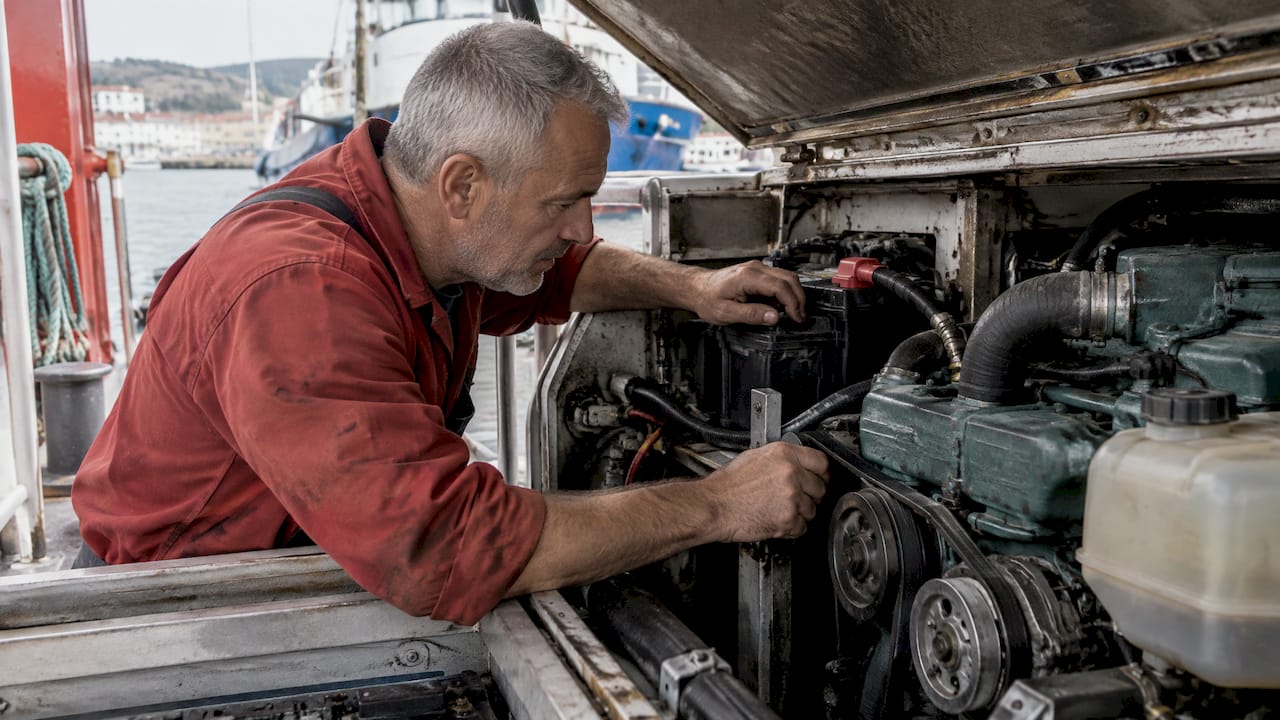
Keep coolant within the stated glycol limits: no more than 60% ethylene glycol or 50% propylene glycol, never water alone, according to the same guide. Keep the system tight and free of air. Check hoses, belt tension and, on marine engines, the raw water strainer, anodes and impeller. The RYA lists weekly strainer and belt checks and annual anode, hose and exhaust elbow inspections.
Electrical
Check battery charge and electrolyte, terminals, alternator belt and wiring. Scania’s low-hour routine includes battery charge, and the RYA lists weekly electrolyte checks on boats.
Emissions equipment
On engines with a diesel particulate filter, maintenance is part of compliance. The California Air Resources Board explains that a DPF can hide engine problems once visible as smoke, and that worn injectors and dirty air or fuel filters raise soot that plugs the filter. It recommends logging coolant and oil consumption and using low-ash CJ-4 oil. Keeping the bay itself clean also makes leaks and weeps easier to see; a guide to cleaning an engine bay safely covers the cleaning side.
Records, hours and warning signs
An interval you cannot prove is an interval you may not have met. Detroit Diesel notes that evidence of regular maintenance is essential for warranty claims, and Perkins recommends keeping a maintenance record as part of the engine’s permanent record and posting the schedule near the engine.
A workable record has one line per service:
- Date and hour-meter reading
- Work done and interval it satisfied
- Part numbers and quantities used
- Oil and coolant top-ups since the last entry
- Anything odd: smoke, noise, temperature, pressure
Treat these as signs to act before the next interval: oil level rising or dropping between checks, rising coolant or oil consumption, a filter restriction indicator in the red, repeated fault codes, more frequent DPF regeneration, or oil analysis results showing wear metals. The hour meter says when service is due; these signs say when it is already late.
What you can do and what belongs to a technician
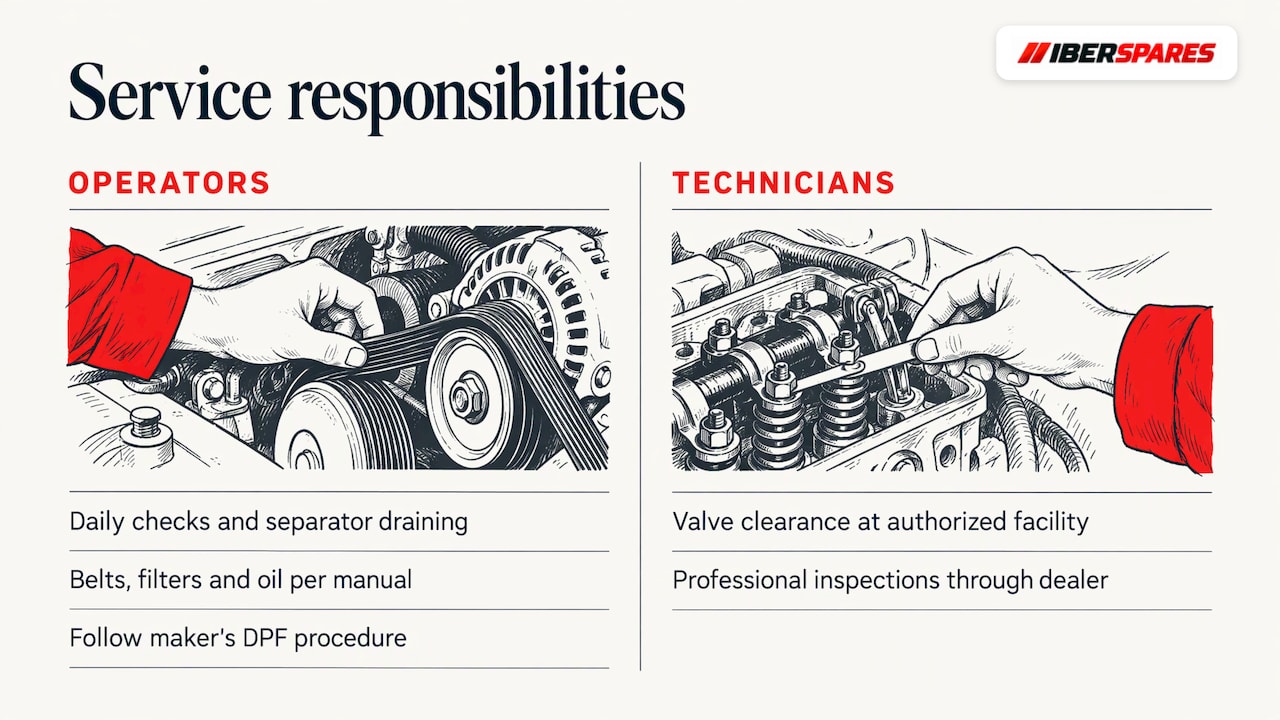
Operators can do the daily checks, drain separators, check belts and replace filters and oil as the manual describes. Some work is marked for authorized technicians in the manufacturer’s tables, for example valve clearance. Detroit Diesel says valve lash should be done at an authorized facility because correct clearance gives best performance at lowest emissions. Yanmar likewise recommends inspections be carried out by professional service staff through the nearest dealer. For DPF-equipped engines, follow the manufacturer’s regeneration and service procedure.
Yanmar also offers an engine support site with manuals, 3D models, a trouble code search and parts information, which helps you identify the exact engine before ordering.
Why parts planning is half of maintenance
A schedule lists the intervals. It does not tell you that the 500-hour kit needs a fuel filter, a separator element, an air element and a belt that fit your specific build. Most delays come at that point: the wrong filter ordered, the right one backordered, a machine parked for a week.
A few habits remove the problem:
- Record the engine model and serial number with each machine, not only the machine brand.
- Build a service kit list per interval (250, 500, 1,000 hours) and order ahead.
- Keep one spare set of the most-used filters and belts for engines in severe duty.
- Order emergency parts for standby units before the season, not after the outage.
Our perspective
Maintenance is a promise you make to the machine, and the promise is only as good as the parts behind it. We spend our days matching Yanmar and Sensei engines to the components they need, across construction, agriculture, marine, power generation, material handling and compact equipment.
What we see in this work is that the application changes the answer. The same engine family behaves differently in a harbor workboat and in a field tractor, and the right part depends on both. That is why our approach is to identify the correct part for the specific application first, then keep it in stock for fast dispatch, so a routine service stays routine and an emergency repair stays short.
Plan the service kit before the hour meter reaches the interval, and downtime stops being a surprise.
Duarte
Get the service parts for your Yanmar or Sensei engine
Maintenance is a promise you make to the machine, and the promise is only as good as the parts behind it. We spend our days matching Yanmar and Sensei engines to the components they need, across construction, agriculture, marine, power generation, material handling and compact equipment.
What we see in this work is that the application changes the answer. The same engine family behaves differently in a harbor workboat and in a field tractor, and the right part depends on both. That is why our approach is to identify the correct part for the specific application first, then keep it in stock for fast dispatch, so a routine service stays routine and an emergency repair stays short.
Plan the service kit before the hour meter reaches the interval, and downtime stops being a surprise.
Duarte
If your next service is coming up, our catalog covers genuine Yanmar and Sensei parts for construction and industry, agriculture, marine, power and generators, material handling and compact equipment. We focus on application-specific components and on identifying the right part quickly, and we keep extensive stock for rapid dispatch.
Browse Yanmar and Sensei parts by application, or start from the Iberspares catalog, with the engine model and serial number to hand.
FAQ
How often should a diesel engine be serviced?
It depends on the make, model and duty. Yanmar’s industrial guidance sets oil filter, fuel filter and air cleaner replacement at 500 hours, while its YT235 tractor schedule changes oil every 250 hours or one year. Apply whichever limit, hours or time, is reached first, and shorten intervals for dusty, hot or stop-and-go work.
What is the most important diesel maintenance task?
Oil and filter changes on schedule. An industry guide on reliable diesel operation calls lubrication perhaps the single most important element of a maintenance program. Clean fuel, a good air filter and correct coolant follow close behind.
How do I service a diesel that runs only a few hours a year?
Go by the calendar. Perkins and Deutz both call for at least a yearly oil and filter change when annual hours fall below the table value. Run standby engines to operating temperature and check oil, coolant, fuel, battery and leaks, and do not store diesel fuel longer than 12 months.
Which Yanmar parts do I need at a 500-hour service?
For industrial engines, Yanmar lists the lube oil filter, fuel filter and air cleaner element, with the fan V-belt tension checked at 250 hours. Exact part numbers depend on the engine model, so match them to the model and serial number before ordering.
Sources
- Maintaining diesel engines for reliable operation (NPIP)
- Maintenance, After Sales Service (Yanmar)
- YT235 maintenance document (Yanmar)
- Recreational marine periodic maintenance FAQ (Yanmar)
- Yanmar engine service support
- Dealing with diesel engines (RYA)
- Heavy-Duty Diesel Engine Maintenance (California Air Resources Board)
- Scheduled Intervals, EuroV MBE 900 operator’s manual (Detroit Diesel)
- Preventive Maintenance Intervals (Detroit Diesel)
- Recommended maintenance schedule, ISMe5 (Cummins)
- Operation and Maintenance Manual, 904F-E28T (Perkins)
- Operation Manual, 1012/1013 (Deutz)
- Clean engine bay: safe steps and ceramic protection
Content strategy and optimisation for Google and AI-powered search platforms by Velveteen SaaS — specialists in online visibility and customer acquisition.