
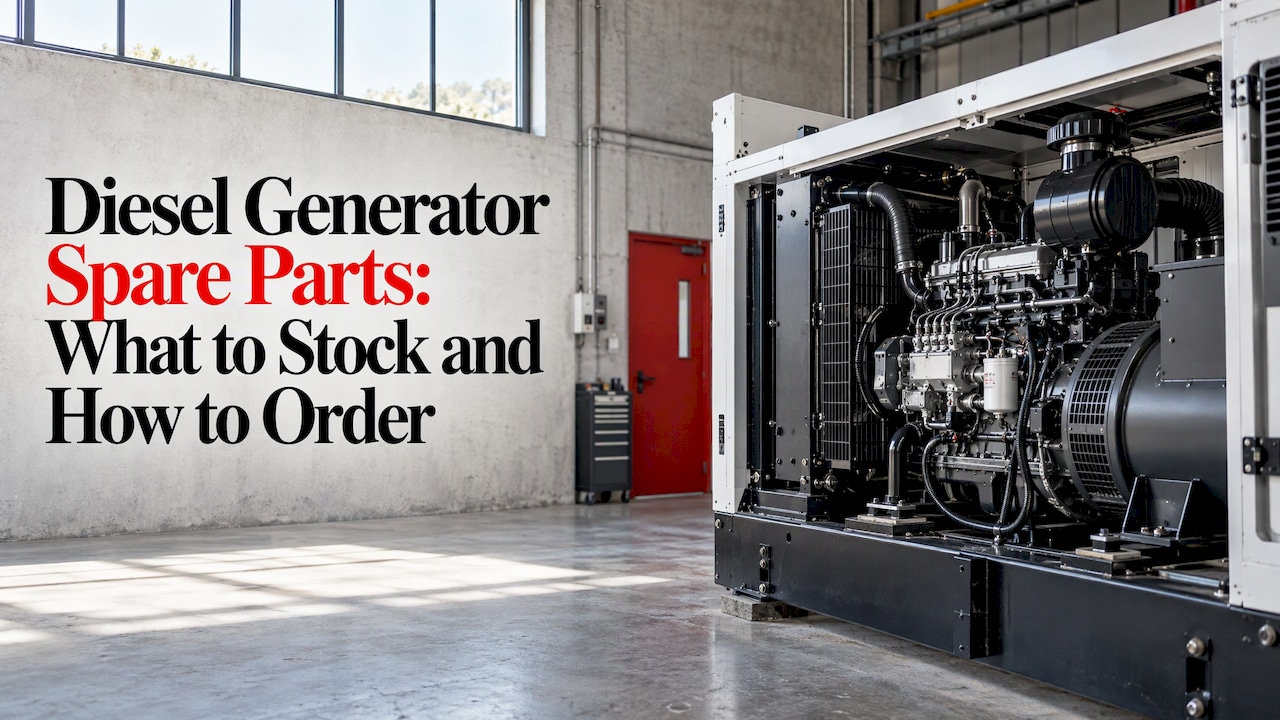
The right diesel generator spare part is the one matched to the engine’s exact model and application, and on your shelf before the set stops. Most downtime comes from two things: ordering a part that almost fits, and discovering the lead time after the failure. This guide covers the parts that wear out, how to identify them correctly, how to build a short stock list, and how conditions in construction, farming, marine and standby power change the list. For Yanmar and Sensei engines, Iberspares supplies the parts and the application knowledge to identify them.
TL;DR
- A generator set is an engine, an alternator, a fuel system, a cooling system and controls. Most spare-part demand sits in the consumables and the small control parts, not in major castings.
- Identify a part from the engine model and serial number plus the application, never from the generator’s brand name alone.
- Keep a short, written must-stock list: filters, belts, hoses, sensors, a starter and gasket sets, decided before the first breakdown.
- Application matters: a standby set, a jobsite set, a farm PTO-replacement set and a marine auxiliary wear differently.
- For Yanmar and Sensei engines, we hold extensive in-stock inventory for rapid dispatch and help match the part to the machine.
Table of Contents
- What a diesel generator is made of, and where parts wear
- How to identify the correct part
- Genuine, OEM or aftermarket: what to check
- Checking a part before installation
- When parts should be inspected or replaced
- Building a short must-stock list
- Spare-parts needs by sector
- Why buying from an application specialist cuts downtime
- Order Yanmar and Sensei generator parts from Iberspares
- FAQ
- Sources
What a diesel generator is made of, and where parts wear
A diesel generator set is a diesel engine coupled to an alternator, with a fuel tank, starter motor, battery, control panel and often an acoustic enclosure. A maintenance handbook for diesel generator sets lists exactly these components, and describes how the lube oil pump draws oil from the pan and pushes it through the oil cooler and filter to the bearings and cylinder liners, while the radiator and fan remove the heat the coolant has absorbed.
That description already tells you where parts go. Anything that filters, circulates, seals or transmits wears with running hours. Anything electronic or electrical fails with age, vibration and heat. Group the set into five systems and think in those terms.
Lubrication and filtration
Oil filters, oil, and the oil pressure sender. The sender matters more than its size suggests: a generator guide from a manufacturer notes that the oil pressure sensor triggers an alarm or shutdown when pressure drops too low, so a faulty one can stop a healthy engine or fail to protect a damaged one.
Fuel system
Fuel filters and water separators, fuel lines, the lift pump, and injectors. Diesel contamination, water and long storage are the usual enemies. Filters are the cheapest part on the list and the most common reason a set starves and stalls under load.
Air intake and exhaust
Air filter elements, intake hoses, clamps, and on turbocharged engines the turbo and its gaskets. The same guide points out that the air filter keeps dust from scoring pistons and cylinders, which is why a clogged or torn element is a wear problem long before it is a power problem.
Cooling system
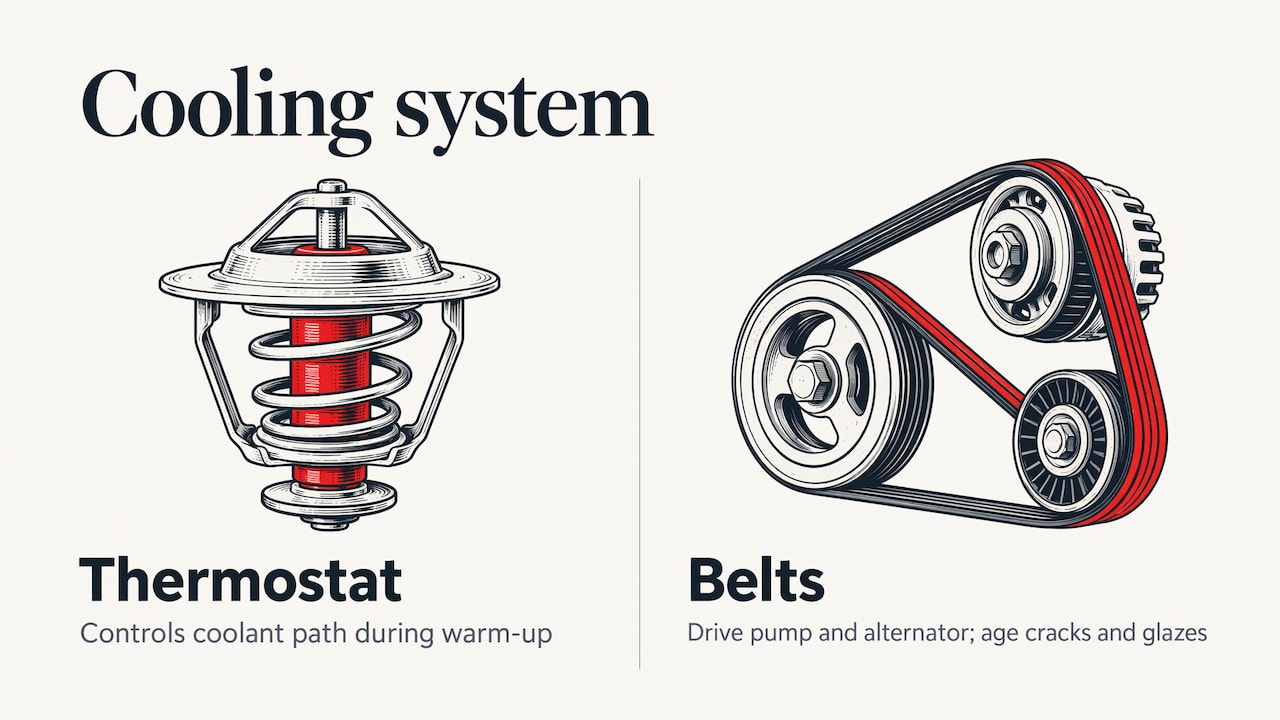
Thermostat, water pump, hoses, belts, radiator cap and coolant. The thermostat controls the coolant path during warm-up, so a stuck unit produces either slow warm-up or overheating. Belts drive the water pump and charging alternator, and they crack and glaze with age whether or not the set runs much.
Starting, charging and controls
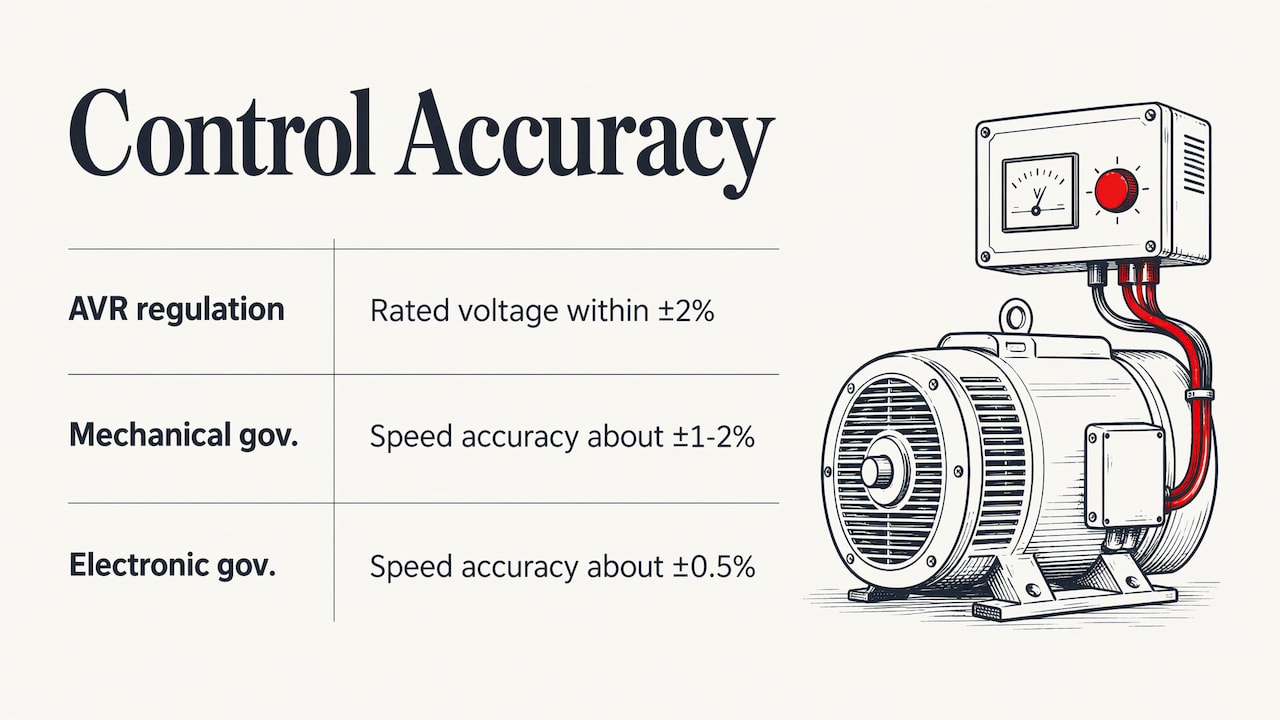
Starter motor, solenoid, glow plugs where fitted, batteries, battery charger, relays, fuses and the governor and voltage-regulation components. The AVR (automatic voltage regulator) watches stator voltage and adjusts exciter current to hold output near rated voltage, which the same guide puts at within ±2%. The governor holds engine speed; the guide gives mechanical governors an accuracy of about ±1 to 2% and electronic ones about ±0.5%. When either drifts, sensitive loads trip first.
How to identify the correct part
Wrong-part orders are the quiet cost in generator maintenance: a day lost in shipping, another in return, and a machine still down. A reliable identification routine has five steps.
- Read the engine plate, not the generator plate. The set builder’s nameplate gives kVA, voltage and frequency. The parts you need depend on the engine maker’s model and serial number, usually on a plate or stamped on the block. Photograph it.
- Record the application. The same engine block is often fitted to a generator, a compact excavator, a tractor or a marine auxiliary, with different fuel pump settings, cooling arrangements, mounting brackets and governors. A part number that fits one build may not fit another.
- Note the build details that vary within a model. Alternator type, starter rotation and voltage, filter head design, and whether the engine is turbocharged are common differences. Write down what you can see before you order.
- Compare the old part to the listing. Check dimensions, connector shape, thread, and number of mounting holes. Keep the old part until the new one is installed and running.
- Order by part number, and confirm it against the engine serial number. A supplier who knows the engine family can catch conflicts you cannot see from a photo.
Step 5 is where we put our effort. Our positioning is deep technical knowledge of Yanmar and Sensei applications and efficient identification of the correct part, so that errors and delays are minimized. Send the engine model, serial number and what the machine does, and the part is matched to the application rather than to the brand name on the set.
Genuine, OEM or aftermarket: what to check
The choice is rarely about the label. It is about whether the part is made to the engine maker’s specification for your engine, and whether you can trace it. When you compare options, check these points:
- Part number traceability. The part should map to a specific engine part number and not to a generic “fits most” description.
- Fit to the exact engine build. Compare dimensions and connector types with the part removed from the engine.
- Packaging and markings. Sealed packaging, clear part numbers and batch markings help you track a part through its life.
- Warranty terms in writing. Know what happens if a part fails early, including who pays for labor.
- Material and finish on wear items. Seals, liners, bearings and injector components are where tolerance matters most.
For Yanmar and Sensei engines, the simplest route is the genuine part, and that is what our site is built around. You avoid tolerance doubt on the parts where engines are least forgiving.
Checking a part before installation
A five-minute bench check saves a second teardown.
- Compare the new part with the old one side by side: dimensions, ports, thread pitch, gasket faces.
- Check seals and O-rings for the right material and size; do not reuse old ones.
- Turn rotating parts by hand. A pump or starter that binds on the bench will not free up on the engine.
- Check electrical parts for connector fit and correct voltage, 12 V or 24 V.
- Clean the mating surfaces and prime the filters and fuel system as the engine’s service manual instructs.
- Record the date, hours and part number in the engine log so the next replacement interval is based on facts.
When parts should be inspected or replaced
The engine maker’s service manual sets the intervals for your model, and those figures outrank any general rule. As a general frame, emergency and standby sets follow a routine of weekly inspection and monthly run tests under NFPA 110, the US standard for emergency and standby power systems. Between those checks, look at fluid levels, leaks, belts, hoses, battery condition and warning lights.
Hours are only part of the story. Adjust intervals for how the set actually works:
- Dusty sites (earthmoving, harvest, quarry): air filters clog faster. Check them more often than the schedule says.
- Light load, long run times: engines run cool and unburned fuel builds up in the exhaust. Exercise standby sets under a meaningful load as the manual directs.
- Long idle periods: fuel degrades, batteries sulfate and rubber hardens. Time, not hours, drives replacement of belts, hoses and batteries.
- Heat, salt and humidity: marine and coastal sets corrode connectors, clamps and electrical terminals early.
- Frequent starts: a starter and its solenoid wear by start count, not run hours.
Building a short must-stock list
The most common mistake is not having a list at all. One supplier’s article describes the usual pattern: a buyer commissions the set, runs it for about two years, then has a breakdown and writes the stock list in a panic. The same source recommends deciding in advance and keeping the list short, with ten items on site rather than a hundred in a catalogue, and asking whether the controller can be replaced and programmed in the field, which critical items have long lead times, and what long-term support is promised in the supply agreement.
That translates into a practical method:
- List what stops the set. Ask for each part: if this fails, does the set stop, trip or run unsafely?
- Mark lead time. Parts that are in local stock the same day need less shelf space than parts that take weeks to arrive.
- Rank by failure frequency and cost of downtime. A $15 filter that stops a $90,000 set earns shelf space. A rarely failing casting does not.
- Write the list down with part numbers. Include the engine model and serial number on the sheet.
- Review it yearly. Update it after each repair and each service.
A sensible starting kit for most diesel sets: oil filters, fuel filters and water separator elements, air filter elements, a set of belts, key hoses and clamps, thermostat and gasket, oil pressure and temperature sensors, a fuse and relay set, glow plugs if fitted, and a starter solenoid. Larger operations add a spare starter, a water pump and a charging alternator.
When the question is whether a diesel set should carry the load at all, a comparison of battery storage and diesel generators sets out how the two options differ and why spare-parts availability belongs in the supply agreement from the start.
Spare-parts needs by sector
| Sector | What stresses the set | Parts to prioritize |
|---|---|---|
| Construction and industry | Dust, vibration, transport shocks, variable load | Air filters, fuel filters and separators, belts, hoses, mounting and vibration parts |
| Agriculture | Seasonal peaks, dust and chaff, long idle periods | Air filters, fuel filters, belts, batteries, starter parts, injector components |
| Marine | Salt, humidity, constant duty, limited access at sea | Impellers and water pump parts, heat exchanger components, filters, corrosion-prone connectors |
| Power generation and standby | Long idle times, light-load tests, critical uptime | Batteries and charger parts, fuel filters, starting components, AVR and governor parts, controller modules |
| Material handling and compact equipment | Frequent starts, shock loads, tight enclosures | Starter and solenoid, filters, belts, hoses, sensors |
The pattern across all sectors: the cost of the part is small against the cost of a stopped machine, so the stock list should follow downtime cost, not purchase price.
Why buying from an application specialist cuts downtime
A general parts catalogue lists thousands of numbers and leaves the matching to you. A specialist narrows the field to one engine family and the applications it goes into, so the question “which variant is on this machine?” gets asked before the order ships, not after it arrives. That is the difference between a repair finished the same week and one that needs a second shipment.
Our view: stock for the failure you can predict
Every workshop we deal with has the same moment: the machine is stopped, the customer is waiting, and the part number is a guess. We built Iberspares around Yanmar and Sensei engines because identifying the right part for the right application is the work that saves the most time.
Our approach is simple. Know the engine and its application well enough to match parts without errors and delays. Keep extensive inventory in stock so that routine and emergency orders can dispatch quickly. Cover the sectors where these engines work: construction, agriculture, marine, power generation, material handling and compact equipment.
If you maintain generator sets on these engines, make the stock list now, put the engine serial numbers on it, and keep the filters, belts and starting parts on the shelf. Then the breakdown becomes a scheduled repair.
Duarte
Order Yanmar and Sensei generator parts from Iberspares
Iberspares supplies parts for Yanmar and Sensei engines and equipment, including a dedicated power and generators category alongside construction and industry, agriculture, marine, material handling and compact equipment. Orders are placed and paid for online, and the catalogue is built for workshops, maintenance companies, dealers, rental fleets and generator suppliers.

Browse the range at Iberspares genuine Yanmar and Sensei parts, choose the category for your machine, and have the engine model and serial number ready.
FAQ
What diesel generator spare parts wear out first?
Filters (oil, fuel, air), belts, hoses and the battery are the usual first replacements, because they filter, flex or age with time as well as hours. Starting parts and sensors follow. Your engine’s service manual gives the intervals for your model.
How do I find the right part number for my generator engine?
Start with the engine plate: engine make, model and serial number, then note the application and any build details such as turbocharging or alternator type. Match the part number to the engine serial number before ordering. A supplier that knows the engine family can confirm the match.
How many spare parts should I keep on site?
Keep the list short and specific: the parts that stop the set if they fail, and those with long lead times. A few well-chosen items such as filters, belts, a thermostat, sensors, fuses and a starter solenoid usually matter more than a large unsorted stock. Review the list after every service.
Do standby generators need different parts than prime-power sets?
The parts are largely the same, but the failure causes differ. Standby sets age through idle time, so batteries, belts, hoses, fuel and rubber parts matter most. Sets that run daily wear filters, bearings and seals faster, so those need shelf space.
Sources
Content strategy and optimisation for Google and AI-powered search platforms by Velveteen SaaS — specialists in online visibility and customer acquisition.