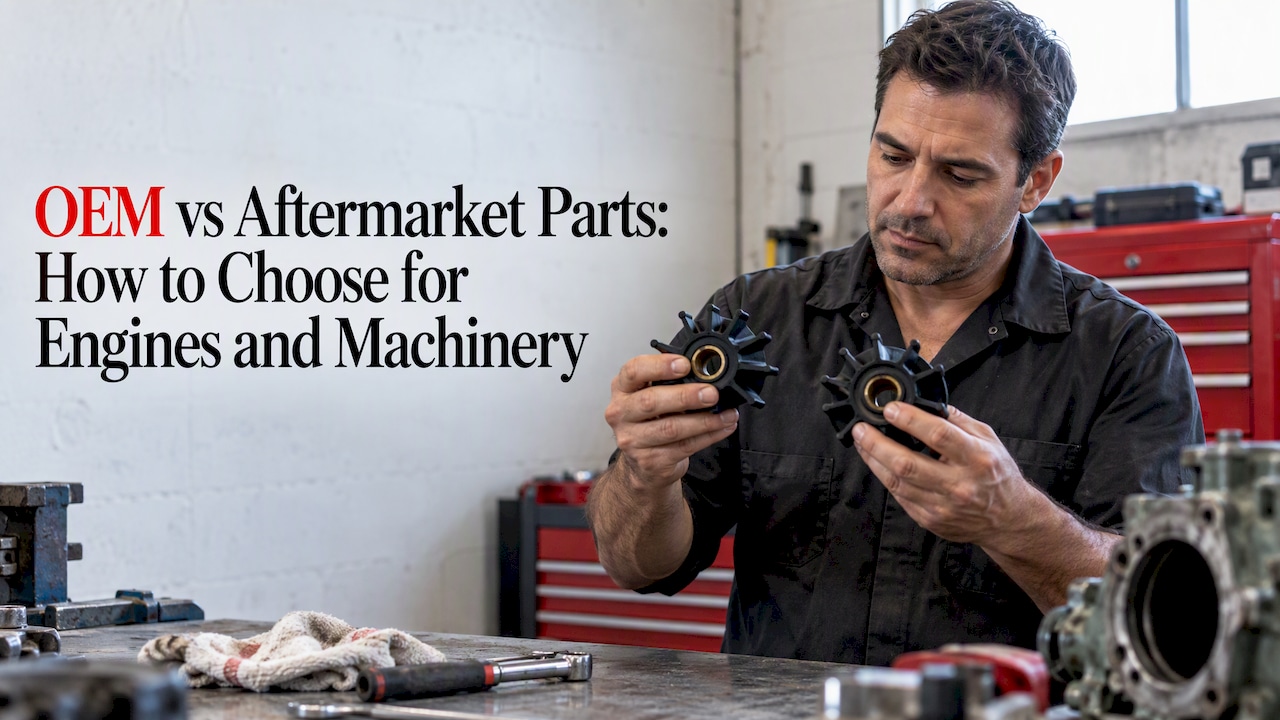
OEM parts are made by, or to the specification of, the company that built your machine. Aftermarket parts are made by other companies to fit the same application. For a working engine, tractor, excavator, forklift or generator, the better choice is usually the part that gives you proven fit and traceability first, and a lower price second. A part that fails early costs far more in downtime than it saved at the counter.
This guide is written for people who keep machines earning: marine operators, farmers, contractors, workshops and fleet managers. Most advice online is about passenger cars. Here we cover what changes when an engine runs 2,000 hours a season and a stopped machine means a stopped job.
Iberspares
Choose Genuine Parts With Confidence
Iberspares supplies genuine Yanmar and Sensei parts, engines and components for marine, agricultural, construction and industrial machinery.
TL;DR
-
OEM means the part matches the machine maker’s own specification. Aftermarket means a third party made it, and quality ranges from excellent to poor.
-
Neither label guarantees anything on its own. Judge the specific part and the supplier behind it.
-
Price is only one line of the cost. Count fitment errors, repeat labor, waiting time and lost work.
-
Using a non-OEM part does not automatically void a warranty in the US, but the maker can refuse a claim if that part caused the failure.
-
For engine internals, fuel, cooling and anything hard to reach, we recommend genuine parts. For simple wear items, a verified alternative can be reasonable.
Table of Contents
-
-
-
-
-
-
-
-
-
-
-
What OEM and aftermarket actually mean
OEM means the part matches the machine maker’s own specification. Aftermarket means a third party made it, and quality ranges from excellent to poor.
Neither label guarantees anything on its own. Judge the specific part and the supplier behind it.
Price is only one line of the cost. Count fitment errors, repeat labor, waiting time and lost work.
Using a non-OEM part does not automatically void a warranty in the US, but the maker can refuse a claim if that part caused the failure.
For engine internals, fuel, cooling and anything hard to reach, we recommend genuine parts. For simple wear items, a verified alternative can be reasonable.
What OEM and aftermarket actually mean
OEM stands for original equipment manufacturer. An OEM part is the one the machine left the factory with, or a part built to the same drawings and tolerances. It carries a part number that traces to the manufacturer’s catalog for your exact model and serial range.
Genuine parts are the maker’s own branded parts sold through the maker’s supply chain. In practice, “genuine” and “OEM” are used almost interchangeably, though a few OEM suppliers also sell identical parts in their own packaging.
Aftermarket parts come from independent manufacturers. Some reverse-engineer the original and match it closely. Some improve one property, such as a stronger material. Others cut cost by changing materials, tolerances or testing. Because the category is so broad, an aftermarket part can be better than the original, equal to it or clearly worse.
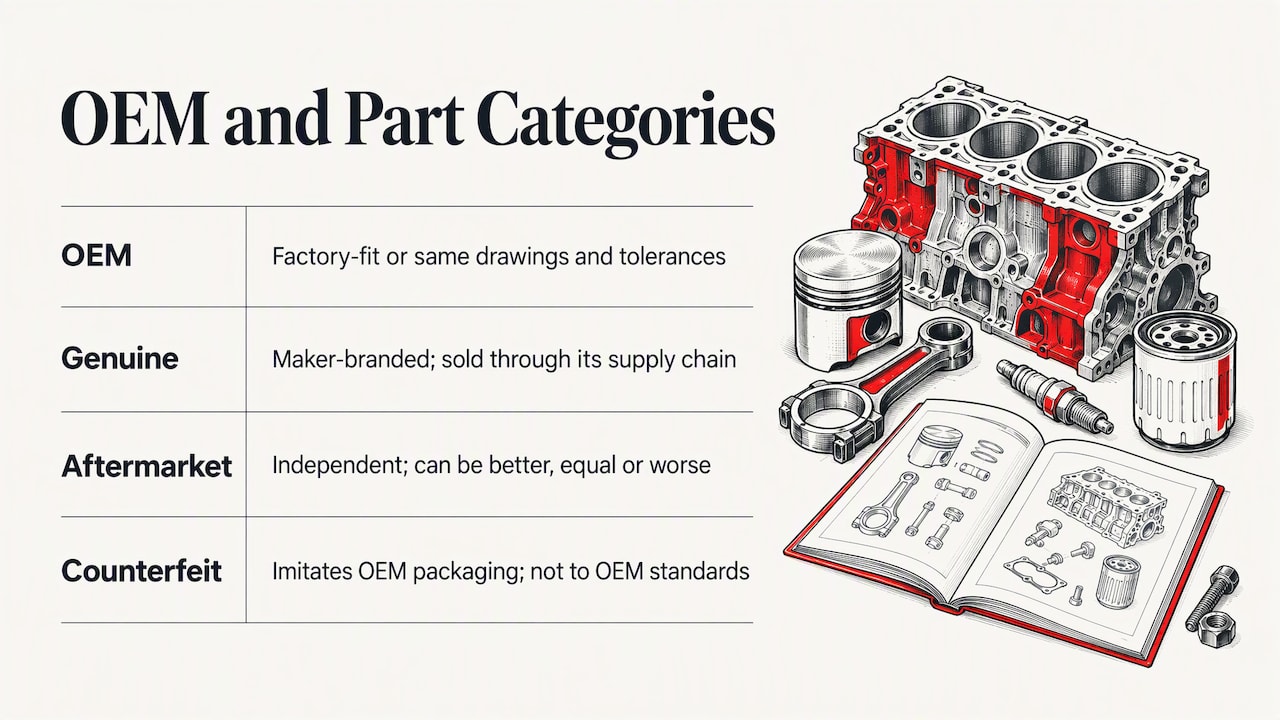
A third group is worth knowing about: counterfeit parts. These imitate the OEM’s packaging and numbers but are not made to its standards. They are a separate problem from honest aftermarket parts, and we come back to them in the verification section.
OEM vs aftermarket at a glance
|
Factor |
OEM / genuine |
Aftermarket |
|---|---|---|
|
Fit |
Matched to your model and serial range |
Varies; check the cross-reference carefully |
|
Quality consistency |
Same specification batch after batch |
Wide range between brands and even product lines |
|
Price |
Usually higher up front |
Often lower, but not always |
|
Choice |
One part per application |
Many brands and grades |
|
Warranty |
Backed by the maker’s parts warranty |
Set by each manufacturer or seller |
|
Documentation |
Catalog number, traceable supply chain |
Depends on the brand |
|
Best for |
Engine internals, fuel systems, cooling, critical safety items |
Simple wear items, where verified quality exists |
The table is a starting point. The sections below explain where each row can flip.
Quality, fit and reliability
Why fit matters more on machinery
A diesel engine is a system of matched parts. A fuel injector, a seal or a water pump impeller is designed around the clearances, pressures and temperatures of that engine. A part that is a fraction of a millimeter off may seat, run and pass a quick check, then wear its neighbors over the next few hundred hours.
That is the hidden cost with lookalike parts. The failure often shows up on a different component, weeks later, when nobody connects it to the cheaper part fitted earlier.
Can aftermarket match or beat OEM?
Yes, sometimes. Independent makers can improve a known weak point, and some supply the same factories that make OEM parts. The Reddit discussion at the top of the search results makes this point: parts intended to beat the original tend to use stronger or lighter materials. That is plausible, but for a given part number you need evidence, not a promise.
The reverse is equally true. Heavy-vehicle inspection specialists point out that an OEM label does not guarantee the longest life and an aftermarket label does not mean poor quality, and that buyers should evaluate the part and the supplier, including configuration, delivery, warranty terms, quality evidence and service history. We agree with that framing. The difference is that with genuine parts, much of that evidence comes built in.
Where we draw the line
Our rule of thumb is to rank parts by consequence of failure:
-
High consequence: pistons, rings, bearings, injectors, fuel pumps, turbochargers, head gaskets, cooling pumps, thermostats, and anything that can cause a seizure, a fire or a loss of propulsion at sea. Use genuine parts.
-
Medium consequence: filters, belts, seals, hoses, sensors. Genuine is the safe default. A verified alternative is possible when you can prove it meets the original specification.
-
Low consequence: bolts and brackets on non-structural parts, cosmetic items, guards. Aftermarket is usually fine.
Filters deserve a special mention. They are cheap, so people swap brands freely, yet filtration rating, bypass valve setting and media quality directly affect injector and pump life. A bargain filter is a false economy on a high-pressure fuel system.
Price, availability and downtime
The real price of a part
OEM parts usually cost more at purchase. Edmunds notes that OEM parts tend to be more expensive but are easier to choose, and that some aftermarket parts equal the original. Those are consumer car findings, yet the logic carries over to machinery.
What the sticker price leaves out:
-
Labor. Replacing a water pump or a head gasket takes hours whatever the part costs. Doing it twice because the first part failed doubles the biggest cost.
-
Consumables. Coolant, oil, gaskets and sealant are spent again on a redo.
-
Downtime. A tractor idle in harvest, a boat out of the water in season or a forklift stopped in a warehouse costs more per day than most parts cost in total.
-
Collateral damage. A failed part can take the component beside it.
A worked example
Imagine a part that costs $60 less in its aftermarket version. If it lasts the same time, you saved $60. If it fails at half the service interval, you pay for the part again, a second round of labor and a day of lost work. One failure erases the savings of many purchases. The reverse also applies: if a verified alternative lasts as long, the saving is real. The point is to know which case you are in.
Availability
Aftermarket gives you more brands, which helps when one is out of stock. OEM gives you one correct answer, which helps when you need to order fast without second-guessing. For older machines, genuine supply can be harder, so it is worth asking a supplier who works with the original catalog whether a part is current, superseded or replaced.
Warranty and your obligations
Warranty is where most myths sit. In the US, the Federal Trade Commission has stated that it is illegal for manufacturers or dealers to deny warranty coverage simply because someone other than the dealer did the work or supplied the part. That guidance is aimed at consumer vehicles. Industrial, marine and agricultural engines are often sold under their own warranty terms, so read the document that came with your machine.
The practical position is this:
-
A warranty claim can still be refused if the maker can show that a specific part, or the way it was fitted, caused the failure.
-
The maker’s own parts warranty covers the genuine parts you buy from the maker’s supply chain. An independent part is covered by whoever made or sold it.
-
Keep your service records, part numbers and invoices. They are your proof if a claim is disputed.
Yanmar, for example, argues that genuine parts and warranty registration protect the engine investment and the engine’s service life. That is a manufacturer’s view, naturally, but it points to a sound habit: register the warranty and document every service.
Outside the US, rules differ by country. If you operate in Europe or elsewhere, check local consumer and commercial law, plus your sales contract.
How to verify quality, whichever you buy
The goal is not to be loyal to a label but to be sure the part conforms to the specification. SAE International’s standard on counterfeit materiel, AS6174A, lists certification, traceability, testing and inspection as the ways of assuring that what you procure is authentic and conforms to requirements. The standard was written for aerospace supply, but the four ideas translate directly to a workshop.
-
Certification. Ask whether the manufacturer holds a recognized quality management certification, and whether the part has a test report or declaration of conformity.
-
Traceability. Can the seller tell you where the part came from? Lot numbers, original packaging and a clean supply chain matter. A seller that cannot answer is a warning sign.
-
Testing. For critical parts, look for dimensional and material data. Ask for tolerances in writing.
-
Inspection. Check the part against the old one before fitting: dimensions, thread, seal faces, markings, weight. Compare packaging and part numbers with the catalog.
Add these checks:
-
Match the part number to your model and serial number, not just the machine type. Mid-production changes are common.
-
Confirm whether the number has been superseded.
-
Get the warranty terms and return policy in writing.
-
Treat a price far below the market as a red flag, not a bargain.
Our perspective
We supply genuine Yanmar and Sensei parts, so you should know where we stand: we think genuine is the right default for equipment that earns money. We also think honest advice beats a pitch.
In our daily work with marine operators, farmers, contractors and workshops, the most common problem is not price. It is identification. People order a part that looks right and is not, because the machine had a running change, or the number was copied from an old invoice. Getting the right part the first time saves more than any discount.
That is why we put identification and compatibility first. Send us the machine model and serial number, and we help you match the correct part number from the original catalog before you buy. Original manufacturer parts come with a clear supply chain and a known specification, so you are not left guessing what is inside the box.
We also tell customers when a part is low consequence. Not every bolt needs a brand name. What matters is that you know what you are fitting and why.
— Iberspares Team
Genuine Yanmar and Sensei parts for working machines
If your machine runs on a Yanmar engine or uses Sensei components, we can help you find the exact part and ship it across Portugal, Spain and Europe. We cover marine, agriculture, construction and industry, power and generators, material handling and compact equipment, from filters, belts and gaskets to pumps and cooling systems.
Browse the full range at Iberspares genuine Yanmar and Sensei parts, or send an enquiry with your model and serial number and we will confirm compatibility before you order.
A short checklist for choosing
Use this before any purchase:
-
What happens if this part fails? If the answer is a breakdown, injury or damage elsewhere, choose genuine.
-
Is the machine under warranty or financed? Keep to the maker’s maintenance requirements and keep records.
-
Can the seller prove origin? If not, walk away.
-
Is the fitment confirmed by serial number? If not, confirm first.
-
What is the cost of a day without the machine? Compare that, not the part price alone.
-
Is the machine old and the part obsolete? Then a verified alternative may be the only practical route. Document it.
When the answers are mixed, buy the genuine part for the critical items and consider alternatives for the rest.
FAQ
Are aftermarket parts always cheaper than OEM?
No. Aftermarket parts are often cheaper, but not always, and a low price can hide shorter life or poor fit. Compare the cost over the service interval, including labor and downtime, rather than the purchase price alone.
Does using aftermarket parts void my warranty?
In the US, the FTC says a maker cannot refuse coverage simply because the part or service was not from the dealer. A claim can still be denied if that part caused the failure. Read your machine’s warranty terms and keep full records.
Is OEM the same as genuine?
Almost. Genuine parts are sold under the machine maker’s brand through its supply chain. OEM parts are made to the maker’s specification, sometimes by the same supplier and sold in other packaging. For purchasing, ask for the catalog part number and the supply source.
How can I tell whether a part is counterfeit?
Check packaging, markings and part numbers against the catalog, and buy from a seller who can show traceability. Certification, testing and inspection are the standard methods of assuring a part is authentic and conforming. A price far below the market is a warning sign.
Which parts should I never compromise on?
Anything whose failure stops the machine or damages other components: injectors, fuel pumps, bearings, pistons, head gaskets, cooling pumps and filters on high-pressure systems. For these we recommend genuine parts.